

[2024年05月]更新のVault-Associate試験資料HashiCorp学習ガイド
有効な問題最新版を試そうVault-Associateテスト解釈Vault-Associate有効な試験ガイド
質問 # 15
Your DevOps team would like to provision VMs in GCP via a CICD pipeline. They would like to integrate Vault to protect the credentials used by the tool. Which secrets engine would you recommend?
- A. Google Cloud Secrets Engine
- B. Identity secrets engine
- C. SSH secrets engine
- D. Key/Value secrets engine version 2
正解:A
解説:
The Google Cloud Secrets Engine is the best option for the DevOps team to provision VMs in GCP via a CICD pipeline and integrate Vault to protect the credentials used by the tool. The Google Cloud Secrets Engine can dynamically generate GCP service account keys or OAuth tokens based on IAM policies, which can be used to authenticate and authorize the CICD tool to access GCP resources. The credentials are automatically revoked when they are no longer used or when the lease expires, ensuring that the credentials are short-lived and secure. The DevOps team can configure rolesets or static accounts in Vault to define the scope and permissions of the credentials, and use the Vault API or CLI to request credentials on demand. The Google Cloud Secrets Engine also supports generating access tokens for impersonated service accounts, which can be useful for delegating access to other service accounts without storing or managing their keys1.
The Identity Secrets Engine is not a good option for this use case, because it does not generate GCP credentials, but rather generates identity tokens that can be used to access other Vault secrets engines or namespaces2. The Key/Value Secrets Engine version 2 is also not a good option, because it does not generate dynamic credentials, but rather stores and manages static secrets that the user provides3. The SSH Secrets Engine is not a good option either, because it does not generate GCP credentials, but rather generates SSH keys or OTPs that can be used to access remote hosts via SSH4.
Reference:
Google Cloud - Secrets Engines | Vault | HashiCorp Developer
Identity - Secrets Engines | Vault | HashiCorp Developer
KV - Secrets Engines | Vault | HashiCorp Developer
SSH - Secrets Engines | Vault | HashiCorp Developer
質問 # 16
A web application uses Vault's transit secrets engine to encrypt data in-transit. If an attacker intercepts the data in transit which of the following statements are true? Choose two correct answers.
- A. You can rotate the encryption key so that the attacker won't be able to decrypt the data
- B. The keys can be rotated and min_decryption_version moved forward to ensure this data cannot be decrypted
- C. Even if the attacker was able to access the raw data, they would only have encrypted bits (TLS in transit)
- D. The Vault administrator would need to seal the Vault server immediately
正解:B、C
解説:
A web application that uses Vault's transit secrets engine to encrypt data in-transit can benefit from the following security features:
Even if the attacker was able to access the raw data, they would only have encrypted bits (TLS in transit). This means that the attacker would need to obtain the encryption key from Vault in order to decrypt the data, which is protected by Vault's authentication and authorization mechanisms. The transit secrets engine does not store the data sent to it, so the attacker cannot access the data from Vault either.
The keys can be rotated and min_decryption_version moved forward to ensure this data cannot be decrypted. This means that the web application can periodically change the encryption key used to encrypt the data, and set a minimum decryption version for the key, which prevents older versions of the key from being used to decrypt the data. This way, even if the attacker somehow obtained an old version of the key, they would not be able to decrypt the data that was encrypted with a newer version of the key.
The other statements are not true, because:
You cannot rotate the encryption key so that the attacker won't be able to decrypt the data. Rotating the key alone does not prevent the attacker from decrypting the data, as they may still have access to the old version of the key that was used to encrypt the data. You need to also move the min_decryption_version forward to invalidate the old version of the key.
The Vault administrator would not need to seal the Vault server immediately. Sealing the Vault server would make it inaccessible to both the attacker and the legitimate users, and would require unsealing it with the unseal keys or the recovery keys. Sealing the Vault server is a last resort option in case of a severe compromise or emergency, and is not necessary in this scenario, as the attacker does not have access to the encryption key or the data in Vault. Reference: Transit - Secrets Engines | Vault | HashiCorp Developer, Encryption as a service: transit secrets engine | Vault | HashiCorp Developer
質問 # 17
Where does the Vault Agent store its cache?
- A. In memory
- B. In the Vault key/value store
- C. In an unencrypted file
- D. In a file encrypted using the Vault transit secret engine
正解:A
解説:
The Vault Agent stores its cache in memory, which means that it does not persist the cached tokens and secrets to disk or any other storage backend. This makes the cache more secure and performant, as it avoids exposing the sensitive data to potential attackers or unauthorized access. However, this also means that the cache is volatile and will be lost if the agent process is terminated or restarted. To mitigate this, the agent can optionally use a persistent cache file to restore the tokens and leases from a previous agent process. The persistent cache file is encrypted using a key derived from the agent's auto-auth token and a nonce, and it is stored in a user-specified location on disk. Reference: Caching - Vault Agent | Vault | HashiCorp Developer, Vault Agent Persistent Caching | Vault | HashiCorp Developer
質問 # 18
An organization wants to authenticate an AWS EC2 virtual machine with Vault to access a dynamic database secret. The only authentication method which they can use in this case is AWS.
- A. True
- B. False
正解:B
解説:
The statement is false. An organization can authenticate an AWS EC2 virtual machine with Vault to access a dynamic database secret using more than one authentication method. The AWS auth method is one of the options, but not the only one. The AWS auth method supports two types of authentication: ec2 and iam. The ec2 type uses the signed EC2 instance identity document to authenticate the EC2 instance. The iam type uses the AWS Signature v4 algorithm to sign a request to the sts:GetCallerIdentity API and authenticate the IAM principal. However, the organization can also use other auth methods that are compatible with EC2 instances, such as AppRole, JWT/OIDC, or Kubernetes. These methods require the EC2 instance to have some sort of identity material, such as a role ID, a secret ID, a JWT token, or a service account token, that can be used to authenticate to Vault. The identity material can be provisioned to the EC2 instance using various mechanisms, such as user data, metadata service, or cloud-init scripts. The choice of the auth method depends on the use case, the security requirements, and the trade-offs between convenience and control. Reference: AWS - Auth Methods | Vault | HashiCorp Developer, AppRole - Auth Methods | Vault | HashiCorp Developer, JWT/OIDC - Auth Methods | Vault | HashiCorp Developer, Kubernetes - Auth Methods | Vault | HashiCorp Developer
質問 # 19
A developer mistakenly committed code that contained AWS S3 credentials into a public repository. You have been tasked with revoking the AWS S3 credential that was in the code. This credential was created using Vault's AWS secrets engine and the developer received the following output when requesting a credential from Vault.
Which Vault command will revoke the lease and remove the credential from AWS?
- A. vault lease revoke f3e92392-7d9c-O9c8-c921-575d62fe80d8
- B. vault lease revoke AKIAI0WQXTLW36DV7IEA
- C. vault lease revoke access_key-AKIAI0WQXTLW36DV7IEA
- D. vault lease revoke aws/creds/s3-access/f3e92392-7d9c-99c8-c921-57Sd62fe89d8
正解:D
解説:
The correct answer is A because the lease ID is the unique identifier for the credential. The lease ID is used to revoke the credential using the vault lease revoke command. This command will invalidate the credential immediately and prevent any further renewals. It will also delete the access key and secret key from AWS, rendering them useless1. The access key and secret key are not sufficient to revoke the credential, as they are not recognized by Vault. The lease ID is composed of the path of the secrets engine, the role name, and a random UUID. In this case, the path is aws/creds, the role name is s3-access, and the UUID is f3e92392-7d9c-99c8-c921-57Sd62fe89d8.
Reference:
lease revoke - Command | Vault | HashiCorp Developer
質問 # 20
You have been tasked with writing a policy that will allow read permissions for all secrets at path secret/bar. The users that are assigned this policy should also be able to list the secrets. What should this policy look like?
- A.

- B.

- C.

- D.

正解:B
解説:
This policy would allow read permissions for all secrets at path secret/bar, as well as list permissions for the secret/bar/ path. The list permission is required to be able to see the names of the secrets under a given path1. The wildcard () character matches any number of characters within a single path segment, while the slash (/) character matches the end of the path2. Therefore, the policy would grant read access to any secret that starts with secret/bar/, such as secret/bar/foo or secret/bar/baz, but not to secret/bar itself. To grant list access to secret/bar, the policy needs to specify the exact path with a slash at the end. This policy follows the principle of least privilege, which means that it only grants the minimum permissions necessary for the users to perform their tasks3.
The other options are not correct because they either grant too much or too little permissions. Option A would grant both read and list permissions to all secrets under secret/bar, which is more than what is required. Option B would grant list permissions to all secrets under secret/bar, but only read permissions to secret/bar itself, which is not what is required. Option D would use an invalid character (+) in the policy, which would cause an error.
Reference:
Policy Syntax | Vault | HashiCorp Developer
Policy Syntax | Vault | HashiCorp Developer
Policies | Vault | HashiCorp Developer
質問 # 21
Which of the following describes the Vault's auth method component?
- A. It verifies a client against an internal or external system, and generates a token with root policy
- B. It dynamically generates a unique set of secrets with appropriate permissions attached
- C. It is responsible for durable storage of client tokens
- D. It verifies a client against an internal or external system, and generates a token with the appropriate policies attached
正解:D
解説:
The Vault's auth method component is the component that performs authentication and assigns identity and policies to a client. It verifies a client against an internal or external system, and generates a token with the appropriate policies attached. The token can then be used to access the secrets and resources that are authorized by the policies. Vault supports various auth methods, such as userpass, ldap, aws, kubernetes, etc., that can integrate with different identity providers and systems. The auth method component can also handle token renewal and revocation, as well as identity grouping and aliasing. Reference: Auth Methods | Vault | HashiCorp Developer, Authentication - Concepts | Vault | HashiCorp Developer
質問 # 22
Which of the following are replication methods available in Vault Enterprise? Choose two correct answers.
- A. Performance Replication
- B. Cluster sharding
- C. Namespaces
- D. Disaster Recovery Replication
正解:A、D
解説:
The replication methods available in Vault Enterprise are performance replication and disaster recovery replication. These methods allow critical data to be replicated across clusters to support horizontally scaling and disaster recovery workloads.
Performance replication enables a primary cluster to replicate data to one or more secondary clusters, which can handle client requests and improve performance and availability. Performance replication replicates most Vault data, such as secrets, policies, auth methods, and leases, but not tokens. Performance secondaries generate their own tokens and leases, which are not replicated back to the primary. Performance replication also supports filtering, which allows selective replication of data based on namespaces or paths.
Disaster recovery replication enables a primary cluster to replicate data to one or more secondary clusters, which act as standby clusters in case of a failure or outage of the primary. Disaster recovery replication replicates all Vault data, including tokens and leases, and maintains the same configuration and state as the primary. Disaster recovery secondaries do not handle client requests, but they can be promoted to a primary in a disaster recovery scenario. Reference: Replication - Vault Enterprise | Vault | HashiCorp Developer, Performance Replication - Vault Enterprise | Vault | HashiCorp Developer, Disaster Recovery Replication - Vault Enterprise | Vault | HashiCorp Developer
質問 # 23
Which of the following statements describe the CLI command below?
S vault login -method-1dap username-mitche11h
- A. By default the generated token is valid for 24 hours
- B. Generates a token which is response wrapped
- C. You will be prompted to enter the password
- D. Fails because the password is not provided
正解:B
解説:
The CLI command vault login -method ldap username=mitchellh generates a token that is response wrapped. This means that the token contains a base64-encoded response wrapper, which is a JSON object that contains information about the token, such as its policies, metadata, and expiration time. The response wrapper is used to verify the authenticity and integrity of the token, and to prevent replay attacks. The response wrapper also allows Vault to automatically renew the token when it expires, or to revoke it if it is compromised. The -method ldap option specifies that the authentication method is LDAP, which requires a username and password to be provided. The username mitchellh is an example of an LDAP user name, and the password will be hidden when entered. Reference: Vault CLI Reference | Vault | HashiCorp Developer, Vault CLI Reference | Vault | HashiCorp Developer
質問 # 24
When using Integrated Storage, which of the following should you do to recover from possible data loss?
- A. Use snapshot
- B. Use server logs
- C. Failover to a standby node
- D. Use audit logs
正解:A
解説:
Integrated Storage is a Raft-based storage backend that allows Vault to store its data internally without relying on an external storage system. It also enables Vault to run in high availability mode with automatic leader election and failover. However, Integrated Storage is not immune to data loss or corruption due to hardware failures, network partitions, or human errors. Therefore, it is recommended to use the snapshot feature to backup and restore the Vault data periodically or on demand. A snapshot is a point-in-time capture of the entire Vault data, including the encrypted secrets, the configuration, and the metadata. Snapshots can be taken and restored using the vault operator raft snapshot command or the sys/storage/raft/snapshot API endpoint. Snapshots are encrypted and can only be restored with a quorum of unseal keys or recovery keys. Snapshots are also portable and can be used to migrate data between different Vault clusters or storage backends. Reference: https://developer.hashicorp.com/vault/docs/concepts/integrated-storage1, https://developer.hashicorp.com/vault/docs/commands/operator/raft/snapshot2, https://developer.hashicorp.com/vault/api-docs/system/storage/raft/snapshot3
質問 # 25
What does the following policy do?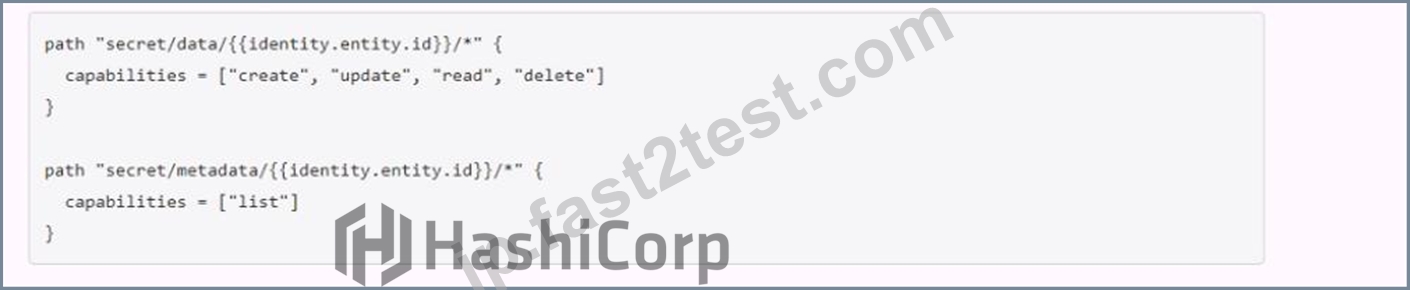
- A. Grants access for each user to a KV folder which shares their id
- B. Grants access to a special system entity folder
- C. Nothing, this is not a valid policy
- D. Allows a user to read data about the secret endpoint identity
正解:D
解説:
This policy allows a user to read data about the secret endpoint identity. The policy grants the user the ability to create, update, read, and delete data in the "secret/data/{identity.entity.id}" path. Additionally, the user is allowed to list data in the "secret/metadata/{identity.entity.id}" path. This policy is useful for users who need to access information about the secret endpoint identity.
The secret endpoint identity is a feature of the Identity Secrets Engine, which allows Vault to generate identity tokens that can be used to access other Vault secrets engines or namespaces. The identity tokens are based on the entity and group information of the user or machine that authenticates with Vault. The entity is a unique identifier for the user or machine, and the group is a collection of entities that share some common attributes. The identity tokens can carry metadata and policies that are associated with the entity and group.
The "secret/data/{identity.entity.id}" path is where the user can store and retrieve data that is related to the secret endpoint identity. For example, the user can store some configuration or preferences for the secret endpoint identity in this path. The "secret/metadata/{identity.entity.id}" path is where the user can list the metadata of the data stored in the "secret/data/{identity.entity.id}" path. For example, the user can list the version, creation time, deletion time, and destroy time of the data in this path.
Reference:
[Identity - Secrets Engines | Vault | HashiCorp Developer]
[KV - Secrets Engines | Vault | HashiCorp Developer]
質問 # 26
How would you describe the value of using the Vault transit secrets engine?
- A. The transit secrets engine ensures encryption in-transit and at-rest is enforced enterprise wide
- B. Encryption for application data is best handled by a storage system or database engine, while storing encryption keys in Vault
- C. The transit secrets engine relieves the burden of proper encryption/decryption from application developers and pushes the burden onto the operators of Vault
- D. Vault has an API that can be programmatically consumed by applications
正解:C
解説:
The transit secrets engine relieves the burden of proper encryption/decryption from application developers and pushes the burden onto the operators of Vault. The transit secrets engine provides encryption as a service, which means that it performs cryptographic operations on data in-transit without storing any data. This allows developers to delegate the responsibility of managing encryption keys and algorithms to Vault operators, who can define and enforce policies on the transit secrets engine. This way, developers can focus on their application logic and data, while Vault handles the encryption and decryption of data in a secure and scalable manner. Reference: Transit - Secrets Engines | Vault | HashiCorp Developer, Encryption as a service: transit secrets engine | Vault | HashiCorp Developer
質問 # 27
Where can you set the Vault seal configuration? Choose two correct answers.
- A. Vault API
- B. Environment variables
- C. Cloud Provider KMS
- D. Vault configuration file
- E. Vault CLI
正解:B、D
解説:
The Vault seal configuration can be set in two ways: through the Vault configuration file or through environment variables. The Vault configuration file is a text file that contains the settings and options for Vault, such as the storage backend, the listener, the telemetry, and the seal. The seal stanza in the configuration file specifies the seal type and the parameters to use for additional data protection, such as using HSM or Cloud KMS solutions to encrypt and decrypt the root key. The seal configuration can also be set through environment variables, which will take precedence over the values in the configuration file. The environment variables are prefixed with VAULT_SEAL_ and followed by the seal type and the parameter name. For example, VAULT_SEAL_AWSKMS_REGION sets the region for the AWS KMS seal. Reference: Seals - Configuration | Vault | HashiCorp Developer, Environment Variables | Vault | HashiCorp Developer
質問 # 28
You are performing a high number of authentications in a short amount of time. You're experiencing slow throughput for token generation. How would you solve this problem?
- A. Implement batch tokens
- B. Increase the time-to-live on service tokens
- C. Reduce the number of policies attached to the tokens
- D. Establish a rate limit quota
正解:A
解説:
Batch tokens are a type of tokens that are not persisted in Vault's storage backend, but are encrypted blobs that carry enough information to perform Vault actions. Batch tokens are extremely lightweight and scalable, and can improve the throughput for token generation. Batch tokens are suitable for high-volume and ephemeral workloads, such as containers or serverless functions, that require short-lived and non-renewable tokens. Batch tokens can be created by using the -type=batch flag in the vault token create command, or by configuring the token_type parameter in the auth method's role or mount options. Batch tokens have some limitations compared to service tokens, such as the lack of renewal, revocation, listing, accessor, and cubbyhole features. Therefore, batch tokens should be used with caution and only when the trade-offs are acceptable. Reference: https://developer.hashicorp.com/vault/tutorials/tokens/batch-tokens1, https://developer.hashicorp.com/vault/docs/commands/token/create2, https://developer.hashicorp.com/vault/docs/concepts/tokens#token-types3
質問 # 29
What is the Vault CLI command to query information about the token the client is currently using?
- A. vault self-lookup
- B. vault lookup token
- C. vault token lookup
- D. vault lookup self
正解:C
解説:
The Vault CLI command to query information about the token the client is currently using is vault token lookup. This command displays information about the token or accessor provided as an argument, or the locally authenticated token if no argument is given. The information includes the token ID, accessor, policies, TTL, creation time, and metadata. This command can be useful for debugging and auditing purposes, as well as for renewing or revoking tokens. Reference: token lookup - Command | Vault | HashiCorp Developer, Tokens | Vault | HashiCorp Developer
質問 # 30
An authentication method should be selected for a use case based on:
- A. Compatibility with the secret engine which is to be used
- B. The strongest available cryptographic hash for the use case
- C. The cloud provider for which the client is located on
- D. The auth method that best establishes the identity of the client
正解:D
解説:
An authentication method should be selected for a use case based on the auth method that best establishes the identity of the client. The identity of the client is the basis for assigning a set of policies and permissions to the client in Vault. Different auth methods have different ways of verifying the identity of the client, such as using passwords, tokens, certificates, cloud credentials, etc. Depending on the use case, some auth methods may be more suitable or convenient than others. For example, for human users, the userpass or ldap auth methods may be easy to use, while for machines or applications, the approle or aws auth methods may be more secure and scalable. The choice of the auth method should also consider the trade-offs between security, performance, and usability. Reference: Auth Methods | Vault | HashiCorp Developer, Authentication - Concepts | Vault | HashiCorp Developer
質問 # 31
When creating a policy, an error was thrown:
Which statement describes the fix for this issue?
- A. Replace write with create in the capabilities list
- B. You cannot have a wildcard (" * ") in the path
- C. sudo is not a capability
正解:A
解説:
The error was thrown because the policy code contains an invalid capability, "write". The valid capabilities for a policy are "create", "read", "update", "delete", "list", and "sudo". The "write" capability is not recognized by Vault and should be replaced with "create", which allows creating new secrets or overwriting existing ones. The other statements are not correct, because the wildcard (*) and the sudo capability are both valid in a policy. The wildcard matches any number of characters within a path segment, and the sudo capability allows performing certain operations that require root privileges.
Reference:
[Policy Syntax | Vault | HashiCorp Developer]
[Policy Syntax | Vault | HashiCorp Developer]
質問 # 32
Security requirements demand that no secrets appear in the shell history. Which command does not meet this requirement?
- A. vault kv put secret/password value-SSECRET_VALUE
- B. vault kv put secret/password [email protected]
- C. generate-password | vault kv put secret/password value
- D. vault kv put secret/password value-itsasecret
正解:D
解説:
The command that does not meet the security requirement of not having secrets appear in the shell history is B. vault kv put secret/password value-itsasecret. This command would store the secret value "itsasecret" in the key/value secrets engine at the path secret/password, but it would also expose the secret value in the shell history, which could be accessed by other users or malicious actors. This is not a secure way of storing secrets in Vault.
The other commands are more secure ways of storing secrets in Vault without revealing them in the shell history.
A). generate-password | vault kv put secret/password value would use a pipe to pass the output of the generate-password command, which could be a script or a tool that generates a random password, to the vault kv put command, which would store the password in the key/value secrets engine at the path secret/password. The password would not be visible in the shell history, only the commands.
C). vault kv put secret/password [email protected] would use the @ syntax to read the secret value from a file named data.txt, which could be encrypted or protected by file permissions, and store it in the key/value secrets engine at the path secret/password. The file name would be visible in the shell history, but not the secret value.
D). vault kv put secret/password value-SSECRET_VALUE would use the -S syntax to read the secret value from the environment variable SECRET_VALUE, which could be set and unset in the shell session, and store it in the key/value secrets engine at the path secret/password. The environment variable name would be visible in the shell history, but not the secret value.
Reference:
[Write Secrets | Vault | HashiCorp Developer]
質問 # 33
......
HashiCorp Vault-Associate 認定試験の出題範囲:
| トピック | 出題範囲 |
|---|---|
| トピック 1 |
|
| トピック 2 |
|
| トピック 3 |
|
| トピック 4 |
|
| トピック 5 |
|
| トピック 6 |
|
Vault-Associate試験問題と解答:https://jp.fast2test.com/Vault-Associate-premium-file.html