

[2023年06月] 学習材料には有効なAssociate-Developer-Apache-Spark効率的問題集!
最新のAssociate-Developer-Apache-SparkテストエンジンPDF無料問題集保証!
Databricks Associate-Developer-Apache-Spark試験は、60問の多肢選択問題からなるタイムド試験で、監視下で受験する必要があります。この試験は、世界中のどこからでもオンラインで受験することができ、合格点は70%です。試験料は300ドルで、有効期間は2年間です。
質問 # 17
Which of the following describes characteristics of the Spark driver?
- A. In a non-interactive Spark application, the Spark driver automatically creates the SparkSession object.
- B. If set in the Spark configuration, Spark scales the Spark driver horizontally to improve parallel processing performance.
- C. The Spark driver's responsibility includes scheduling queries for execution on worker nodes.
- D. The Spark driver processes partitions in an optimized, distributed fashion.
- E. The Spark driver requests the transformation of operations into DAG computations from the worker nodes.
正解:A
解説:
Explanation
The Spark driver requests the transformation of operations into DAG computations from the worker nodes.
No, the Spark driver transforms operations into DAG computations itself.
If set in the Spark configuration, Spark scales the Spark driver horizontally to improve parallel processing performance.
No. There is always a single driver per application, but one or more executors.
The Spark driver processes partitions in an optimized, distributed fashion.
No, this is what executors do.
In a non-interactive Spark application, the Spark driver automatically creates the SparkSession object.
Wrong. In a non-interactive Spark application, you need to create the SparkSession object. In an interactive Spark shell, the Spark driver instantiates the object for you.
質問 # 18
Which of the following code blocks removes all rows in the 6-column DataFrame transactionsDf that have missing data in at least 3 columns?
- A. transactionsDf.dropna(thresh=2)
- B. transactionsDf.drop.na("",2)
- C. transactionsDf.dropna("",4)
- D. transactionsDf.dropna("any")
- E. transactionsDf.dropna(thresh=4)
正解:E
解説:
Explanation
transactionsDf.dropna(thresh=4)
Correct. Note that by only working with the thresh keyword argument, the first how keyword argument is ignored. Also, figuring out which value to set for thresh can be difficult, especially when under pressure in the exam. Here, I recommend you use the notes to create a "simulation" of what different values for thresh would do to a DataFrame. Here is an explanatory image why thresh=4 is the correct answer to the question:
transactionsDf.dropna(thresh=2)
Almost right. See the comment about thresh for the correct answer above.
transactionsDf.dropna("any")
No, this would remove all rows that have at least one missing value.
transactionsDf.drop.na("",2)
No, drop.na is not a proper DataFrame method.
transactionsDf.dropna("",4)
No, this does not work and will throw an error in Spark because Spark cannot understand the first argument.
More info: pyspark.sql.DataFrame.dropna - PySpark 3.1.1 documentation (https://bit.ly/2QZpiCp) Static notebook | Dynamic notebook: See test 1 (https://flrs.github.io/spark_practice_tests_code/#1/20.html ,
https://bit.ly/sparkpracticeexams_import_instructions)
質問 # 19
Which of the following describes how Spark achieves fault tolerance?
- A. Due to the mutability of DataFrames after transformations, Spark reproduces them using observed lineage in case of worker node failure.
- B. Spark helps fast recovery of data in case of a worker fault by providing the MEMORY_AND_DISK storage level option.
- C. Spark builds a fault-tolerant layer on top of the legacy RDD data system, which by itself is not fault tolerant.
- D. If an executor on a worker node fails while calculating an RDD, that RDD can be recomputed by another executor using the lineage.
- E. Spark is only fault-tolerant if this feature is specifically enabled via the spark.fault_recovery.enabled property.
正解:D
解説:
Explanation
Due to the mutability of DataFrames after transformations, Spark reproduces them using observed lineage in case of worker node failure.
Wrong - Between transformations, DataFrames are immutable. Given that Spark also records the lineage, Spark can reproduce any DataFrame in case of failure. These two aspects are the key to understanding fault tolerance in Spark.
Spark builds a fault-tolerant layer on top of the legacy RDD data system, which by itself is not fault tolerant.
Wrong. RDD stands for Resilient Distributed Dataset and it is at the core of Spark and not a "legacy system".
It is fault-tolerant by design.
Spark helps fast recovery of data in case of a worker fault by providing the MEMORY_AND_DISK storage level option.
This is not true. For supporting recovery in case of worker failures, Spark provides "_2", "_3", and so on, storage level options, for example MEMORY_AND_DISK_2. These storage levels are specifically designed to keep duplicates of the data on multiple nodes. This saves time in case of a worker fault, since a copy of the data can be used immediately, vs. having to recompute it first.
Spark is only fault-tolerant if this feature is specifically enabled via the spark.fault_recovery.enabled property.
No, Spark is fault-tolerant by design.
質問 # 20
Which of the following statements about lazy evaluation is incorrect?
- A. Lineages allow Spark to coalesce transformations into stages
- B. Execution is triggered by transformations.
- C. Spark will fail a job only during execution, but not during definition.
- D. Predicate pushdown is a feature resulting from lazy evaluation.
- E. Accumulators do not change the lazy evaluation model of Spark.
正解:B
解説:
Explanation
Execution is triggered by transformations.
Correct. Execution is triggered by actions only, not by transformations.
Lineages allow Spark to coalesce transformations into stages.
Incorrect. In Spark, lineage means a recording of transformations. This lineage enables lazy evaluation in Spark.
Predicate pushdown is a feature resulting from lazy evaluation.
Wrong. Predicate pushdown means that, for example, Spark will execute filters as early in the process as possible so that it deals with the least possible amount of data in subsequent transformations, resulting in a performance improvements.
Accumulators do not change the lazy evaluation model of Spark.
Incorrect. In Spark, accumulators are only updated when the query that refers to the is actually executed. In other words, they are not updated if the query is not (yet) executed due to lazy evaluation.
Spark will fail a job only during execution, but not during definition.
Wrong. During definition, due to lazy evaluation, the job is not executed and thus certain errors, for example reading from a non-existing file, cannot be caught. To be caught, the job needs to be executed, for example through an action.
質問 # 21
Which of the following code blocks creates a new DataFrame with 3 columns, productId, highest, and lowest, that shows the biggest and smallest values of column value per value in column productId from DataFrame transactionsDf?
Sample of DataFrame transactionsDf:
1.+-------------+---------+-----+-------+---------+----+
2.|transactionId|predError|value|storeId|productId| f|
3.+-------------+---------+-----+-------+---------+----+
4.| 1| 3| 4| 25| 1|null|
5.| 2| 6| 7| 2| 2|null|
6.| 3| 3| null| 25| 3|null|
7.| 4| null| null| 3| 2|null|
8.| 5| null| null| null| 2|null|
9.| 6| 3| 2| 25| 2|null|
10.+-------------+---------+-----+-------+---------+----+
- A. transactionsDf.max('value').min('value')
- B. transactionsDf.groupby(col(productId)).agg(max(col(value)).alias("highest"), min(col(value)).alias("lowest"))
- C. transactionsDf.agg(max('value').alias('highest'), min('value').alias('lowest'))
- D. transactionsDf.groupby('productId').agg(max('value').alias('highest'), min('value').alias('lowest'))
- E. transactionsDf.groupby("productId").agg({"highest": max("value"), "lowest": min("value")})
正解:D
解説:
Explanation
transactionsDf.groupby('productId').agg(max('value').alias('highest'), min('value').alias('lowest')) Correct. groupby and aggregate is a common pattern to investigate aggregated values of groups.
transactionsDf.groupby("productId").agg({"highest": max("value"), "lowest": min("value")}) Wrong. While DataFrame.agg() accepts dictionaries, the syntax of the dictionary in this code block is wrong.
If you use a dictionary, the syntax should be like {"value": "max"}, so using the column name as the key and the aggregating function as value.
transactionsDf.agg(max('value').alias('highest'), min('value').alias('lowest')) Incorrect. While this is valid Spark syntax, it does not achieve what the question asks for. The question specifically asks for values to be aggregated per value in column productId - this column is not considered here. Instead, the max() and min() values are calculated as if the entire DataFrame was a group.
transactionsDf.max('value').min('value')
Wrong. There is no DataFrame.max() method in Spark, so this command will fail.
transactionsDf.groupby(col(productId)).agg(max(col(value)).alias("highest"), min(col(value)).alias("lowest")) No. While this may work if the column names are expressed as strings, this will not work as is. Python will interpret the column names as variables and, as a result, pySpark will not understand which columns you want to aggregate.
More info: pyspark.sql.DataFrame.agg - PySpark 3.1.2 documentation
Static notebook | Dynamic notebook: See test 3
質問 # 22
Which of the following describes the role of the cluster manager?
- A. The cluster manager allocates resources to the DataFrame manager.
- B. The cluster manager schedules tasks on the cluster in client mode.
- C. The cluster manager allocates resources to Spark applications and maintains the executor processes in remote mode.
- D. The cluster manager schedules tasks on the cluster in local mode.
- E. The cluster manager allocates resources to Spark applications and maintains the executor processes in client mode.
正解:E
解説:
Explanation
The cluster manager allocates resources to Spark applications and maintains the executor processes in client mode.
Correct. In cluster mode, the cluster manager is located on a node other than the client machine. From there it starts and ends executor processes on the cluster nodes as required by the Spark application running on the Spark driver.
The cluster manager allocates resources to Spark applications and maintains the executor processes in remote mode.
Wrong, there is no "remote" execution mode in Spark. Available execution modes are local, client, and cluster.
The cluster manager allocates resources to the DataFrame manager
Wrong, there is no "DataFrame manager" in Spark.
The cluster manager schedules tasks on the cluster in client mode.
No, in client mode, the Spark driver schedules tasks on the cluster - not the cluster manager.
The cluster manager schedules tasks on the cluster in local mode.
Wrong: In local mode, there is no "cluster". The Spark application is running on a single machine, not on a cluster of machines.
質問 # 23
The code block shown below should read all files with the file ending .png in directory path into Spark.
Choose the answer that correctly fills the blanks in the code block to accomplish this.
spark.__1__.__2__(__3__).option(__4__, "*.png").__5__(path)
- A. 1. open
2. as
3. "binaryFile"
4. "pathGlobFilter"
5. load - B. 1. read()
2. format
3. "binaryFile"
4. "recursiveFileLookup"
5. load - C. 1. open
2. format
3. "image"
4. "fileType"
5. open - D. 1. read
2. format
3. "binaryFile"
4. "pathGlobFilter"
5. load - E. 1. read
2. format
3. binaryFile
4. pathGlobFilter
5. load
正解:D
解説:
Explanation
Correct code block:
spark.read.format("binaryFile").option("recursiveFileLookup", "*.png").load(path) Spark can deal with binary files, like images. Using the binaryFile format specification in the SparkSession's read API is the way to read in those files. Remember that, to access the read API, you need to start the command with spark.read. The pathGlobFilter option is a great way to filter files by name (and ending). Finally, the path can be specified using the load operator - the open operator shown in one of the answers does not exist.
質問 # 24
The code block displayed below contains at least one error. The code block should return a DataFrame with only one column, result. That column should include all values in column value from DataFrame transactionsDf raised to the power of 5, and a null value for rows in which there is no value in column value. Find the error(s).
Code block:
1.from pyspark.sql.functions import udf
2.from pyspark.sql import types as T
3.
4.transactionsDf.createOrReplaceTempView('transactions')
5.
6.def pow_5(x):
7. return x**5
8.
9.spark.udf.register(pow_5, 'power_5_udf', T.LongType())
10.spark.sql('SELECT power_5_udf(value) FROM transactions')
- A. The pow_5 method is unable to handle empty values in column value, the UDF function is not registered properly with the Spark driver, and the name of the column in the returned DataFrame is not result.
- B. The pow_5 method is unable to handle empty values in column value and the name of the column in the returned DataFrame is not result.
- C. The pow_5 method is unable to handle empty values in column value, the name of the column in the returned DataFrame is not result, and Spark driver does not call the UDF function appropriately.
- D. The returned DataFrame includes multiple columns instead of just one column.
- E. The pow_5 method is unable to handle empty values in column value, the name of the column in the returned DataFrame is not result, and the SparkSession cannot access the transactionsDf DataFrame.
正解:C
解説:
Explanation
Correct code block:
from pyspark.sql.functions import udf
from pyspark.sql import types as T
transactionsDf.createOrReplaceTempView('transactions')
def pow_5(x):
if x:
return x**5
return x
spark.udf.register('power_5_udf', pow_5, T.LongType())
spark.sql('SELECT power_5_udf(value) AS result FROM transactions')
Here it is important to understand how the pow_5 method handles empty values. In the wrong code block above, the pow_5 method is unable to handle empty values and will throw an error, since Python's ** operator cannot deal with any null value Spark passes into method pow_5.
The order of arguments for registering the UDF function with Spark via spark.udf.register matters. In the code snippet in the question, the arguments for the SQL method name and the actual Python function are switched. You can read more about the arguments of spark.udf.register and see some examples of its usage in the documentation (link below).
Finally, you should recognize that in the original code block, an expression to rename column created through the UDF function is missing. The renaming is done by SQL's AS result argument.
Omitting that argument, you end up with the column name power_5_udf(value) and not result.
More info: pyspark.sql.functions.udf - PySpark 3.1.1 documentation
質問 # 25
Which of the following code blocks displays the 10 rows with the smallest values of column value in DataFrame transactionsDf in a nicely formatted way?
- A. transactionsDf.sort(col("value")).show(10)
- B. transactionsDf.sort(asc(value)).show(10)
- C. transactionsDf.sort(col("value").desc()).head()
- D. transactionsDf.sort(col("value").asc()).print(10)
- E. transactionsDf.orderBy("value").asc().show(10)
正解:A
解説:
Explanation
show() is the correct method to look for here, since the question specifically asks for displaying the rows in a nicely formatted way. Here is the output of show (only a few rows shown):
+-------------+---------+-----+-------+---------+----+---------------+
|transactionId|predError|value|storeId|productId| f|transactionDate|
+-------------+---------+-----+-------+---------+----+---------------+
| 3| 3| 1| 25| 3|null| 1585824821|
| 5| null| 2| null| 2|null| 1575285427|
| 4| null| 3| 3| 2|null| 1583244275|
+-------------+---------+-----+-------+---------+----+---------------+
With regards to the sorting, specifically in ascending order since the smallest values should be shown first, the following expressions are valid:
- transactionsDf.sort(col("value")) ("ascending" is the default sort direction in the sort method)
- transactionsDf.sort(asc(col("value")))
- transactionsDf.sort(asc("value"))
- transactionsDf.sort(transactionsDf.value.asc())
- transactionsDf.sort(transactionsDf.value)
Also, orderBy is just an alias of sort, so all of these expressions work equally well using orderBy.
Static notebook | Dynamic notebook: See test 1
質問 # 26
The code block displayed below contains multiple errors. The code block should return a DataFrame that contains only columns transactionId, predError, value and storeId of DataFrame transactionsDf. Find the errors.
Code block:
transactionsDf.select([col(productId), col(f)])
Sample of transactionsDf:
1.+-------------+---------+-----+-------+---------+----+
2.|transactionId|predError|value|storeId|productId| f|
3.+-------------+---------+-----+-------+---------+----+
4.| 1| 3| 4| 25| 1|null|
5.| 2| 6| 7| 2| 2|null|
6.| 3| 3| null| 25| 3|null|
7.+-------------+---------+-----+-------+---------+----+
- A. The column names should be listed directly as arguments to the operator and not as a list.
- B. The select operator should be replaced by a drop operator.
- C. The select operator should be replaced by a drop operator, the column names should be listed directly as arguments to the operator and not as a list, and all column names should be expressed as strings without being wrapped in a col() operator.
- D. The select operator should be replaced by a drop operator, the column names should be listed directly as arguments to the operator and not as a list, and all col() operators should be removed.
- E. The column names should be listed directly as arguments to the operator and not as a list and following the pattern of how column names are expressed in the code block, columns productId and f should be replaced by transactionId, predError, value and storeId.
正解:C
解説:
Explanation
Correct code block: transactionsDf.drop("productId", "f")
This question requires a lot of thinking to get right. For solving it, you may take advantage of the digital notepad that is provided to you during the test. You have probably seen that the code block includes multiple errors. In the test, you are usually confronted with a code block that only contains a single error. However, since you are practicing here, this challenging multi-error question will make it easier for you to deal with single-error questions in the real exam.
The select operator should be replaced by a drop operator, the column names should be listed directly as arguments to the operator and not as a list, and all column names should be expressed as strings without being wrapped in a col() operator.
Correct! Here, you need to figure out the many, many things that are wrong with the initial code block. While the question can be solved by using a select statement, a drop statement, given the answer options, is the correct one. Then, you can read in the documentation that drop does not take a list as an argument, but just the column names that should be dropped. Finally, the column names should be expressed as strings and not as Python variable names as in the original code block.
The column names should be listed directly as arguments to the operator and not as a list.
Incorrect. While this is a good first step and part of the correct solution (see above), this modification is insufficient to solve the question.
The column names should be listed directly as arguments to the operator and not as a list and following the pattern of how column names are expressed in the code block, columns productId and f should be replaced by transactionId, predError, value and storeId.
Wrong. If you use the same pattern as in the original code block (col(productId), col(f)), you are still making a mistake. col(productId) will trigger Python to search for the content of a variable named productId instead of telling Spark to use the column productId - for that, you need to express it as a string.
The select operator should be replaced by a drop operator, the column names should be listed directly as arguments to the operator and not as a list, and all col() operators should be removed.
No. This still leaves you with Python trying to interpret the column names as Python variables (see above).
The select operator should be replaced by a drop operator.
Wrong, this is not enough to solve the question. If you do this, you will still face problems since you are passing a Python list to drop and the column names are still interpreted as Python variables (see above).
More info: pyspark.sql.DataFrame.drop - PySpark 3.1.2 documentation
Static notebook | Dynamic notebook: See test 3
質問 # 27
Which of the following code blocks reads in the JSON file stored at filePath, enforcing the schema expressed in JSON format in variable json_schema, shown in the code block below?
Code block:
1.json_schema = """
2.{"type": "struct",
3. "fields": [
4. {
5. "name": "itemId",
6. "type": "integer",
7. "nullable": true,
8. "metadata": {}
9. },
10. {
11. "name": "supplier",
12. "type": "string",
13. "nullable": true,
14. "metadata": {}
15. }
16. ]
17.}
18."""
- A. spark.read.json(filePath, schema=schema_of_json(json_schema))
- B. spark.read.json(filePath, schema=json_schema)
- C. spark.read.json(filePath, schema=spark.read.json(json_schema))
- D. spark.read.schema(json_schema).json(filePath)
1.schema = StructType.fromJson(json.loads(json_schema))
2.spark.read.json(filePath, schema=schema)
正解:D
解説:
Explanation
Spark provides a way to digest JSON-formatted strings as schema. However, it is not trivial to use. Although slightly above exam difficulty, this question is beneficial to your exam preparation, since it helps you to familiarize yourself with the concept of enforcing schemas on data you are reading in - a topic within the scope of the exam.
The first answer that jumps out here is the one that uses spark.read.schema instead of spark.read.json. Looking at the documentation of spark.read.schema (linked below), we notice that the operator expects types pyspark.sql.types.StructType or str as its first argument. While variable json_schema is a string, the documentation states that the str should be "a DDL-formatted string (For example col0 INT, col1 DOUBLE)". Variable json_schema does not contain a string in this type of format, so this answer option must be wrong.
With four potentially correct answers to go, we now look at the schema parameter of spark.read.json() (documentation linked below). Here, too, the schema parameter expects an input of type pyspark.sql.types.StructType or "a DDL-formatted string (For example col0 INT, col1 DOUBLE)". We already know that json_schema does not follow this format, so we should focus on how we can transform json_schema into pyspark.sql.types.StructType. Hereby, we also eliminate the option where schema=json_schema.
The option that includes schema=spark.read.json(json_schema) is also a wrong pick, since spark.read.json returns a DataFrame, and not a pyspark.sql.types.StructType type.
Ruling out the option which includes schema_of_json(json_schema) is rather difficult. The operator's documentation (linked below) states that it "[p]arses a JSON string and infers its schema in DDL format". This use case is slightly different from the case at hand: json_schema already is a schema definition, it does not make sense to "infer" a schema from it. In the documentation you can see an example use case which helps you understand the difference better. Here, you pass string '{a: 1}' to schema_of_json() and the method infers a DDL-format schema STRUCT<a: BIGINT> from it.
In our case, we may end up with the output schema of schema_of_json() describing the schema of the JSON schema, instead of using the schema itself. This is not the right answer option.
Now you may consider looking at the StructType.fromJson() method. It returns a variable of type StructType - exactly the type which the schema parameter of spark.read.json expects.
Although we could have looked at the correct answer option earlier, this explanation is kept as exhaustive as necessary to teach you how to systematically eliminate wrong answer options.
More info:
- pyspark.sql.DataFrameReader.schema - PySpark 3.1.2 documentation
- pyspark.sql.DataFrameReader.json - PySpark 3.1.2 documentation
- pyspark.sql.functions.schema_of_json - PySpark 3.1.2 documentation
Static notebook | Dynamic notebook: See test 3
質問 # 28
Which of the following code blocks returns a one-column DataFrame for which every row contains an array of all integer numbers from 0 up to and including the number given in column predError of DataFrame transactionsDf, and null if predError is null?
Sample of DataFrame transactionsDf:
1.+-------------+---------+-----+-------+---------+----+
2.|transactionId|predError|value|storeId|productId| f|
3.+-------------+---------+-----+-------+---------+----+
4.| 1| 3| 4| 25| 1|null|
5.| 2| 6| 7| 2| 2|null|
6.| 3| 3| null| 25| 3|null|
7.| 4| null| null| 3| 2|null|
8.| 5| null| null| null| 2|null|
9.| 6| 3| 2| 25| 2|null|
10.+-------------+---------+-----+-------+---------+----+
- A. 1.def count_to_target(target):
2. if target is None:
3. return
4.
5. result = [range(target)]
6. return result
7.
8.count_to_target_udf = udf(count_to_target, ArrayType[IntegerType])
9.
10.transactionsDf.select(count_to_target_udf(col('predError'))) - B. 1.def count_to_target(target):
2. if target is None:
3. return
4.
5. result = list(range(target))
6. return result
7.
8.count_to_target_udf = udf(count_to_target)
9.
10.transactionsDf.select(count_to_target_udf('predError')) - C. 1.def count_to_target(target):
2. result = list(range(target))
3. return result
4.
5.count_to_target_udf = udf(count_to_target, ArrayType(IntegerType()))
6.
7.df = transactionsDf.select(count_to_target_udf('predError')) - D. 1.def count_to_target(target):
2. if target is None:
3. return
4.
5. result = list(range(target))
6. return result
7.
8.count_to_target_udf = udf(count_to_target, ArrayType(IntegerType()))
9.
10.transactionsDf.select(count_to_target_udf('predError'))
(Correct) - E. 1.def count_to_target(target):
2. if target is None:
3. return
4.
5. result = list(range(target))
6. return result
7.
8.transactionsDf.select(count_to_target(col('predError')))
正解:D
解説:
Explanation
Correct code block:
def count_to_target(target):
if target is None:
return
result = list(range(target))
return result
count_to_target_udf = udf(count_to_target, ArrayType(IntegerType()))
transactionsDf.select(count_to_target_udf('predError'))
Output of correct code block:
+--------------------------+
|count_to_target(predError)|
+--------------------------+
| [0, 1, 2]|
| [0, 1, 2, 3, 4, 5]|
| [0, 1, 2]|
| null|
| null|
| [0, 1, 2]|
+--------------------------+
This question is not exactly easy. You need to be familiar with the syntax around UDFs (user-defined functions). Specifically, in this question it is important to pass the correct types to the udf method - returning an array of a specific type rather than just a single type means you need to think harder about type implications than usual.
Remember that in Spark, you always pass types in an instantiated way like ArrayType(IntegerType()), not like ArrayType(IntegerType). The parentheses () are the key here - make sure you do not forget those.
You should also pay attention that you actually pass the UDF count_to_target_udf, and not the Python method count_to_target to the select() operator.
Finally, null values are always a tricky case with UDFs. So, take care that the code can handle them correctly.
More info: How to Turn Python Functions into PySpark Functions (UDF) - Chang Hsin Lee - Committing my thoughts to words.
Static notebook | Dynamic notebook: See test 3
質問 # 29
Which of the following describes the difference between client and cluster execution modes?
- A. In client mode, the cluster manager runs on the same host as the driver, while in cluster mode, the cluster manager runs on a separate node.
- B. In cluster mode, the driver runs on the edge node, while the client mode runs the driver in a worker node.
- C. In cluster mode, each node will launch its own executor, while in client mode, executors will exclusively run on the client machine.
- D. In cluster mode, the driver runs on the master node, while in client mode, the driver runs on a virtual machine in the cloud.
- E. In cluster mode, the driver runs on the worker nodes, while the client mode runs the driver on the client machine.
正解:E
解説:
Explanation
In cluster mode, the driver runs on the master node, while in client mode, the driver runs on a virtual machine in the cloud.
This is wrong, since execution modes do not specify whether workloads are run in the cloud or on-premise.
In cluster mode, each node will launch its own executor, while in client mode, executors will exclusively run on the client machine.
Wrong, since in both cases executors run on worker nodes.
In cluster mode, the driver runs on the edge node, while the client mode runs the driver in a worker node.
Wrong - in cluster mode, the driver runs on a worker node. In client mode, the driver runs on the client machine.
In client mode, the cluster manager runs on the same host as the driver, while in cluster mode, the cluster manager runs on a separate node.
No. In both modes, the cluster manager is typically on a separate node - not on the same host as the driver. It only runs on the same host as the driver in local execution mode.
More info: Learning Spark, 2nd Edition, Chapter 1, and Spark: The Definitive Guide, Chapter 15. ()
質問 # 30
The code block displayed below contains an error. The code block should create DataFrame itemsAttributesDf which has columns itemId and attribute and lists every attribute from the attributes column in DataFrame itemsDf next to the itemId of the respective row in itemsDf. Find the error.
A sample of DataFrame itemsDf is below.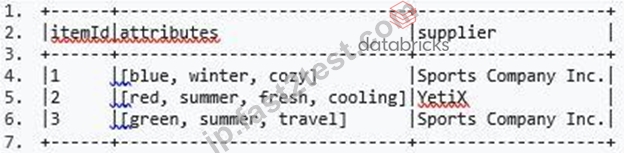
Code block:
itemsAttributesDf = itemsDf.explode("attributes").alias("attribute").select("attribute", "itemId")
- A. The explode() method expects a Column object rather than a string.
- B. Since itemId is the index, it does not need to be an argument to the select() method.
- C. The alias() method needs to be called after the select() method.
- D. The split() method should be used inside the select() method instead of the explode() method.
- E. explode() is not a method of DataFrame. explode() should be used inside the select() method instead.
正解:E
解説:
The correct code block looks like this:
Then, the first couple of rows of itemAttributesDf look like this: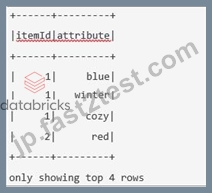
explode() is not a method of DataFrame. explode() should be used inside the select() method instead.
This is correct.
The split() method should be used inside the select() method instead of the explode() method.
No, the split() method is used to split strings into parts. However, column attributs is an array of strings. In this case, the explode() method is appropriate.
Since itemId is the index, it does not need to be an argument to the select() method.
No, itemId still needs to be selected, whether it is used as an index or not.
The explode() method expects a Column object rather than a string.
No, a string works just fine here. This being said, there are some valid alternatives to passing in a string:
The alias() method needs to be called after the select() method.
No.
More info: pyspark.sql.functions.explode - PySpark 3.1.1 documentation (https://bit.ly/2QUZI1J) Static notebook | Dynamic notebook: See test 1 (https://flrs.github.io/spark_practice_tests_code/#1/22.html ,
https://bit.ly/sparkpracticeexams_import_instructions)
質問 # 31
Which of the following code blocks reads all CSV files in directory filePath into a single DataFrame, with column names defined in the CSV file headers?
Content of directory filePath:
1._SUCCESS
2._committed_2754546451699747124
3._started_2754546451699747124
4.part-00000-tid-2754546451699747124-10eb85bf-8d91-4dd0-b60b-2f3c02eeecaa-298-1-c000.csv.gz
5.part-00001-tid-2754546451699747124-10eb85bf-8d91-4dd0-b60b-2f3c02eeecaa-299-1-c000.csv.gz
6.part-00002-tid-2754546451699747124-10eb85bf-8d91-4dd0-b60b-2f3c02eeecaa-300-1-c000.csv.gz
7.part-00003-tid-2754546451699747124-10eb85bf-8d91-4dd0-b60b-2f3c02eeecaa-301-1-c000.csv.gz spark.option("header",True).csv(filePath)
- A. spark.read().option("header",True).load(filePath)
- B. spark.read.format("csv").option("header",True).option("compression","zip").load(filePath)
- C. spark.read.load(filePath)
- D. spark.read.format("csv").option("header",True).load(filePath)
正解:D
解説:
Explanation
The files in directory filePath are partitions of a DataFrame that have been exported using gzip compression.
Spark automatically recognizes this situation and imports the CSV files as separate partitions into a single DataFrame. It is, however, necessary to specify that Spark should load the file headers in the CSV with the header option, which is set to False by default.
質問 # 32
The code block shown below should return a DataFrame with two columns, itemId and col. In this DataFrame, for each element in column attributes of DataFrame itemDf there should be a separate row in which the column itemId contains the associated itemId from DataFrame itemsDf. The new DataFrame should only contain rows for rows in DataFrame itemsDf in which the column attributes contains the element cozy.
A sample of DataFrame itemsDf is below.
Code block:
itemsDf.__1__(__2__).__3__(__4__, __5__(__6__))
- A. 1. filter
2. "array_contains(attributes, 'cozy')"
3. select
4. "itemId"
5. map
6. "attributes" - B. 1. where
2. "array_contains(attributes, 'cozy')"
3. select
4. itemId
5. explode
6. attributes - C. 1. filter
2. "array_contains(attributes, cozy)"
3. select
4. "itemId"
5. explode
6. "attributes" - D. 1. filter
2. "array_contains(attributes, 'cozy')"
3. select
4. "itemId"
5. explode
6. "attributes" - E. 1. filter
2. array_contains("cozy")
3. select
4. "itemId"
5. explode
6. "attributes"
正解:D
解説:
Explanation
The correct code block is:
itemsDf.filter("array_contains(attributes, 'cozy')").select("itemId", explode("attributes")) The key here is understanding how to use array_contains(). You can either use it as an expression in a string, or you can import it from pyspark.sql.functions. In that case, the following would also work:
itemsDf.filter(array_contains("attributes", "cozy")).select("itemId", explode("attributes")) Static notebook | Dynamic notebook: See test 1 (https://flrs.github.io/spark_practice_tests_code/#1/29.html ,
https://bit.ly/sparkpracticeexams_import_instructions)
質問 # 33
Which of the following code blocks reads the parquet file stored at filePath into DataFrame itemsDf, using a valid schema for the sample of itemsDf shown below?
Sample of itemsDf:
1.+------+-----------------------------+-------------------+
2.|itemId|attributes |supplier |
3.+------+-----------------------------+-------------------+
4.|1 |[blue, winter, cozy] |Sports Company Inc.|
5.|2 |[red, summer, fresh, cooling]|YetiX |
6.|3 |[green, summer, travel] |Sports Company Inc.|
7.+------+-----------------------------+-------------------+
- A. 1.itemsDfSchema = StructType([
2. StructField("itemId", IntegerType()),
3. StructField("attributes", ArrayType([StringType()])),
4. StructField("supplier", StringType())])
5.
6.itemsDf = spark.read(schema=itemsDfSchema).parquet(filePath) - B. 1.itemsDfSchema = StructType([
2. StructField("itemId", IntegerType),
3. StructField("attributes", ArrayType(StringType)),
4. StructField("supplier", StringType)])
5.
6.itemsDf = spark.read.schema(itemsDfSchema).parquet(filePath) - C. 1.itemsDf = spark.read.schema('itemId integer, attributes <string>, supplier string').parquet(filePath)
- D. 1.itemsDfSchema = StructType([
2. StructField("itemId", IntegerType()),
3. StructField("attributes", StringType()),
4. StructField("supplier", StringType())])
5.
6.itemsDf = spark.read.schema(itemsDfSchema).parquet(filePath) - E. 1.itemsDfSchema = StructType([
2. StructField("itemId", IntegerType()),
3. StructField("attributes", ArrayType(StringType())),
4. StructField("supplier", StringType())])
5.
6.itemsDf = spark.read.schema(itemsDfSchema).parquet(filePath)
正解:E
解説:
Explanation
The challenge in this question comes from there being an array variable in the schema. In addition, you should know how to pass a schema to the DataFrameReader that is invoked by spark.read.
The correct way to define an array of strings in a schema is through ArrayType(StringType()). A schema can be passed to the DataFrameReader by simply appending schema(structType) to the read() operator. Alternatively, you can also define a schema as a string. For example, for the schema of itemsDf, the following string would make sense: itemId integer, attributes array<string>, supplier string.
A thing to keep in mind is that in schema definitions, you always need to instantiate the types, like so:
StringType(). Just using StringType does not work in pySpark and will fail.
Another concern with schemas is whether columns should be nullable, so allowed to have null values. In the case at hand, this is not a concern however, since the question just asks for a
"valid"
schema. Both non-nullable and nullable column schemas would be valid here, since no null value appears in the DataFrame sample.
More info: Learning Spark, 2nd Edition, Chapter 3
Static notebook | Dynamic notebook: See test 3
質問 # 34
Which of the elements in the labeled panels represent the operation performed for broadcast variables?
Larger image
- A. 2, 3
- B. 0
- C. 1, 2
- D. 2, 5
- E. 1, 3, 4
正解:A
解説:
Explanation
2,3
Correct! Both panels 2 and 3 represent the operation performed for broadcast variables. While a broadcast operation may look like panel 3, with the driver being the bottleneck, it most probably looks like panel 2.
This is because the torrent protocol sits behind Spark's broadcast implementation. In the torrent protocol, each executor will try to fetch missing broadcast variables from the driver or other nodes, preventing the driver from being the bottleneck.
1,2
Wrong. While panel 2 may represent broadcasting, panel 1 shows bi-directional communication which does not occur in broadcast operations.
3
No. While broadcasting may materialize like shown in panel 3, its use of the torrent protocol also enables communciation as shown in panel 2 (see first explanation).
1,3,4
No. While panel 2 shows broadcasting, panel 1 shows bi-directional communication - not a characteristic of broadcasting. Panel 4 shows uni-directional communication, but in the wrong direction.
Panel 4 resembles more an accumulator variable than a broadcast variable.
2,5
Incorrect. While panel 2 shows broadcasting, panel 5 includes bi-directional communication - not a characteristic of broadcasting.
More info: Broadcast Join with Spark - henning.kropponline.de
質問 # 35
......
Databricks Associate-Developer-Apache-Spark の認定を受けることの利点は多岐に渡ります。まず第一に、候補者が Spark アプリケーションを開発するために必要な知識とスキルを持っていることを潜在雇用主に示すことができます。また、認定を受けた開発者は、最新の技術やトレンドについて常に最新情報を得ることができます。さらに、認定された開発者はネットワーキングの機会や専用のイベントやリソースへのアクセスを活用することができます。
Databricks Associate-Developer-Apache-Spark 認定試験はビッグデータ業界のプロフェッショナルにとって貴重な認定資格です。この資格は雇用主に高く評価され、プロフェッショナルが Spark アプリケーション開発の熟練度を証明するのに役立ちます。試験は難しいですが、適切な準備をすれば、受験者は試験に合格し、Spark 開発のスキルを証明することができます。
Associate-Developer-Apache-Spark問題集最新の練習テストと179独特な解答:https://jp.fast2test.com/Associate-Developer-Apache-Spark-premium-file.html
最新Databricks Certification Associate-Developer-Apache-Spark実際の無料試験解答:https://drive.google.com/open?id=1iXTRIAawpQAStgIN7QLWpHI0IyLvHG7q