

2023年06月本日更新されたDatabricks-Certified-Professional-Data-Engineer試験問題集PDF試験エンジン無料!
こちらには最新版のDatabricks-Certified-Professional-Data-Engineerリアル試験解答!
質問 # 46
Newly joined data analyst requested read-only access to tables, assuming you are owner/admin which section of Databricks platform is going to facilitate granting select access to the user
- A. Azure RBAC
- B. User settings
- C. Admin console
- D. Data explorer
- E. Azure Databricks control pane IAM
正解:D
解説:
Explanation
Anser is Data Explorer
https://docs.databricks.com/sql/user/data/index.html
Data explorer lets you easily explore and manage permissions on databases and tables. Users can view schema details, preview sample data, and see table details and properties. Administrators can view and change owners, and admins and data object owners can grant and revoke permissions.
To open data explorer, click Data in the sidebar.
質問 # 47
Which of the following is a correct statement on how the data is organized in the storage when when managing a DELTA table?
- A. All of the data is broken down into one or many parquet files, log files are broken down into one or many JSON files, and each transaction creates a new data file(s) and log file.
(Correct) - B. All of the data is stored into one parquet file, log files are broken down into one or many json files.
- C. All of the data and log are stored in a single parquet file
- D. All of the data is broken down into one or many parquet files, but the log file is stored as a single json file, and every transaction creates a new data file(s) and log file gets appended.
- E. All of the data is broken down into one or many parquet files, log file is removed once the transaction is committed.
正解:A
解説:
Explanation
Answer is
All of the data is broken down into one or many parquet files, log files are broken down into one or many json files, and each transaction creates a new data file(s) and log file.
here is sample layout of how DELTA table might look,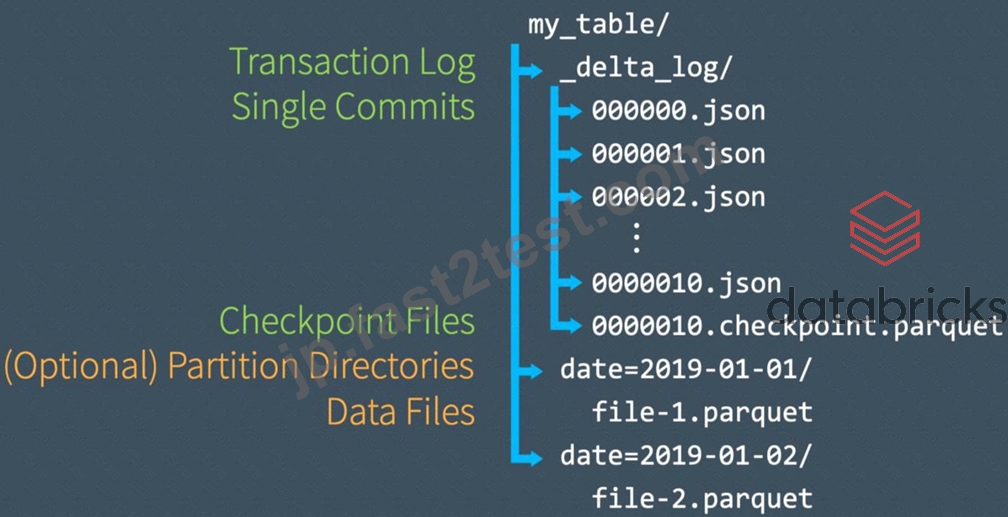
質問 # 48
A denote the event 'student is female' and let B denote the event 'student is French'. In a class of 100 students
suppose 60 are French, and suppose that 10 of the French students are females. Find the probability that if I
pick a French student, it will be a girl, that is, find P(A|B).
- A. 2/3
- B. 2/6
- C. 1/6
- D. 1/3
正解:C
解説:
Explanation
Since 10 out of 100 students are both French and female, then
P(AandB)=10100
Also. 60 out of the 100 students are French, so
P(B)=60100
So the required probability is:
P(A|B)=P(AandB)P(B)=10/10060/100=16
質問 # 49
A dataset has been defined using Delta Live Tables and includes an expectations clause: CON-STRAINT valid_timestamp EXPECT (timestamp > '2020-01-01') ON VIOLATION DROP ROW What is the expected behavior when a batch of data containing data that violates these constraints is processed?
- A. Records that violate the expectation are added to the target dataset and flagged as in-valid in a field added to the target dataset.
- B. Records that violate the expectation are dropped from the target dataset and loaded into a quarantine table.
- C. Records that violate the expectation are dropped from the target dataset and recorded as invalid in the event log.
- D. Records that violate the expectation cause the job to fail.
- E. Records that violate the expectation are added to the target dataset and recorded as invalid in the event log.
正解:C
解説:
Explanation
The answer is Records that violate the expectation are dropped from the target dataset and recorded as invalid in the event log.
Delta live tables support three types of expectations to fix bad data in DLT pipelines Review below example code to examine these expectations, Diagram Description automatically generated with medium confidence
質問 # 50
You are currently working with the second team and both teams are looking to modify the same notebook, you noticed that the second member is copying the notebooks to the personal folder to edit and replace the collaboration notebook, which notebook feature do you recommend to make the process easier to collaborate.
- A. Databricks notebooks should be copied to a local machine and setup source control lo-cally to version the notebooks
- B. Databricks notebooks can be exported into dbc archive files and stored in data lake
- C. Databricks Notebooks support real-time coauthoring on a single notebook
- D. Databricks notebooks support automatic change tracking and versioning
- E. Databricks notebook can be exported as HTML and imported at a later time
正解:C
解説:
Explanation
Answer is Databricks Notebooks support real-time coauthoring on a single notebook Every change is saved, and a notebook can be changed my multiple users.
質問 # 51
Question-26. There are 5000 different color balls, out of which 1200 are pink color. What is the maximum
likelihood estimate for the proportion of "pink" items in the test set of color balls?
- A. 2.4
- B. .48
- C. .24
- D. 4.8
- E. 24 0
正解:C
解説:
Explanation
Given no additional information, the MLE for the probability of an item in the test set is exactly its frequency
in the training set. The method of maximum likelihood corresponds to many well-known estimation methods
in statistics. For example, one may be interested in the heights of adult female penguins, but be unable to
measure the height of every single penguin in a population due to cost or time constraints. Assuming that the
heights are normally (Gaussian) distributed with some unknown mean and variance, the mean and variance
can be estimated with MLE while only knowing the heights of some sample of the overall population. MLE
would accomplish this by taking the mean and variance as parameters and finding particular parametric values
that make the observed results the most probable (given the model).
In general, for a fixed set of data and underlying statistical model the method of maximum likelihood selects
the set of values of the model parameters that maximizes the likelihood function. Intuitively, this maximizes
the "agreement" of the selected model with the observed data, and for discrete random variables it indeed
maximizes the probability of the observed data under the resulting distribution. Maximum-likelihood
estimation gives a unified approach to estimation, which is well-defined in the case of the normal distribution
and many other problems. However in some complicated problems, difficulties do occur: in such problems,
maximum-likelihood estimators are unsuitable or do not exist.
質問 # 52
When writing streaming data, Spark's structured stream supports the below write modes
- A. Append, Delta, Complete
- B. Append, Complete, Update
- C. Append, overwrite, Continuous
- D. Complete, Incremental, Update
- E. Delta, Complete, Continuous
正解:B
解説:
Explanation
The answer is Append, Complete, Update
*Append mode (default) - This is the default mode, where only the new rows added to the Result Table since the last trigger will be outputted to the sink. This is supported for only those queries where rows added to the Result Table is never going to change. Hence, this mode guarantees that each row will be output only once (assuming fault-tolerant sink). For example, queries with only select, where, map, flatMap, filter, join, etc. will support Append mode.
*Complete mode - The whole Result Table will be outputted to the sink after every trigger. This is supported for aggregation queries.
*Update mode - (Available since Spark 2.1.1) Only the rows in the Result Table that were updated since the last trigger will be outputted to the sink. More information to be added in future releases.
質問 # 53
Which of the following locations hosts the driver and worker nodes of a Databricks-managed clus-ter?
- A. JDBC data source
- B. Control plane
- C. Databricks web application
- D. Data plane
- E. Databricks Filesystem
正解:D
解説:
Explanation
The answer is Data Plane, which is where compute(all-purpose, Job Cluster, DLT) are stored this is generally a customer cloud account, there is one exception SQL Warehouses, currently there are 3 types of SQL Warehouse compute available(classic, pro, serverless), in classic and pro compute is located in customer cloud account but serverless computed is located in Databricks cloud account.
Diagram, timeline Description automatically generated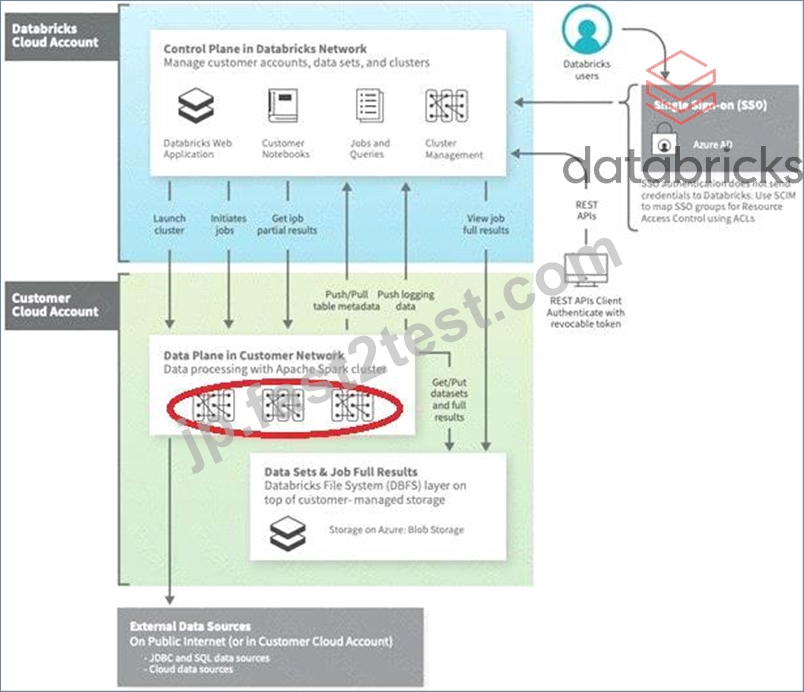
質問 # 54
You are currently working on reloading customer_sales tables using the below query
1. INSERT OVERWRITE customer_sales
2. SELECT * FROM customers c
3. INNER JOIN sales_monthly s on s.customer_id = c.customer_id
After you ran the above command, the Marketing team quickly wanted to review the old data that was in the table. How does INSERT OVERWRITE impact the data in the customer_sales table if you want to see the previous version of the data prior to running the above statement?
- A. Overwrites the current version of the data but clears all historical versions of the data, so you can not time travel to previous versions.
- B. Overwrites the data in the table but preserves all historical versions of the data, you can time travel to previous versions
- C. Overwrites the data in the table, all historical versions of the data, you can not time travel to previous versions
- D. By default, overwrites the data and schema, you cannot perform time travel
- E. Appends the data to the current version, you can time travel to previous versions
正解:B
解説:
Explanation
The answer is, INSERT OVERWRITE Overwrites the current version of the data but preserves all historical versions of the data, you can time travel to previous versions.
1.INSERT OVERWRITE customer_sales
2.SELECT * FROM customers c
3.INNER JOIN sales s on s.customer_id = c.customer_id
Let's just assume that this is the second time you are running the above statement, you can still query the prior version of the data using time travel, and any DML/DDL except DROP TABLE creates new PARQUET files so you can still access the previous versions of data.
SQL Syntax for Time travel
SELECT * FROM table_name as of [version number]
with customer_sales example
SELECT * FROM customer_sales as of 1 -- previous version
SELECT * FROM customer_sales as of 2 -- current version
You see all historical changes on the table using DESCRIBE HISTORY table_name Note: the main difference between INSERT OVERWRITE and CREATE OR REPLACE TABLE(CRAS) is that CRAS can modify the schema of the table, i.e it can add new columns or change data types of existing columns. By default INSERT OVERWRITE only overwrites the data.
INSERT OVERWRITE can also be used to update the schema when
spark.databricks.delta.schema.autoMerge.enabled is set true if this option is not enabled and if there is a schema mismatch command INSERT OVERWRITEwill fail.
Any DML/DDL operation(except DROP TABLE) on the Delta table preserves the historical ver-sion of the data.
質問 # 55
Which of the following SQL statement can be used to query a table by eliminating duplicate rows from the query results?
- A. SELECT DISTINCT * FROM table_name
- B. SELECT DISTINCT_ROWS (*) FROM table_name
- C. SELECT * FROM table_name GROUP BY * HAVING COUNT(*) < 1
- D. SELECT * FROM table_name GROUP BY * HAVING COUNT(*) > 1
- E. SELECT DISTINCT * FROM table_name HAVING COUNT(*) > 1
正解:A
解説:
Explanation
The answer is SELECT DISTINCT * FROM table_name
質問 # 56
Which of the following techniques structured streaming uses to ensure recovery of failures during stream processing?
- A. Checkpointing and write-ahead logging
- B. The stream will failover to available nodes in the cluster
- C. Delta time travel
- D. Checkpointing and Watermarking
- E. Write ahead logging and watermarking
- F. Checkpointing and Idempotent sinks
正解:A
解説:
Explanation
The answer is Checkpointing and write-ahead logging.
Structured Streaming uses checkpointing and write-ahead logs to record the offset range of data being processed during each trigger interval.
質問 # 57
One of the queries in the Databricks SQL Dashboard takes a long time to refresh, which of the be-low steps can be taken to identify the root cause of this issue?
- A. Restart the SQL endpoint
- B. Change the Spot Instance Policy from "Cost optimized" to "Reliability Optimized."
- C. Use Query History, to view queries and select query, and check query profile to time spent in each step
- D. Select the SQL endpoint cluster, spark UI, SQL tab to see the execution plan and time spent in each step
- E. Run optimize and Z ordering
正解:C
解説:
Explanation
The answer is, Use Query History, to view queries and select query, and check the query profile to see time spent in each step.
Here is the view of the query profile, for more info use the link
https://docs.microsoft.com/en-us/azure/databricks/sql/admin/query-profile As you can see here Databricks SQL query profile is much different to Spark UI and provides much more clear information on how time is being spent on different queries and time it spent on each step.
Graphical user interface, application Description automatically generated
質問 # 58
Your team has hundreds of jobs running but it is difficult to track cost of each job run, you are asked to provide a recommendation on how to monitor and track cost across various workloads
- A. Use Tags, during job creation so cost can be easily tracked
- B. Create jobs in different workspaces, so we can track the cost easily
- C. Use job logs to monitor and track the costs
- D. Use workspace admin reporting
- E. Use a single cluster for all the jobs, so cost can be easily tracked
正解:A
解説:
Explanation
The answer is Use Tags, during job creation so cost can be easily tracked Review below link for more details
https://docs.databricks.com/administration-guide/account-settings/usage-detail-tags-aws.html Here is a view how tags get propagated from pools to clusters and clusters without pools, Diagram Description automatically generated
質問 # 59
Which of the following describes a scenario in which a data engineer will want to use a Job cluster instead of
an all-purpose cluster?
- A. A data team needs to collaborate on the development of a machine learning model
- B. A Databricks SQL query needs to be scheduled for upward reporting
- C. An ad-hoc analytics report needs to be developed while minimizing compute costs
- D. A data engineer needs to manually investigate a production error
- E. An automated workflow needs to be run every 30 minutes
正解:E
質問 # 60
What is the best way to query external csv files located on DBFS Storage to inspect the data using SQL?
- A. SELECT * FROM 'dbfs:/location/csv_files/' USING CSV
- B. SELECT * FROM 'dbfs:/location/csv_files/' FORMAT = 'CSV'
- C. You can not query external files directly, us COPY INTO to load the data into a table first
- D. SELECT CSV. * from 'dbfs:/location/csv_files/'
- E. SELECT * FROM CSV. 'dbfs:/location/csv_files/'
正解:E
解説:
Explanation
Answer is, SELECT * FROM CSV. 'dbfs:/location/csv_files/'
you can query external files stored on the storage using below syntax
SELECT * FROM format.`/Location`
format - CSV, JSON, PARQUET, TEXT
質問 # 61
Which of the following Structured Streaming queries is performing a hop from a Bronze table to a Silver
table?
- A. 1. (spark.table("sales")
2. .agg(sum("sales"),
3. sum("units"))
4. .writeStream
5. .option("checkpointLocation", checkpointPath)
6. .outputMode("complete")
7. .table("aggregatedSales")
8. ) - B. 1. (spark.read.load(rawSalesLocation)
2. .writeStream
3. .option("checkpointLocation", checkpointPath)
4. .outputMode("append")
5. .table("uncleanedSales")
6. ) - C. 1. (spark.table("sales")
2. .withColumn("avgPrice", col("sales") / col("units"))
3. .writeStream
4. .option("checkpointLocation", checkpointPath)
5. .outputMode("append")
6. .table("cleanedSales")
7.) - D. 1. (spark.readStream.load(rawSalesLocation)
2. .writeStream
3. .option("checkpointLocation", checkpointPath)
4. .outputMode("append")
5. .table("uncleanedSales")
6. ) - E. 1. (spark.table("sales")
2. .groupBy("store")
3. .agg(sum("sales"))
4. .writeStream
5. .option("checkpointLocation", checkpointPath)
6. .outputMode("complete")
7. .table("aggregatedSales")
8.)
正解:C
質問 # 62
A data engineering team has created a series of tables using Parquet data stored in an external sys-tem. The
team is noticing that after appending new rows to the data in the external system, their queries within
Databricks are not returning the new rows. They identify the caching of the previous data as the cause of this
issue.
Which of the following approaches will ensure that the data returned by queries is always up-to-date?
- A. The tables should be altered to include metadata to not cache
- B. The tables should be converted to the Delta format
- C. The tables should be updated before the next query is run
- D. The tables should be stored in a cloud-based external system
- E. The tables should be refreshed in the writing cluster before the next query is run
正解:B
質問 # 63
When building a DLT s pipeline you have two options to create a live tables, what is the main dif-ference between CREATE STREAMING LIVE TABLE vs CREATE LIVE TABLE?
- A. CREATE LIVE TABLE is used in DELTA LIVE TABLES, CREATE STREAMING LIVE can only used in Structured Streaming applications
- B. CREATE STREAMING LIVE TABLE is used when working with Streaming data sources and Incremental data
- C. CREATE LIVE TABLE is used when working with Streaming data sources and Incremental data
- D. There is no difference both are the same, CREATE STRAMING LIVE will be deprecated soon
- E. CREATE STREAMING LIVE table is used in MULTI HOP Architecture
正解:B
解説:
Explanation
The answer is, CREATE STREAMING LIVE TABLE is used when working with Streaming data sources and Incremental data
質問 # 64
......
材料 From:
- 2023年最新の Databricks-Certified-Professional-Data-Engineer試験問題集で(PDFとテストエンジン)無料提供:https://jp.fast2test.com/Databricks-Certified-Professional-Data-Engineer-premium-file.html
- 2023年最新のDatabricks-Certified-Professional-Data-EngineerのPDF試験問題集で無料提供:https://drive.google.com/open?id=1qeE8_wMzbXS9_2Jf0d8oZZ3tzCy53tfl
無料材料を提供しております!お客様の全試験合格を助けます!