

[2022年05月13日] 365日更新、有効なDP-200知能問題集
ベスト品質のDP-200試験問題集でMicrosoftテスト高得点を目指そう
Microsoft DP-200 認定試験の出題範囲:
| トピック | 出題範囲 |
|---|---|
| トピック 1 |
|
| トピック 2 |
|
| トピック 3 |
|
| トピック 4 |
|
| トピック 5 |
|
質問 119
Note: This question is a part of series of questions that present the same scenario. Each question in the series contains a unique solution. Determine whether the solution meets the stated goals.
You develop a data ingestion process that will import data to an enterprise data warehouse in Azure Synapse Analytics. The data to be ingested resides in parquet files stored in an Azure Data Lake Gen 2 storage account.
You need to load the data from the Azure Data Lake Gen 2 storage account into the Data Warehouse.
Solution:
1. Use Azure Data Factory to convert the parquet files to CSV files
2. Create an external data source pointing to the Azure storage account
3. Create an external file format and external table using the external data source
4. Load the data using the INSERT...SELECTstatement
Does the solution meet the goal?
- A. Yes
- B. No
正解: B
解説:
There is no need to convert the parquet files to CSV files.
You load the data using the CREATE TABLE AS SELECT statement.
References:
https://docs.microsoft.com/en-us/azure/sql-data-warehouse/sql-data-warehouse-load-from-azure-data-lake- store
質問 120
Note: This question is part of a series of questions that present the same scenario. Each question in the series contains a unique solution that might meet the stated goals. Some questions sets might have more than one correct solution, while others might not have a correct solution.
After you answer a question in this section, you will NOT be able to return to it. As a result, these questions will not appear in the review screen.
You need to configure data encryption for external applications.
Solution:
1. Access the Always Encrypted Wizard in SQL Server Management Studio
2. Select the column to be encrypted
3. Set the encryption type to Deterministic
4. Configure the master key to use the Azure Key Vault
5. Validate configuration results and deploy the solution
Does the solution meet the goal?
- A. No
- B. Yes
正解: B
解説:
Explanation
We use the Azure Key Vault, not the Windows Certificate Store, to store the master key.
Note: The Master Key Configuration page is where you set up your CMK (Column Master Key) and select the key store provider where the CMK will be stored. Currently, you can store a CMK in the Windows certificate store, Azure Key Vault, or a hardware security module (HSM).
References:
https://docs.microsoft.com/en-us/azure/sql-database/sql-database-always-encrypted-azure-key-vault
質問 121
You manage the Microsoft Azure Databricks environment for a company. You must be able to access a private Azure Blob Storage account. Data must be available to all Azure Databricks workspaces. You need to provide the data access.
Which three actions should you perform in sequence? To answer, move the appropriate actions from the list of actions to the answer area and arrange them in the correct order.
正解:
解説:
Explanation:
Step 1: Create a secret scope
Step 2: Add secrets to the scope
Note: dbutils.secrets.get(scope = "<scope-name>", key = "<key-name>") gets the key that has been stored as a secret in a secret scope.
Step 3: Mount the Azure Blob Storage container
You can mount a Blob Storage container or a folder inside a container through Databricks File System - DBFS. The mount is a pointer to a Blob Storage container, so the data is never synced locally.
Note: To mount a Blob Storage container or a folder inside a container, use the following command:
Python
dbutils.fs.mount(
source = "wasbs://<your-container-name>@<your-storage-account-name>.blob.core.windows.net", mount_point = "/mnt/<mount-name>", extra_configs = {"<conf-key>":dbutils.secrets.get(scope = "<scope-name>", key = "<key-name>")}) where:
dbutils.secrets.get(scope = "<scope-name>", key = "<key-name>") gets the key that has been stored as a secret in a secret scope.
References:
https://docs.databricks.com/spark/latest/data-sources/azure/azure-storage.html
質問 122
Note: This question is part of a series of questions that present the same scenario. Each question in the series contains a unique solution that might meet the stated goals. Some question sets might have more than one correct solution, while others might not have a correct solution.
After you answer a question in this scenario, you will NOT be able to return to it. As a result, these questions will not appear in the review screen.
You plan to create an Azure Databricks workspace that has a tiered structure. The workspace will contain the following three workloads:
* A workload for data engineers who will use Python and SQL
* A workload for jobs that will run notebooks that use Python, Spark, Scala, and SQL
* A workload that data scientists will use to perform ad hoc analysis in Scala and R The enterprise architecture team at your company identifies the following standards for Databricks environments:
* The data engineers must share a cluster.
* The job cluster will be managed by using a request process whereby data scientists and data engineers provide packaged notebooks for deployment to the cluster.
* All the data scientists must be assigned their own cluster that terminates automatically after 120 minutes of inactivity. Currently, there are three data scientists.
You need to create the Databrick clusters for the workloads.
Solution: You create a Standard cluster for each data scientist, a High Concurrency cluster for the data engineers, and a High Concurrency cluster for the jobs.
Does this meet the goal?
- A. No
- B. Yes
正解: B
解説:
Topic 2, Proseware Inc
Background
Proseware, Inc, develops and manages a product named Poll Taker. The product is used for delivering public opinion polling and analysis.
Polling data comes from a variety of sources, including online surveys, house-to-house interviews, and booths at public events.
Polling data
Polling data is stored in one of the two locations:
* An on-premises Microsoft SQL Server 2019 database named PollingData
* Azure Data Lake Gen 2
Data in Data Lake is queried by using PolyBase
Poll metadata
Each poll has associated metadata with information about the poll including the date and number of respondents. The data is stored as JSON.
Phone-based polling
Security
* Phone-based poll data must only be uploaded by authorized users from authorized devices
* Contractors must not have access to any polling data other than their own
* Access to polling data must set on a per-active directory user basis
Data migration and loading
* All data migration processes must use Azure Data Factory
* All data migrations must run automatically during non-business hours
* Data migrations must be reliable and retry when needed
Performance
After six months, raw polling data should be moved to a lower-cost storage solution.
Deployments
* All deployments must be performed by using Azure DevOps. Deployments must use templates used in multiple environments
* No credentials or secrets should be used during deployments
Reliability
All services and processes must be resilient to a regional Azure outage.
Monitoring
All Azure services must be monitored by using Azure Monitor. On-premises SQL Server performance must be monitored.
質問 123
You use Azure Stream Analytics to receive Twitter data from Azure Event Hubs and to output the data to an Azure Blob storage account.
You need to output the count of tweets during the last five minutes every five minutes. Each tweet must only be counted once.
Which windowing function should you use?
- A. a five-minute Hopping window that has one-minute hop
- B. a five-minute Sliding window
- C. a five-minute Session window
- D. a five-minute Tumbling window
正解: D
解説:
Explanation
Tumbling window functions are used to segment a data stream into distinct time segments and perform a function against them, such as the example below. The key differentiators of a Tumbling window are that they repeat, do not overlap, and an event cannot belong to more than one tumbling window.
References:
https://docs.microsoft.com/en-us/azure/stream-analytics/stream-analytics-window-functions
質問 124
You have an Azure Synapse Analytics SQL pool named Pool1 on a logical Microsoft SQL server named Server1.
You need to implement Transparent Data Encryption (TDE) on Pool1 by using a custom key named key1.
Which five actions should you perform in sequence? To answer, move the appropriate actions from the list of actions to the answer area and arrange them in the correct order.
正解:
解説:
Explanation
Step 1: Assign a managed identity to Server1
You will need an existing Managed Instance as a prerequisite.
Step 2: Create an Azure key vault and grant the managed identity permissions to the vault Create Resource and setup Azure Key Vault.
Step 3 :Add key1 to the Azure key vault
The recommended way is to import an existing key from a .pfx file or get an existing key from the vault.
Alternatively, generate a new key directly in Azure Key Vault.
Step 4: Configure key1 as the TDE protector for Server1
Provide TDE Protector key
Step 5: Enable TDE on Pool1
Reference:
https://docs.microsoft.com/en-us/azure/azure-sql/managed-instance/scripts/transparent-data-encryption-byok-po
質問 125
You are responsible for providing access to an Azure Data Lake Storage Gen2 account.
Your user account has contributor access to the storage account, and you have the application ID access key.
You plan to use PolyBase to load data into Azure SQL data warehouse.
You need to configure PolyBase to connect the data warehouse to the storage account.
Which three components should you create in sequence? To answer, move the appropriate components from the list of components to the answer are and arrange them in the correct order.
正解:
解説:
Explanation:
Step 1: a database scoped credential
To access your Data Lake Storage account, you will need to create a Database Master Key to encrypt your credential secret used in the next step. You then create a database scoped credential.
Step 2: an external data source
Create the external data source. Use the CREATE EXTERNAL DATA SOURCE command to store the location of the data. Provide the credential created in the previous step.
Step 3: an external file format
Configure data format: To import the data from Data Lake Storage, you need to specify the External File Format. This object defines how the files are written in Data Lake Storage.
References:
https://docs.microsoft.com/en-us/azure/sql-data-warehouse/sql-data-warehouse-load-from-azure-data-lake-store
質問 126
You implement an Azure SQL Data Warehouse instance.
You plan to migrate the largest fact table to Azure SQL Data Warehouse. The table resides on Microsoft SQL Server on-premises and is 10 terabytes (TB) is size.
Incoming queries use the primary key Sale Key column to retrieve data as displayed in the following table:
You need to distribute the large fact table across multiple nodes to optimize performance of the table.
Which technology should you use?
- A. round robin distributed table with clustered ColumnStore index
- B. hash distributed table with clustered index
- C. hash distributed table with clustered ColumnStore index
- D. round robin distributed table with clustered index
- E. heap table with distribution replicate
正解: C
解説:
Hash-distributed tables improve query performance on large fact tables.
Columnstore indexes can achieve up to 100x better performance on analytics and data warehousing workloads and up to 10x better data compression than traditional rowstore indexes.
Incorrect Answers:
D, E: Round-robin tables are useful for improving loading speed.
References:
https://docs.microsoft.com/en-us/azure/sql-data-warehouse/sql-data-warehouse-tables-distribute
https://docs.microsoft.com/en-us/sql/relational-databases/indexes/columnstore-indexes-query-performance
質問 127
You are developing the data platform for a global retail company. The company operates during normal working hours in each region. The analytical database is used once a week for building sales projections.
Each region maintains its own private virtual network.
Building the sales projections is very resource intensive are generates upwards of 20 terabytes (TB) of data.
Microsoft Azure SQL Databases must be provisioned.
* Database provisioning must maximize performance and minimize cost
* The daily sales for each region must be stored in an Azure SQL Database instance
* Once a day, the data for all regions must be loaded in an analytical Azure SQL Database instance You need to provision Azure SQL database instances.
How should you provision the database instances? To answer, drag the appropriate Azure SQL products to the correct databases. Each Azure SQL product may be used once, more than once, or not at all. You may need to drag the split bar between panes or scroll to view content.
NOTE: Each correct selection is worth one point.
正解:
解説:
Explanation
Box 1: Azure SQL Database elastic pools
SQL Database elastic pools are a simple, cost-effective solution for managing and scaling multiple databases that have varying and unpredictable usage demands. The databases in an elastic pool are on a single Azure SQL Database server and share a set number of resources at a set price. Elastic pools in Azure SQL Database enable SaaS developers to optimize the price performance for a group of databases within a prescribed budget while delivering performance elasticity for each database.
Box 2: Azure SQL Database Hyperscale
A Hyperscale database is an Azure SQL database in the Hyperscale service tier that is backed by the Hyperscale scale-out storage technology. A Hyperscale database supports up to 100 TB of data and provides high throughput and performance, as well as rapid scaling to adapt to the workload requirements. Scaling is transparent to the application - connectivity, query processing, and so on, work like any other SQL database.
質問 128
You manage security for a database that supports a line of business application.
Private and personal data stored in the database must be protected and encrypted.
You need to configure the database to use Transparent Data Encryption (TDE).
Which five actions should you perform in sequence? To answer, select the appropriate actions from the list of actions to the answer area and arrange them in the correct order.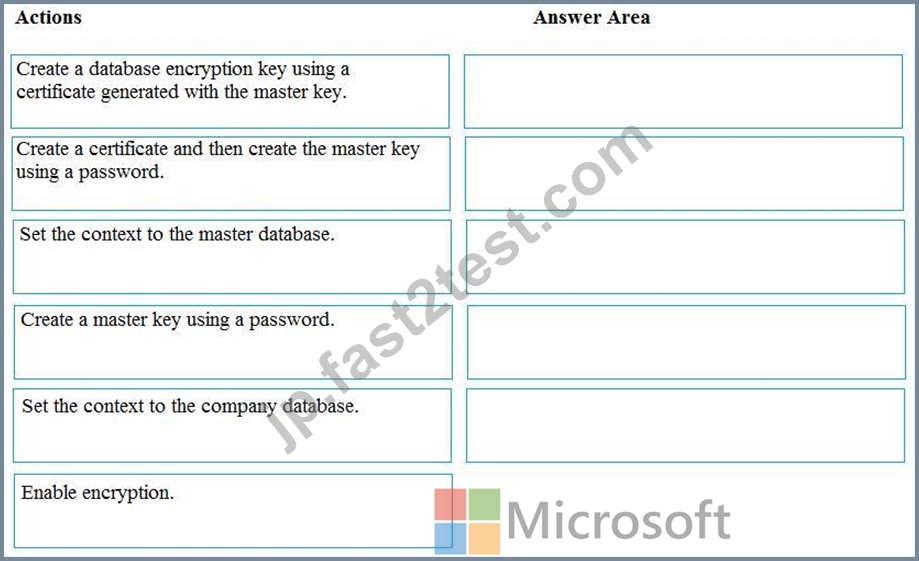
正解:
解説:
Explanation
Step 1: Create a master key
Step 2: Create or obtain a certificate protected by the master key
Step 3: Set the context to the company database
Step 4: Create a database encryption key and protect it by the certificate Step 5: Set the database to use encryption Example code:
USE master;
GO
CREATE MASTER KEY ENCRYPTION BY PASSWORD = '<UseStrongPasswordHere>';
go
CREATE CERTIFICATE MyServerCert WITH SUBJECT = 'My DEK Certificate';
go
USE AdventureWorks2012;
GO
CREATE DATABASE ENCRYPTION KEY
WITH ALGORITHM = AES_128
ENCRYPTION BY SERVER CERTIFICATE MyServerCert;
GO
ALTER DATABASE AdventureWorks2012
SET ENCRYPTION ON;
GO
References:
https://docs.microsoft.com/en-us/sql/relational-databases/security/encryption/transparent-data-encryption
質問 129
Your company has on-premises Microsoft SQL Server instance.
The data engineering team plans to implement a process that copies data from the SQL Server instance to Azure Blob storage. The process must orchestrate and manage the data lifecycle.
You need to configure Azure Data Factory to connect to the SQL Server instance.
Which three actions should you perform in sequence? To answer, move the appropriate actions from the list of actions to the answer area and arrange them in the correct order.
正解:
解説:
Explanation
Step 1: Deploy an Azure Data Factory
You need to create a data factory and start the Data Factory UI to create a pipeline in the data factory.
Step 2: From the on-premises network, install and configure a self-hosted runtime.
To use copy data from a SQL Server database that isn't publicly accessible, you need to set up a self-hosted integration runtime.
Step 3: Configure a linked service to connect to the SQL Server instance.
References:
https://docs.microsoft.com/en-us/azure/data-factory/connector-sql-server
質問 130
You need to build a solution to collect the telemetry data for Race Control.
What should you use? To answer, select the appropriate options in the answer area.
NOTE: Each correct selection is worth one point.
正解:
解説:
Explanation
API: MongoDB
Consistency level: Strong
Use the strongest consistency Strong to minimize convergence time.
Scenario: The data must be written to the Azure datacentre closest to each race and must converge in the least amount of time.
References:
https://docs.microsoft.com/en-us/azure/cosmos-db/consistency-levels
Topic 4, ADatum Corporation
Case study
Overview
ADatum Corporation is a retailer that sells products through two sales channels: retail stores and a website.
Existing Environment
ADatum has one database server that has Microsoft SQL Server 2016 installed. The server hosts three mission-critical databases named SALESDB, DOCDB, and REPORTINGDB.
SALESDB collects data from the stored and the website.
DOCDB stored documents that connect to the sales data in SALESDB. The documents are stored in two different JSON formats based on the sales channel.
REPORTINGDB stores reporting data and contains server columnstore indexes. A daily process creates reporting data in REPORTINGDB from the data in SALESDB. The process is implemented as a SQL Server Integration Services (SSIS) package that runs a stored procedure from SALESDB.
Requirements
Planned Changes
ADatum plans to move the current data infrastructure to Azure. The new infrastructure has the following requirements:
* Migrate SALESDB and REPORTINGDB to an Azure SQL database.
* Migrate DOCDB to Azure Cosmos DB.
* The sales data including the documents in JSON format, must be gathered as it arrives and analyzed online by using Azure Stream Analytics. The analytic process will perform aggregations that must be done continuously, without gaps, and without overlapping.
* As they arrive, all the sales documents in JSON format must be transformed into one consistent format.
* Azure Data Factory will replace the SSIS process of copying the data from SALESDB to REPORTINGDB.
Technical Requirements
The new Azure data infrastructure must meet the following technical requirements:
* Data in SALESDB must encrypted by using Transparent Data Encryption (TDE). The encryption must use your own key.
* SALESDB must be restorable to any given minute within the past three weeks.
* Real-time processing must be monitored to ensure that workloads are sized properly based on actual usage patterns.
* Missing indexes must be created automatically for REPORTINGDB.
* Disk IO, CPU, and memory usage must be monitored for SALESDB.
質問 131
You plan to use Microsoft Azure SQL Database instances with strict user access control. A user object must:
* Move with the database if it is run elsewhere
* Be able to create additional users
You need to create the user object with correct permissions.
Which two Transact-SQL commands should you run? Each correct answer presents part of the solution.
NOTE: Each correct selection is worth one point.
- A. ALTER LOGIN Mary WITH PASSWORD = 'strong_password';
- B. CREATE LOGIN Mary WITH PASSWORD = 'strong_password';
- C. CREATE USER Mary WITH PASSWORD = 'strong_password';
- D. ALTER ROLE db_owner ADD MEMBER Mary;
- E. GRANT ALTER ANY USER TO Mary;
正解: C,D
解説:
Explanation
Explanation:
C: ALTER ROLE adds or removes members to or from a database role, or changes the name of a user- defined database role.
Members of the db_owner fixed database role can perform all configuration and maintenance activities on the database, and can also drop the database in SQL Server.
D: CREATE USER adds a user to the current database.
Note: Logins are created at the server level, while users are created at the database level. In other words, a login allows you to connect to the SQL Server service (also called an instance), and permissions inside the database are granted to the database users, not the logins. The logins will be assigned to server roles (for example, serveradmin) and the database users will be assigned to roles within that database (eg.
db_datareader, db_bckupoperator).
References:
https://docs.microsoft.com/en-us/sql/t-sql/statements/alter-role-transact-sql
https://docs.microsoft.com/en-us/sql/t-sql/statements/create-user-transact-sql Manage data security Testlet 2 Background Proseware, Inc, develops and manages a product named Poll Taker. The product is used for delivering public opinion polling and analysis.
Polling data comes from a variety of sources, including online surveys, house-to-house interviews, and booths at public events.
Polling data
Polling data is stored in one of the two locations:
* An on-premises Microsoft SQL Server 2019 database named PollingData
* Azure Data Lake Gen 2
Data in Data Lake is queried by using PolyBase
Poll metadata
Each poll has associated metadata with information about the poll including the date and number of respondents. The data is stored as JSON.
Phone-based polling
Security
* Phone-based poll data must only be uploaded by authorized users from authorized devices
* Contractors must not have access to any polling data other than their own
* Access to polling data must set on a per-active directory user basis
Data migration and loading
* All data migration processes must use Azure Data Factory
* All data migrations must run automatically during non-business hours
* Data migrations must be reliable and retry when needed
Performance
After six months, raw polling data should be moved to a storage account. The storage must be available in the event of a regional disaster. The solution must minimize costs.
Deployments
* All deployments must be performed by using Azure DevOps. Deployments must use templates used in multiple environments
* No credentials or secrets should be used during deployments
Reliability
All services and processes must be resilient to a regional Azure outage.
Monitoring
All Azure services must be monitored by using Azure Monitor. On-premises SQL Server performance must be monitored.
Manage data security
Testlet 3
Overview
Current environment
Contoso relies on an extensive partner network for marketing, sales, and distribution. Contoso uses external companies that manufacture everything from the actual pharmaceutical to the packaging.
The majority of the company's data reside in Microsoft SQL Server database. Application databases fall into one of the following tiers:
The company has a reporting infrastructure that ingests data from local databases and partner services.
Partners services consists of distributors, wholesales, and retailers across the world. The company performs daily, weekly, and monthly reporting.
Requirements
Tier 3 and Tier 6 through Tier 8 application must use database density on the same server and Elastic pools in a cost-effective manner.
Applications must still have access to data from both internal and external applications keeping the data encrypted and secure at rest and in transit.
A disaster recovery strategy must be implemented for Tier 3 and Tier 6 through 8 allowing for failover in the case of server going offline.
Selected internal applications must have the data hosted in single Microsoft Azure SQL Databases.
* Tier 1 internal applications on the premium P2 tier
* Tier 2 internal applications on the standard S4 tier
The solution must support migrating databases that support external and internal application to Azure SQL Database. The migrated databases will be supported by Azure Data Factory pipelines for the continued movement, migration and updating of data both in the cloud and from local core business systems and repositories.
Tier 7 and Tier 8 partner access must be restricted to the database only.
In addition to default Azure backup behavior, Tier 4 and 5 databases must be on a backup strategy that performs a transaction log backup eve hour, a differential backup of databases every day and a full back up every week.
Back up strategies must be put in place for all other standalone Azure SQL Databases using Azure SQL- provided backup storage and capabilities.
Databases
Contoso requires their data estate to be designed and implemented in the Azure Cloud. Moving to the cloud must not inhibit access to or availability of data.
Databases:
Tier 1 Database must implement data masking using the following masking logic:
Tier 2 databases must sync between branches and cloud databases and in the event of conflicts must be set up for conflicts to be won by on-premises databases.
Tier 3 and Tier 6 through Tier 8 applications must use database density on the same server and Elastic pools in a cost-effective manner.
Applications must still have access to data from both internal and external applications keeping the data encrypted and secure at rest and in transit.
A disaster recovery strategy must be implemented for Tier 3 and Tier 6 through 8 allowing for failover in the case of a server going offline.
Selected internal applications must have the data hosted in single Microsoft Azure SQL Databases.
* Tier 1 internal applications on the premium P2 tier
* Tier 2 internal applications on the standard S4 tier
Reporting
Security and monitoring
Security
A method of managing multiple databases in the cloud at the same time is must be implemented to streamlining data management and limiting management access to only those requiring access.
Monitoring
Monitoring must be set up on every database. Contoso and partners must receive performance reports as part of contractual agreements.
Tiers 6 through 8 must have unexpected resource storage usage immediately reported to data engineers.
The Azure SQL Data Warehouse cache must be monitored when the database is being used. A dashboard monitoring key performance indicators (KPIs) indicated by traffic lights must be created and displayed based on the following metrics:
Existing Data Protection and Security compliances require that all certificates and keys are internally managed in an on-premises storage.
You identify the following reporting requirements:
* Azure Data Warehouse must be used to gather and query data from multiple internal and external databases
* Azure Data Warehouse must be optimized to use data from a cache
* Reporting data aggregated for external partners must be stored in Azure Storage and be made available during regular business hours in the connecting regions
* Reporting strategies must be improved to real time or near real time reporting cadence to improve competitiveness and the general supply chain
* Tier 9 reporting must be moved to Event Hubs, queried, and persisted in the same Azure region as the company's main office
* Tier 10 reporting data must be stored in Azure Blobs
Issues
Team members identify the following issues:
* Both internal and external client application run complex joins, equality searches and group-by clauses.
Because some systems are managed externally, the queries will not be changed or optimized by Contoso
* External partner organization data formats, types and schemas are controlled by the partner companies
* Internal and external database development staff resources are primarily SQL developers familiar with the Transact-SQL language.
* Size and amount of data has led to applications and reporting solutions not performing are required speeds
* Tier 7 and 8 data access is constrained to single endpoints managed by partners for access
* The company maintains several legacy client applications. Data for these applications remains isolated form other applications. This has led to hundreds of databases being provisioned on a per application basis
質問 132
Note: This question is part of a series of questions that present the same scenario. Each question in the series contains a unique solution that might meet the stated goals. Some question sets might have more than one correct solution, while others might not have a correct solution.
After you answer a question in this section, you will NOT be able to return to it. As a result, these questions will not appear in the review screen.
You have an Azure SQL database named DB1 that contains a table named Table1. Table1 has a field named Customer_ID that is varchar(22).
You need to implement masking for the Customer_ID field to meet the following requirements:
* The first two prefix characters must be exposed.
* The last four suffix characters must be exposed.
* All other characters must be masked.
Solution: You implement data masking and use a credit card function mask.
Does this meet the goal?
- A. Yes
- B. No
正解: B
解説:
Must use Custom Text data masking, which exposes the first and last characters and adds a custom padding string in the middle.
Reference:
https://docs.microsoft.com/en-us/azure/sql-database/sql-database-dynamic-data-masking-get-started
質問 133
You need set up the Azure Data Factory JSON definition for Tier 10 data.
What should you use? To answer, select the appropriate options in the answer area.
NOTE: Each correct selection is worth one point.
正解:
解説:
Explanation:
Box 1: Connection String
To use storage account key authentication, you use the ConnectionString property, which xpecify the information needed to connect to Blobl Storage.
Mark this field as a SecureString to store it securely in Data Factory. You can also put account key in Azure Key Vault and pull the accountKey configuration out of the connection string.
Box 2: Azure Blob
Tier 10 reporting data must be stored in Azure Blobs
References:
https://docs.microsoft.com/en-us/azure/data-factory/connector-azure-blob-storage
質問 134
A company plans to analyze a continuous flow of data from a social media platform by using Microsoft Azure Stream Analytics. The incoming data is formatted as one record per row.
You need to create the input stream.
How should you complete the REST API segment? To answer, select the appropriate configuration in the answer area.
NOTE: Each correct selection is worth one point.
正解:
解説:
Explanation
Box 1: CSV
A comma-separated values (CSV) file is a delimited text file that uses a comma to separate values. A CSV file stores tabular data (numbers and text) in plain text. Each line of the file is a data record.
JSON and AVRO are not formatted as one record per row.
Box 2: "type":"Microsoft.ServiceBus/EventHub",
Properties include "EventHubName"
References:
https://docs.microsoft.com/en-us/azure/stream-analytics/stream-analytics-define-inputs
https://en.wikipedia.org/wiki/Comma-separated_values
質問 135
A company builds an application to allow developers to share and compare code. The conversations, code snippets, and links shared by people in the application are stored in a Microsoft Azure SQL Database instance. The application allows for searches of historical conversations and code snippets.
When users share code snippets, the code snippet is compared against previously share code snippets by using a combination of Transact-SQL functions including SUBSTRING, FIRST_VALUE, and SQRT. If a match is found, a link to the match is added to the conversation.
Customers report the following issues:
Delays occur during live conversations
A delay occurs before matching links appear after code snippets are added to conversations You need to resolve the performance issues.
Which technologies should you use? To answer, drag the appropriate technologies to the correct issues. Each technology may be used once, more than once, or not at all. You may need to drag the split bar between panes or scroll to view content.
NOTE: Each correct selection is worth one point.
正解:
解説:
References:
https://docs.microsoft.com/en-us/azure/architecture/patterns/materialized-view
質問 136
You implement an event processing solution using Microsoft Azure Stream Analytics.
The solution must meet the following requirements:
*Ingest data from Blob storage
* Analyze data in real time
*Store processed data in Azure Cosmos DB
Which three actions should you perform in sequence? To answer, move the appropriate actions from the list of actions to the answer area and arrange them in the correct order.
正解:
解説:
Explanation
Step 1: Configure Blob storage as input; select items with the TIMESTAMP BY clause The default timestamp of Blob storage events in Stream Analytics is the timestamp that the blob was last modified, which is BlobLastModifiedUtcTime. To process the data as a stream using a timestamp in the event payload, you must use the TIMESTAMP BY keyword.
Example:
The following is a TIMESTAMP BY example which uses the EntryTime column as the application time for events:
SELECT TollId, EntryTime AS VehicleEntryTime, LicensePlate, State, Make, Model, VehicleType, VehicleWeight, Toll, Tag FROM TollTagEntry TIMESTAMP BY EntryTime Step 2: Set up cosmos DB as the output Creating Cosmos DB as an output in Stream Analytics generates a prompt for information as seen below.
Step 3: Create a query statement with the SELECT INTO statement.
References:
https://docs.microsoft.com/en-us/azure/stream-analytics/stream-analytics-define-inputs
質問 137
You need to provision the polling data storage account.
How should you configure the storage account? To answer, drag the appropriate Configuration Value to the correct Setting. Each Configuration Value may be used once, more than once, or not at all. You may need to drag the split bar between panes or scroll to view content.
NOTE: Each correct selection is worth one point.
正解:
解説:
Explanation:
Account type: StorageV2
You must create new storage accounts as type StorageV2 (general-purpose V2) to take advantage of Data Lake Storage Gen2 features.
Scenario: Polling data is stored in one of the two locations:
An on-premises Microsoft SQL Server 2019 database named PollingData
Azure Data Lake Gen 2
Data in Data Lake is queried by using PolyBase
Replication type: RA-GRS
Scenario: All services and processes must be resilient to a regional Azure outage.
Geo-redundant storage (GRS) is designed to provide at least 99.99999999999999% (16 9's) durability of objects over a given year by replicating your data to a secondary region that is hundreds of miles away from the primary region. If your storage account has GRS enabled, then your data is durable even in the case of a complete regional outage or a disaster in which the primary region isn't recoverable.
If you opt for GRS, you have two related options to choose from:
GRS replicates your data to another data center in a secondary region, but that data is available to be read only if Microsoft initiates a failover from the primary to secondary region.
Read-access geo-redundant storage (RA-GRS) is based on GRS. RA-GRS replicates your data to another data center in a secondary region, and also provides you with the option to read from the secondary region. With RA-GRS, you can read from the secondary region regardless of whether Microsoft initiates a failover from the primary to secondary region.
References:
https://docs.microsoft.com/bs-cyrl-ba/azure/storage/blobs/data-lake-storage-quickstart-create-account
https://docs.microsoft.com/en-us/azure/storage/common/storage-redundancy-grs
質問 138
Note: This question is part of a series of questions that present the same scenario. Each question in the series contains a unique solution that might meet the stated goals. Some questions sets might have more than one correct solution, while others might not have a correct solution.
After you answer a question in this section, you will NOT be able to return to it. As a result, these questions will not appear in the review screen.
You have an Azure subscription that contains an Azure Storage account.
You plan to implement changes to a data storage solution to meet regulatory and compliance standards.
Every day, Azure needs to identify and delete blobs that were modified during the last 100 days.
Solution: You apply an expired tag to the blobs in the storage account.
Does this meet the goal?
- A. Yes
- B. No
正解: B
解説:
Explanation
Instead apply an Azure Blob storage lifecycle policy.
Reference:
https://docs.microsoft.com/en-us/azure/storage/blobs/storage-lifecycle-management-concepts?tabs=azure-portal
質問 139
Your company uses Microsoft Azure SQL Database configure with Elastic pool. You use Elastic Database jobs to run queries across all databases in the pod.
You need to analyze, troubleshoot, and report on components responsible for running Elastic Database jobs.
You need to determine the component responsible for running job service tasks.
Which components should you use for each Elastic pool job services task? To answer, drag the appropriate component to the correct task. Each component may be used once, more than once, or not at all. You may need to drag the split bar between panes or scroll to view content.
NOTE: Each correct selection is worth one point.
正解:
解説:
References:
https://docs.microsoft.com/en-us/azure/sql-database/sql-database-job-automation-overview
質問 140
A company runs Microsoft SQL Server in an on-premises virtual machine (VM).
You must migrate the database to Azure SQL Database. You synchronize users from Active Directory to Azure Active Directory (Azure AD).
You need to configure Azure SQL Database to use an Azure AD user as administrator.
What should you configure?
- A. For each Azure SQL Database, set the Active Directory administrator role.
- B. For each Azure SQL Database server, set the Access Control to administrator.
- C. For each Azure SQL Database server, set the Active Directory to administrator.
- D. For each Azure SQL Database, set the Access Control to administrator.
正解: A
解説:
There are two administrative accounts (Server admin and Active Directory admin) that act as administrators.
One Azure Active Directory account, either an individual or security group account, can also be configured as an administrator. It is optional to configure an Azure AD administrator, but an Azure AD administrator must be configured if you want to use Azure AD accounts to connect to SQL Database.
References:
https://docs.microsoft.com/en-us/azure/sql-database/sql-database-manage-logins
質問 141
You need set up the Azure Data Factory JSON definition for Tier 10 data.
What should you use? To answer, select the appropriate options in the answer area.
NOTE: Each correct selection is worth one point.
正解:
解説:
Explanation
Box 1: Connection String
To use storage account key authentication, you use the ConnectionString property, which xpecify the information needed to connect to Blobl Storage.
Mark this field as a SecureString to store it securely in Data Factory. You can also put account key in Azure Key Vault and pull the accountKey configuration out of the connection string.
Box 2: Azure Blob
Tier 10 reporting data must be stored in Azure Blobs
References:
https://docs.microsoft.com/en-us/azure/data-factory/connector-azure-blob-storage
質問 142
......
注目すべき時短になるDP-200オールインワン試験ガイド:https://jp.fast2test.com/DP-200-premium-file.html