

[2022年03月] 学習材料には有効なAZ-305効率的問題集!
最新のAZ-305テストエンジンPDF無料問題集保証!
Microsoft AZ-305 認定試験の出題範囲:
| トピック | 出題範囲 |
|---|---|
| トピック 1 |
|
| トピック 2 |
|
| トピック 3 |
|
| トピック 4 |
|
| トピック 5 |
|
質問 13
You have an Azure subscription that contains the SQL servers shown in the following table.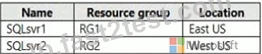
The subscription contains the storage accounts shown in the following table.
You create the Azure SQL databases shown in the following table.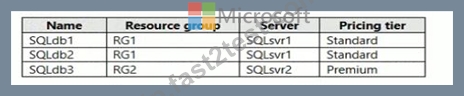
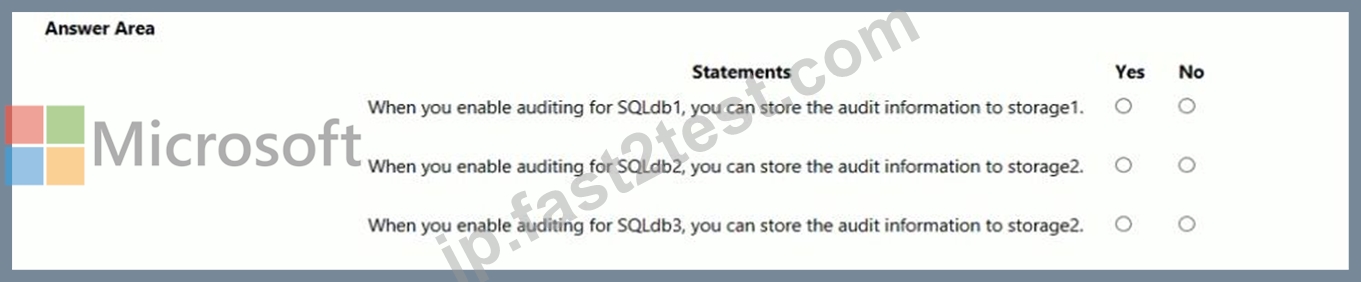
正解:
解説: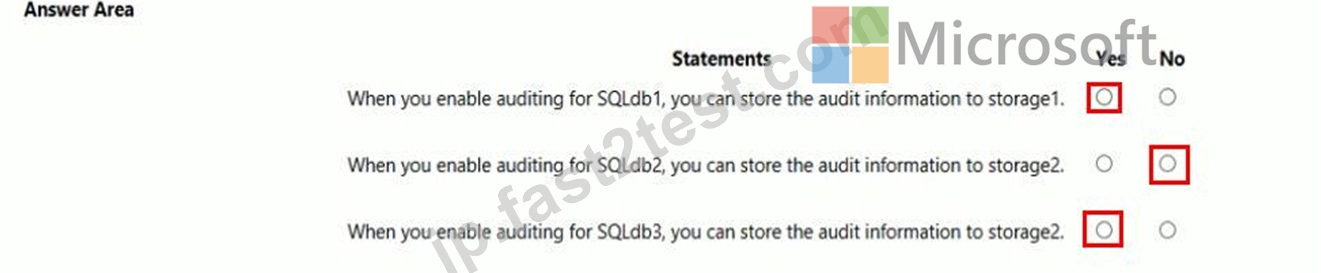
Reference:
https://docs.microsoft.com/en-us/azure/sql-database/sql-database-auditing
https://docs.microsoft.com/en-us/previous-versions/azure/dn741340(v=azure.100)?redirectedfrom=MSDN
質問 14
You have 100 servers that run Windows Server 2012 R2 and host Microsoft SQL Server 2012 R2 instances. The instances host databases that have the following characteristics:
The largest database is currently 3 TB. None of the databases will ever exceed 4 TB.
Stored procedures are implemented by using CLR.
You plan to move all the data from SQL Server to Azure.
You need to recommend an Azure service to host the databases. The solution must meet the following requirements:
Whenever possible, minimize management overhead for the migrated databases.
Minimize the number of database changes required to facilitate the migration.
Ensure that users can authenticate by using their Active Directory credentials.
What should you include in the recommendation?
- A. SQL Server 2016 on Azure virtual machines
- B. Azure SQL Database single databases
- C. Azure SQL Database Managed Instance
- D. Azure SQL Database elastic pools
正解: C
解説:
SQL Managed Instance allows existing SQL Server customers to lift and shift their on-premises applications to the cloud with minimal application and database changes. At the same time, SQL Managed Instance preserves all PaaS capabilities (automatic patching and version updates, automated backups, high availability) that drastically reduce management overhead and TCO.
https://docs.microsoft.com/en-us/azure/azure-sql/managed-instance/transact-sql-tsql-differences-sql-server#clr
https://docs.microsoft.com/en-gb/azure/azure-sql/database/transact-sql-tsql-differences-sql-server#transact-sql-syntax-not-supported-in-azure-sql-database Reference:
https://docs.microsoft.com/en-us/azure/sql-database/sql-database-managed-instance
質問 15
You need to recommend a strategy for the web tier of WebApp1. The solution must minimize What should you recommend?
- A. Configure the Scale Up settings for a web app.
- B. Create a runbook that resizes virtual machines automatically to a smaller size outside of business hours.
- C. Configure the Scale Out settings for a web app.
- D. Deploy a virtual machine scale set that scales out on a 75 percent CPU threshold.
正解: B
質問 16
You ate designing a SQL database solution. The solution will include 20 databases that will be 20 GB each and have varying usage patterns. You need to recommend a database platform to host the databases. The solution must meet the following requirements:
* The compute resources allocated to the databases must scale dynamically.
* The solution must meet an SLA of 99.99% uptime.
* The solution must have reserved capacity.
* Compute charges must be minimized.
What should you include in the recommendation?
- A. an elastic pool that contains 20 Azure SQL databases
- B. 20 instances of Azure SQL Database serverless
- C. 20 databases on a Microsoft SQL server that runs on an Azure virtual machine
- D. 20 databases on a Microsoft SQL server that runs on an Azure virtual machine in an availability set
正解: A
解説:
Azure SQL Database elastic pools are a simple, cost-effective solution for managing and scaling multiple databases that have varying and unpredictable usage demands. The databases in an elastic pool are on a single server and share a set number of resources at a set price. Elastic pools in Azure SQL Database enable SaaS developers to optimize the price performance for a group of databases within a prescribed budget while delivering performance elasticity for each database.
Guaranteed 99.995 percent uptime for SQL Database
Reference:
https://docs.microsoft.com/en-us/azure/azure-sql/database/elastic-pool-overview
https://azure.microsoft.com/en-us/pricing/details/sql-database/elastic/
https://www.azure.cn/en-us/support/sla/virtual-machines/
https://techcommunity.microsoft.com/t5/azure-sql/optimize-price-performance-with-compute-auto-scaling-in-azure/ba-p/966149
質問 17
You have the Azure resources shown in the following table.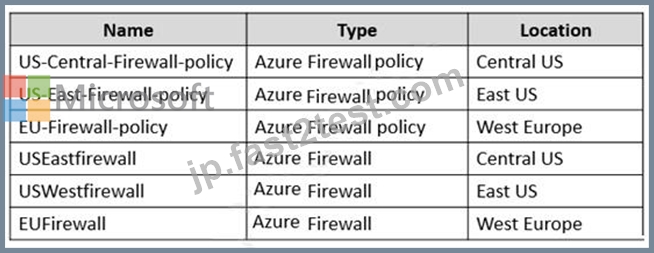
You need to deploy a new Azure Firewall policy that will contain mandatory rules for all Azure Firewall deployments. The new policy will be configured as a parent policy for the existing policies.
What is the minimum number of additional Azure Firewall policies you should create?
- A. 0
- B. 1
- C. 2
- D. 3
正解: A
解説:
Firewall policies work across regions and subscriptions.
Place all your global configurations in the parent policy.
Note: Policies can be created in a hierarchy. You can create a parent/global policy that will contain configurations and rules that will apply to all/a number of firewall instances. Then you create a child policy that inherits from the parent; note that rules changes in the parent instantly appear in the child. The child is associated with a firewall and applies configurations/rules from the parent policy and the child policy instantly to the firewall.
Reference:
https://aidanfinn.com/?p=22006
質問 18
Note: This question is part of a series of questions that present the same scenario. Each question in the series contains a unique solution that might meet the stated goals. Some question sets might have more than one correct solution, while others might not have a correct solution.
After you answer a question in this section, you will NOT be able to return to it. As a result, these questions will not appear in the review screen.
Your company has deployed several virtual machines (VMs) on-premises and to Azure. Azure ExpressRoute has been deployed and configured for on-premises to Azure connectivity.
Several VMs are exhibiting network connectivity issues.
You need to analyze the network traffic to determine whether packets are being allowed or denied to the VMs.
Solution: Use Azure Network Watcher to run IP flow verify to analyze the network traffic Does the solution meet the goal?
- A. No
- B. Yes
正解: B
解説:
The Network Watcher Network performance monitor is a cloud-based hybrid network monitoring solution that helps you monitor network performance between various points in your network infrastructure. It also helps you monitor network connectivity to service and application endpoints and monitor the performance of Azure ExpressRoute.
Note:
IP flow verify checks if a packet is allowed or denied to or from a virtual machine. The information consists of direction, protocol, local IP, remote IP, local port, and remote port. If the packet is denied by a security group, the name of the rule that denied the packet is returned. While any source or destination IP can be chosen, IP flow verify helps administrators quickly diagnose connectivity issues from or to the internet and from or to the on-premises environment.
IP flow verify looks at the rules for all Network Security Groups (NSGs) applied to the network interface, such as a subnet or virtual machine NIC. Traffic flow is then verified based on the configured settings to or from that network interface. IP flow verify is useful in confirming if a rule in a Network Security Group is blocking ingress or egress traffic to or from a virtual machine.
Reference:
https://docs.microsoft.com/en-us/azure/network-watcher/network-watcher-monitoring-overview
https://docs.microsoft.com/en-us/azure/network-watcher/network-watcher-ip-flow-verify-overview
質問 19
How should the migrated databases DB1 and DB2 be implemented in Azure?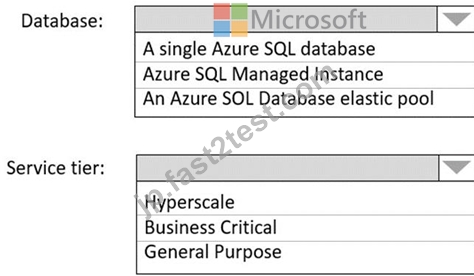
正解:
解説: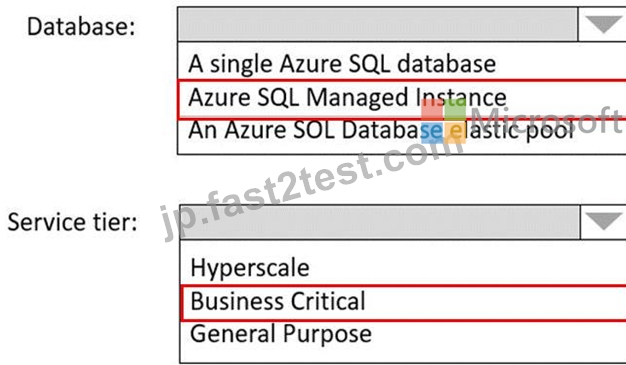
Reference:
https://docs.microsoft.com/en-us/azure/azure-sql/database/auto-failover-group-overview
https://docs.microsoft.com/en-us/azure/azure-sql/managed-instance/sql-managed-instance-paas-overview
質問 20
Your company has an app named App1 that uses data from the on-premises Microsoft SQL Server databases shown in the following table.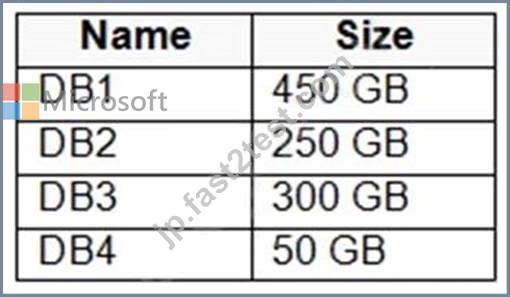
App1 and the data are used on the first day of the month only. The data is not expected to grow more than 3% each year.
The company is rewriting App1 as an Azure web app and plans to migrate all the data to Azure.
You need to migrate the data to Azure SQL Database. The solution must minimize costs.
Which service tier should you use?
- A. DTU-based Standard
- B. vCore-based General Purpose
- C. vCore-based Business Critical
- D. DTU-based Basic
正解: A
解説:
DTU-based Standard supports databases up to 1 TB in size.
Reference:
https://docs.microsoft.com/en-us/azure/azure-sql/database/service-tiers-dtu
質問 21
You need to design a storage solution for an app that will store large amounts of frequently used dat a. The solution must meet the following requirements:
Maximize data throughput.
Prevent the modification of data for one year.
Minimize latency for read and write operations.
Which Azure Storage account type and storage service should you recommend? To answer, select the appropriate options in the answer area.
NOTE: Each correct selection is worth one point.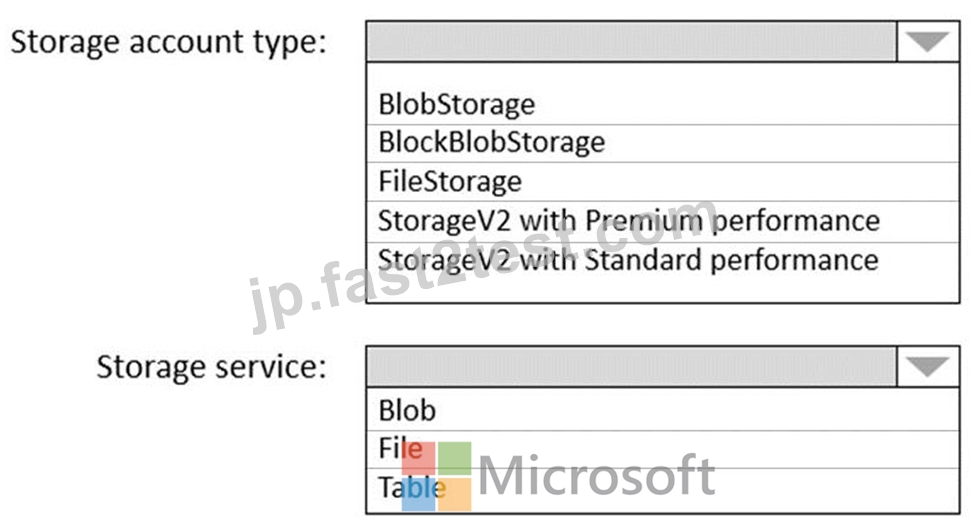
正解:
解説: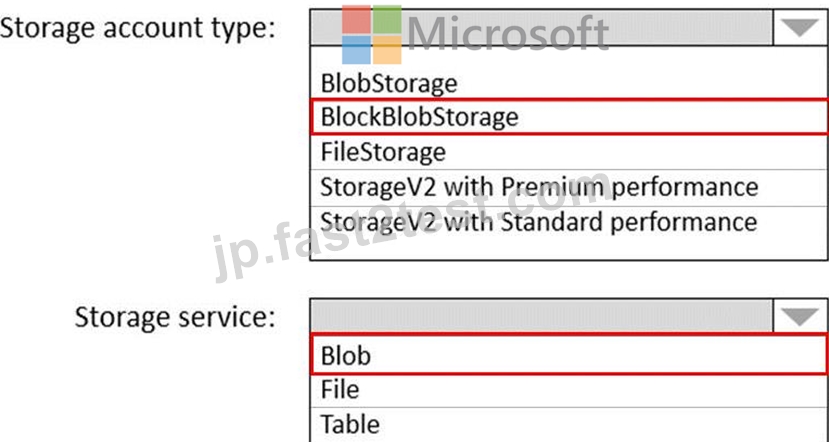
Reference:
https://docs.microsoft.com/en-us/azure/storage/blobs/archive-blob
質問 22
You design a solution for the web tier of WebApp1 as shown in the exhibit.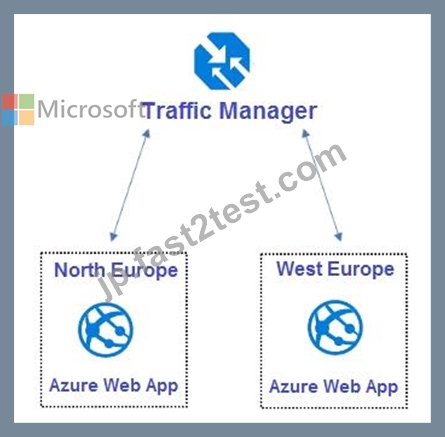
For each of the following statements, select Yes if the statement is true. Otherwise, select No.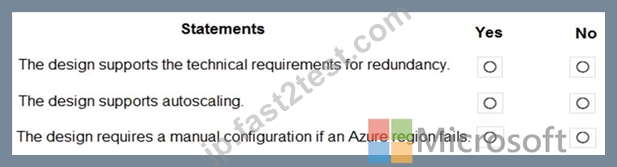
正解:
解説: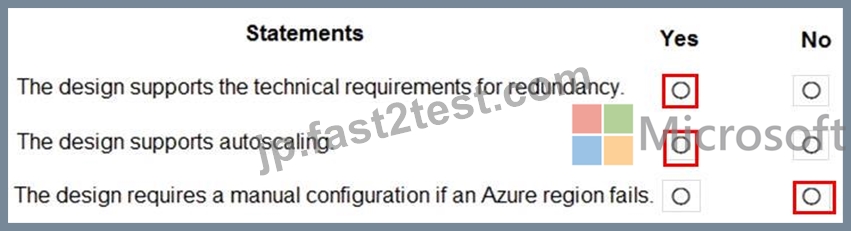
Reference:
https://docs.microsoft.com/en-us/azure/traffic-manager/traffic-manager-overview
https://blogs.msdn.microsoft.com/hsirtl/2017/07/03/autoscaling-azure-web-apps/
質問 23
You are planning an Azure IoT Hub solution that will include 50,000 IoT devices.
Each device will stream data, including temperature, device ID, and time dat a. Approximately 50,000 records will be written every second. The data will be visualized in near real time.
You need to recommend a service to store and query the data.
Which two services can you recommend? Each correct answer presents a complete solution.
NOTE: Each correct selection is worth one point.
- A. Azure Event Grid
- B. Azure Table Storage
- C. Azure Cosmos DB SQL API
- D. Azure Time Series Insights
正解: C,D
解説:
D: Time Series Insights is a fully managed service for time series data. In this architecture, Time Series Insights performs the roles of stream processing, data store, and analytics and reporting. It accepts streaming data from either IoT Hub or Event Hubs and stores, processes, analyzes, and displays the data in near real time.
C: The processed data is stored in an analytical data store, such as Azure Data Explorer, HBase, Azure Cosmos DB, Azure Data Lake, or Blob Storage.
Reference:
https://docs.microsoft.com/en-us/azure/architecture/data-guide/scenarios/time-series
質問 24
You plan to migrate App1 to Azure. The solution must meet the authentication and authorization requirements.
Which type of endpoint should App1 use to obtain an access token?
- A. Azure Service Management
- B. Azure Instance Metadata Service (IMDS)
- C. Microsoft identity platform
- D. Azure AD
正解: C
解説:
Scenario: To access the resources in Azure, App1 must use the managed identity of the virtual machines that will host the app.
Managed identities provide an identity for applications to use when connecting to resources that support Azure Active Directory (Azure AD) authentication. Applications may use the managed identity to obtain Azure AD tokens.
Reference:
https://docs.microsoft.com/en-us/azure/active-directory/managed-identities-azure-resources/overview
質問 25
You need to recommend a solution that meets the data requirements for App1.
What should you recommend deploying to each availability zone that contains an instance of App1?
正解:
解説:
Scenario: App1 has the following data requirements:
Each instance will write data to a data store in the same availability zone as the instance.
Data written by any App1 instance must be visible to all App1 instances.
Azure Cosmos DB: Each partition across all the regions is replicated. Each region contains all the data partitions of an Azure Cosmos container and can serve reads as well as serve writes when multi-region writes is enabled.
Reference:
https://docs.microsoft.com/en-us/azure/cosmos-db/high-availability
質問 26
Your on-premises network contains a server named Server1 that runs an ASP.NET application named App1.
You have a hybrid deployment of Azure Active Directory (Azure AD).
You need to recommend a solution to ensure that users sign in by using their Azure AD account and Azure Multi-Factor Authentication (MFA) when they connect to App1 from the internet.
Which three Azure services should you recommend be deployed and configured in sequence? To answer, move the appropriate services from the list of services to the answer area and arrange them in the correct order.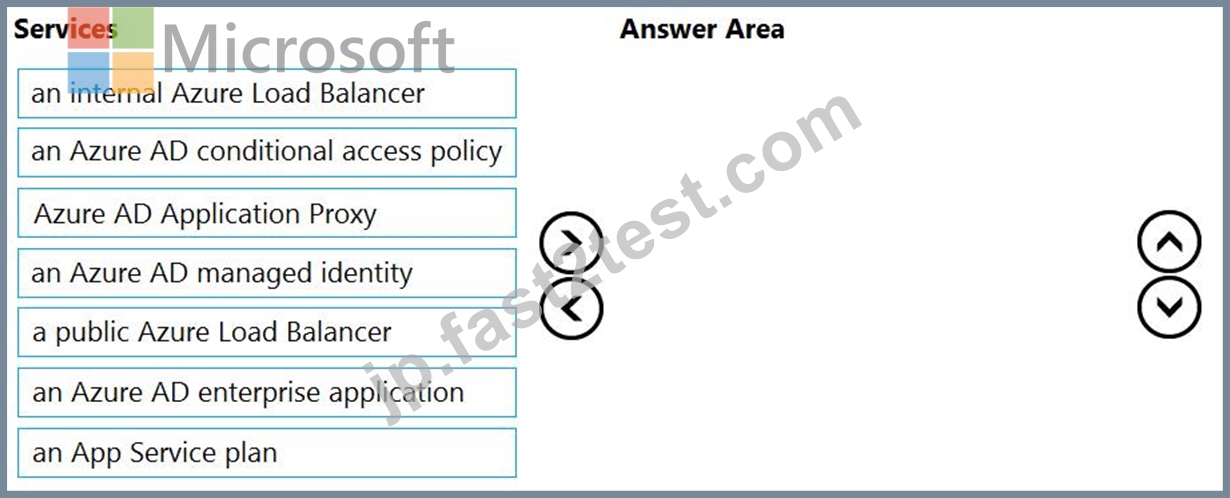
正解:
解説: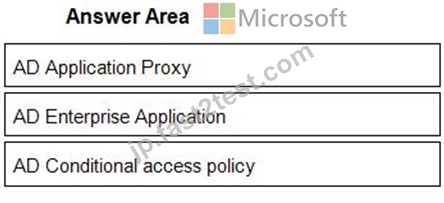
1 - AD Application Proxy
2 - AD Enterprise Application
3 - AD Conditional access policy
質問 27
You plan to create an Azure Storage account that will host file shares. The shares will be accessed from on-premises applications that are transaction-intensive.
You need to recommend a solution to minimize latency when accessing the file shares. The solution must provide the highest-level of resiliency for the selected storage tier.
What should you include in the recommendation? To answer, select the appropriate options in the answer area.
NOTE: Each correct selection is worth one point.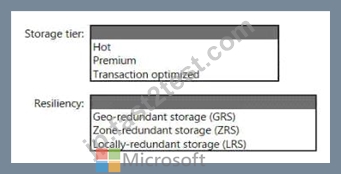
正解:
解説: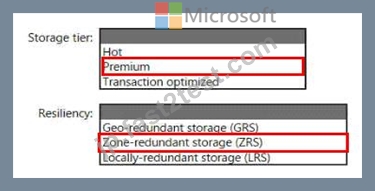
Reference:
https://docs.microsoft.com/en-us/azure/storage/files/storage-files-planning
質問 28
You migrate App1 to Azure.
You need to ensure that the data storage for App1 meets the security and compliance requirement What should you do?
- A. Modify the access level of the blob service.
- B. Implement Azure resource locks.
- C. Create an access policy for the blob
- D. Create Azure RBAC assignments.
正解: B
解説:
Scenario: Once App1 is migrated to Azure, you must ensure that new data can be written to the app, and the modification of new and existing data is prevented for a period of three years.
As an administrator, you can lock a subscription, resource group, or resource to prevent other users in your organization from accidentally deleting or modifying critical resources. The lock overrides any permissions the user might have.
Reference:
https://docs.microsoft.com/en-us/azure/azure-resource-manager/management/lock-resources
質問 29
Note: This question is part of a series of questions that present the same scenario. Each question in the series contains a unique solution that might meet the stated goals. Some question sets might have more than one correct solution, while others might not have a correct solution.
After you answer a question in this section, you will NOT be able to return to it. As a result, these questions will not appear in the review screen.
Your company plans to deploy various Azure App Service instances that will use Azure SQL databases. The App Service instances will be deployed at the same time as the Azure SQL databases.
The company has a regulatory requirement to deploy the App Service instances only to specific Azure regions. The resources for the App Service instances must reside in the same region.
You need to recommend a solution to meet the regulatory requirement.
Solution: You recommend using an Azure policy initiative to enforce the location.
Does this meet the goal?
- A. No
- B. Yes
正解: B
解説:
Azure Resource Policy Definitions can be used which can be applied to a specific Resource Group with the App Service instances.
Reference:
https://docs.microsoft.com/en-us/azure/governance/policy/overview
質問 30
You are designing a large Azure environment that will contain many subscriptions.
You plan to use Azure Policy as part of a governance solution.
To which three scopes can you assign Azure Policy definitions? Each correct answer presents a complete solution.
NOTE: Each correct selection is worth one point.
- A. resource groups
- B. Azure Active Directory (Azure AD) tenants
- C. Azure Active Directory (Azure AD) administrative units
- D. management groups
- E. compute resources
- F. subscriptions
正解: A,D,F
解説:
Azure Policy evaluates resources in Azure by comparing the properties of those resources to business rules.
Once your business rules have been formed, the policy definition or initiative is assigned to any scope of resources that Azure supports, such as management groups, subscriptions, resource groups, or individual resources.
Reference:
https://docs.microsoft.com/en-us/azure/governance/policy/overview
質問 31
You are designing an application that will aggregate content for users.
You need to recommend a database solution for the application. The solution must meet the following requirements:
Support SQL commands.
Support multi-master writes.
Guarantee low latency read operations.
What should you include in the recommendation?
- A. Azure SQL Database that uses active geo-replication
- B. Azure SQL Database Hyperscale
- C. Azure Database for PostgreSQL
- D. Azure Cosmos DB SQL API
正解: D
解説:
With Cosmos DB's novel multi-region (multi-master) writes replication protocol, every region supports both writes and reads. The multi-region writes capability also enables:
Unlimited elastic write and read scalability.
99.999% read and write availability all around the world.
Guaranteed reads and writes served in less than 10 milliseconds at the 99th percentile.
Reference:
https://docs.microsoft.com/en-us/azure/cosmos-db/distribute-data-globally
質問 32
You need to implement the Azure RBAC role assignments for the Network Contributor role. The solution must meet the authentication and authorization requirements.
What is the minimum number of assignments that you must use?
- A. 0
- B. 1
- C. 2
- D. 3
- E. 4
正解: C
解説:
Scenario: The Network Contributor built-in RBAC role must be used to grant permissions to the network administrators for all the virtual networks in all the Azure subscriptions.
RBAC roles must be applied at the highest level possible.
Overview:
Topic 1, Litware, Inc
Overview. General Overview
Litware, Inc. is a medium-sized finance company.
Overview. Physical Locations
Litware has a main office in Boston.
Existing Environment
Identity Environment
The network contains an Active Directory forest named Litware.com that is linked to an Azure Active Directory (Azure AD) tenant named Litware.com. All users have Azure Active Directory Premium P2 licenses.
Litware has a second Azure AD tenant named dev.Litware.com that is used as a development environment.
The Litware.com tenant has a conditional access policy named capolicy1. Capolicy1 requires that when users manage the Azure subscription for a production environment by using the Azure portal, they must connect from a hybrid Azure AD-joined device.
Existing Environment. Azure Environment
Litware has 10 Azure subscriptions that are linked to the Litware.com tenant and five Azure subscriptions that are linked to the dev.Litware.com tenant. All the subscriptions are in an Enterprise Agreement (EA).
The Litware.com tenant contains a custom Azure role-based access control (Azure RBAC) role named Role1 that grants the DataActions read permission to the blobs and files in Azure Storage.
Existing Environment. On-premises Environment
The on-premises network of Litware contains the resources shown in the following table.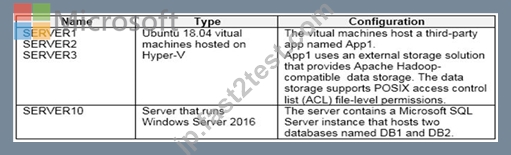
Existing Environment. Network Environment
Litware has ExpressRoute connectivity to Azure.
Planned Changes and Requirements. Planned Changes
Litware plans to implement the following changes:
Migrate DB1 and DB2 to Azure.
Migrate App1 to Azure virtual machines.
Deploy the Azure virtual machines that will host App1 to Azure dedicated hosts.
Planned Changes and Requirements. Authentication and Authorization Requirements Litware identifies the following authentication and authorization requirements:
Users that manage the production environment by using the Azure portal must connect from a hybrid Azure AD-joined device and authenticate by using Azure Multi-Factor Authentication (MFA).
The Network Contributor built-in RBAC role must be used to grant permission to all the virtual networks in all the Azure subscriptions.
To access the resources in Azure, App1 must use the managed identity of the virtual machines that will host the app.
Role1 must be used to assign permissions to the storage accounts of all the Azure subscriptions.
RBAC roles must be applied at the highest level possible.
Planned Changes and Requirements. Resiliency Requirements
Litware identifies the following resiliency requirements:
Once migrated to Azure, DB1 and DB2 must meet the following requirements:
- Maintain availability if two availability zones in the local Azure region fail.
- Fail over automatically.
- Minimize I/O latency.
App1 must meet the following requirements:
- Be hosted in an Azure region that supports availability zones.
- Be hosted on Azure virtual machines that support automatic scaling.
- Maintain availability if two availability zones in the local Azure region fail.
Planned Changes and Requirements. Security and Compliance Requirements
Litware identifies the following security and compliance requirements:
Once App1 is migrated to Azure, you must ensure that new data can be written to the app, and the modification of new and existing data is prevented for a period of three years.
On-premises users and services must be able to access the Azure Storage account that will host the data in App1.
Access to the public endpoint of the Azure Storage account that will host the App1 data must be prevented.
All Azure SQL databases in the production environment must have Transparent Data Encryption (TDE) enabled.
App1 must not share physical hardware with other workloads.
Planned Changes and Requirements. Business Requirements
Litware identifies the following business requirements:
Minimize administrative effort.
Minimize costs.
質問 33
......
AZ-305問題集最新の練習テストと80独特な解答:https://jp.fast2test.com/AZ-305-premium-file.html
最新Microsoft Azure Solutions Architect Expert AZ-305実際の無料試験解答:https://drive.google.com/open?id=1FLMdbviXaIb84_BjTp39YiZtmk67JzHd