

[2022年01月]更新のF5 301bテストエンジンとPDFで完全版無料問題集を無料提供
最新版を今すぐ試そう301b認定有効な試験問題集
F5 301b 認定試験の出題範囲:
| トピック | 出題範囲 |
|---|---|
| トピック 1 |
|
| トピック 2 |
|
| トピック 3 |
|
| トピック 4 |
|
| トピック 5 |
|
| トピック 6 |
|
| トピック 7 |
|
質問 28
Given the iRule:
when HTTP_REQUEST { if {([HTTP::username] ne "") and ([HTTP::password] ne "") } { log local0. "client ip [IP::remote_addr] credentials provided [HTTP::username] [HTTP::password]"} else { pool old_application_pool }
} The associated virtual server has a default pool named new_application_pool.
Which functionality does the iRule provide?
- A. Allows clients with credentials to access the old_application_pool and logs the access of clients without credentials to the new_application_pool.
- B. Allows clients without credentials to access the old_application_pool and logs the attempted access of clients without credentials to the new_application_pool.
- C. Allows clients without credentials to access the old_application_pool and logs the access of clients with credentials to the new_application_pool.
- D. Allows clients with credentials to access the old_application_pool and logs the attempted access of clients with credentials to the new_application_pool.
正解: C
質問 29
-- Exhibit -
-- Exhibit -
Refer to the exhibit.
A user is unable to access a secure application via a virtual server.
What is the cause of the issue?
- A. The client and server CANNOT agree on a common cipher.
- B. The virtual server does NOT have a client SSL profile configured.
- C. The virtual server does NOT have a pool configured.
- D. The client authentication failed.
正解: D
質問 30
-- Exhibit-
-- Exhibit -
Refer to the exhibits.
An LTM Specialist uses the information in the logs to determine the cause of a failover event in a high-availability (HA) pair.
What caused the failover?
- A. The configuration reload request caused the config to reload and the device to failover.
- B. The process bcm56xxd received SIGTERM from the watchdog process.
- C. The overdog process crashed.
- D. The system was administratively rebooted.
正解: D
質問 31
An LTM Specialist is tasked with ensuring that the syslogs for the LTM device are sent to a remote syslog server.
The following is an extract from the config file detailing the node and monitor that the LTM device is using for the
remote syslog server:
monitor Syslog_15002 { defaults from udp dest *:15002
}
node 91.223.45.231 { monitor Syslog_15002
screen RemoteSYSLOG }
There seem to be problems communicating with the remote syslog server. However, the pool monitor shows that the remote server is up.
The network department has confirmed that there are no firewall rules or networking issues preventing the LTM device from
communicating with the syslog server. The department responsible for the remote syslog server indicates that there may
be problems with the syslog server. The LTM Specialist checks the BIG-IP LTM logs for errors relating to the remote syslog
server. None are found. The LTM Specialist does a tcpdump:
tcpdump -nn port 15002, with the following results: 21:28:36.395543 IP 192.168.100.100.44772 > 91.223.45.231.15002: UDP, length 19 21:28:36.429073 IP 192.168.100.100.39499 > 91.223.45.231.15002: UDP, length 169 21:28:36.430714 IP 192.168.100.100.39499 > 91.223.45.231.15002: UDP, length 181 21:28:36.840524 IP 192.168.100.100.39499 > 91.223.45.231.15002: UDP, length 169 21:28:36.846547 IP 192.168.100.100.39499 > 91.223.45.231.15002: UDP, length 181 21:28:39.886343 IP 192.168.100.100.39499 > 91.223.45.231.15002: UDP, length 144
NotE. 192.168.100.100 is the self IP of the LTM device.
Why are there no errors for the remote syslog server in the log files?
- A. When the remote syslog sever fails, it returns to service before the timeout for the monitor has expired.
- B. The "verbose" logging option needs to be enabled for the pool.
- C. The monitor type used is inappropriate.
- D. The -log option for tcpdump needs to be used.
正解: C
質問 32
-- Exhibit -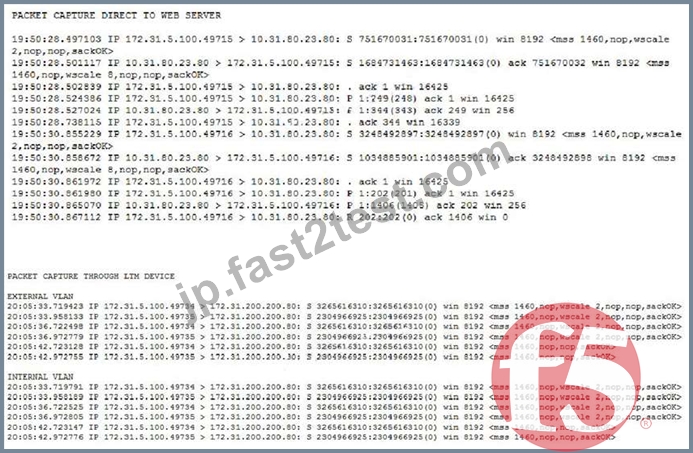
-- Exhibit -
Refer to the exhibits.
Users are able to access the application when connecting directly to the web server but are unsuccessful when connecting to the virtual server. Return traffic bypasses the LTM device using Layer 2 nPath routing.
Which configuration change resolves this problem?
- A. Configure a route on the web server to the client subnet.
- B. Configure the virtual server to listen on port 80 on the LTM device.
- C. Disable address translation on the LTM device.
- D. Enable a SNAT pool on the LTM device.
- E. Configure the VIP address on the loopback interface of the web server.
正解: E
質問 33
-- Exhibit - -- Exhibit -
Refer to the exhibit.
Based on the output of the tmsh interface show command, what is the issue?
- A. Interfaces 2.1 and 2.2 are defective and need replacement.
- B. There are too many drops on inbound traffic on interface 1.1.
- C. There is a duplex mismatch on the management interface.
- D. Flow Control is NOT configured on the management interface.
正解: C
質問 34
-- Exhibit -
-- Exhibit -
Refer to the exhibit.
An LTM Specialist is troubleshooting an issue with SSL and is receiving the error shown when connecting to the virtual server. When connecting directly to the pool member, clients do NOT receive this message, and the application functions correctly. The LTM Specialist exports the appropriate certificate and key from the pool member and imports them into the LTM device. The LTM Specialist then creates the Client SSL profile and associates it with the virtual server.
What is the issue?
- A. The SSL certificate and key do NOT match.
- B. The client CANNOT verify the certification path.
- C. The SSL certificate and key have expired.
- D. The common name on the SSL certificate does NOT match the hostname of the site.
正解: B
質問 35
-- Exhibit -
-- Exhibit --
Refer to the exhibit.
A user is unable to access an HTTP application via a virtual server.
What is the cause of the failure?
- A. The virtual server is in the disabled state.
- B. The Connection: Keep-Alive header is set.
- C. The host header requires a host name.
- D. There is no pool member available to service the request.
正解: D
質問 36
An LTM Specialist is troubleshooting an issue with a new virtual server. When connecting through the virtual server, clients receive the message "Unable to connect" in the browser, although connections directly to the pool member show the application is functioning correctly. The LTM configuration is:
ltm virtual /Common/vs_https {
destination /Common/10.10.1.110:443
ip-protocol udp
mask 255.255.255.255
pool /Common/pool_https
profiles {
/Common/udp { }
}
translate-address enabled
translate-port enabled
vlans-disabled
}
ltm pool /Common/pool_https {
members {
/Common/172.16.20.1:443 {
address 172.16.20.1
}
}
}
How should the LTM Specialist resolve this issue?
- A. Select the correct protocol for the virtual server.
- B. Enable the pool member on the correct VLAN.
- C. Add an HTTP profile to the virtual server.
- D. Remove an HTTP monitor from the pool.
正解: A
質問 37
An LTM HTTP pool has an associated monitor that sends a string equal to 'GET /test.html'.
Which two configurations could an LTM Specialist implement to allow server administrators to disable their pool member servers without logging into the LTM device? (Choose two.)
- A. Set 'disable pool member' equal to 'SERVER UP' and ask the server team to set string 'SERVER DOWN' in test.html.
- B. Set 'alias' equal to 'SERVER DOWN' and ask the server team to set string 'SERVER DOWN' in test.html.
- C. Set 'receive string' equal to 'SERVER UP and ask the server team to set string 'SERVER DOWN' in test.html.
- D. Set 'receive disable string' equal to 'SERVER DOWN' and ask the server team to set string 'SERVER DOWN' in test.html.
- E. Set monitor to transparent and ask the server team to set string 'TRANSPARENT' in test.html.
正解: C,D
質問 38
An LTM Specialist is troubleshooting an issue with a new virtual server. When connecting through the virtual server, clients receive the message "Unable to connect" in the browser, although connections directly to the pool member show the application is functioning correctly. The LTM configuration is:
ltm virtual /Common/vs_https { destination /Common/10.10.1.110:443 ip-protocol udp mask 255.255.255.255 pool /Common/pool_https profiles { /Common/udp { } } translate-address enabled translate-port enabled vlans-disabled }
ltm pool /Common/pool_https { members { /Common/172.16.20.1:443 { address 172.16.20.1 } } }
How should the LTM Specialist resolve this issue?
- A. Select the correct protocol for the virtual server.
- B. Enable the pool member on the correct VLAN.
- C. Add an HTTP profile to the virtual server.
- D. Remove an HTTP monitor from the pool.
正解: A
質問 39
An F5 LTM Specialist needs to perform an LTM device configuration backup prior to RMA swap.
Which command should be executed on the command line interface to create a backup?
- A. tmsh save /sys ucs /var/tmp/backup.ucs
- B. tmsh save /sys config /var/tmp/backup.ucs
- C. tmsh save /sys config ucs /var/tmp/backup.ucs
- D. bigpipe config save /var/tmp/backup.ucs
正解: A
質問 40
Which procedure should an LTM Specialist follow to move a configuration from a 1500 to a 1600 hardware platform during an upgrade?
- A. tmsh save sys config file filename.scf copy the file from the /var/local/scf directory from one device to the other tmsh load sys config file filename.scf
- B. tmsh save sys config file filename.scf copy the file from the /var/local/ucs directory from one device to the other tmsh load sys config file filename.scf
- C. tmsh save sys backup file filename.scf copy the file from the /var/local/ucs directory from one device to the other tmsh load sys backup file filename.scf
- D. tmsh save sys backup file filename.scf copy the file from the /var/local/scf directory from one device to the other tmsh load sys backup file filename.scf
正解: A
質問 41
-- Exhibit -
-- Exhibit --
Refer to the exhibit.
An LTM Specialist is troubleshooting a virtual server. Both the virtual server and the pool are showing blue squares for their statuses, and new clients report receiving "The connection was reset" through their browsers. Connections directly to the pool member are successful.
What is the issue?
- A. The pool member is disabled.
- B. The HTTP profile has incorrect settings.
- C. The virtual server is disabled on all VLANs.
- D. The node is marked as disabled.
正解: D
質問 42
-- Exhibit -
-- Exhibit --
Refer to the exhibit.
A client attempts to connect from a Google Chrome browser to a virtual server on a BIG-IP LTM. The virtual server is SSL Offloaded. When the client connects, the client receives an SSL error. The client receives the same errors when trying Mozilla Firefox and Internet Explorer browsers.
The LTM Specialist does an ssldump on the virtual server and receives the results as per the exhibit.
How should this be resolved?
- A. Select the appropriate "SSL Profile (Client)" in the virtual server settings.
- B. Adjust the SSL key length in the SSL profile to match the minimum required by the client.
- C. Upgrade the client to support the appropriate SSL cipher suite.
- D. Set the virtual server to listen on port 443 (HTTPS).
正解: A
質問 43
Which iRule will reject any connection originating from a 10.0.0.0/8 network?
- A. when CLIENT_ACCEPTED {
set remote_ip [IP::addr [IP::client_addr] mask 255.0.0.0]
switch $remote_ip {
"10.0.0.0" { reject }
"11.0.0.0" { pool pool_http1}
default { pool http_pool }
}
} - B. when CLIENT_ACCEPTED {
set remote_ip [IP::addr [IP::remote_addr] mask 8]
switch $remote_ip {
"10.0.0.0" { reject }
"11.0.0.0" { pool pool_http1}
default { pool http_pool }
}
} - C. when CLIENT_ACCEPTED {
set remote_ip [IP::addr [IP::local_addr] mask 255.0.0.0]
switch $remote_ip {
"10.0.0.0" { reject }
"11.0.0.0" { pool pool_http1}
default { pool http_pool }
}
} - D. when CLIENT_ACCEPTED {
set remote_ip [IP::addr [IP::local_addr] mask 8]
switch $remote_ip {
"10.0.0.0" { reject }
"11.0.0.0" { pool pool_http1}
default { pool http_pool }
}
}
正解: A
質問 44
-- Exhibit-
-- Exhibit --
Refer to the exhibit.
An LTM Specialist is reviewing the virtual server configuration on an LTM device.
Which two actions should the LTM Specialist perform to minimize the virtual server configuration? (Choose two.)
- A. Remove 'snat automap' from the virtual server.
- B. Combine 'marketing_class' and 'default_class' into one class and update associations on the virtual server.
- C. Combine 'acct_class' and 'marketing_class' into one class and update associations on the virtual server.
- D. Remove the 'http' profile from the virtual server.
- E. Remove the 'default_class' from the virtual server.
正解: C,E
質問 45
-- Exhibit -
-- Exhibit --
Refer to the exhibit.
A client attempts to connect from a Google Chrome browser to a virtual server on a BIG-IP LTM.
The virtual server is SSL Offloaded. When the client connects, the client receives an SSL error.
After trying Mozilla Firefox and Internet Explorer browsers, the client still receives the same errors.
The LTM Specialist does an ssldump on the virtual server and receives the results as per the exhibit.
What is the problem?
- A. The SSL key length is incorrect.
- B. The BIG-IP LTM is NOT serving a certificate.
- C. The client needs to be upgraded to the appropriate cipher-suite.
- D. The BIG-IP LTM is NOT listening on port 443.
正解: B
質問 46
......
100%合格保証付きの素晴らしい301b試験問題PDF:https://jp.fast2test.com/301b-premium-file.html
301b問題集で2022年最新のF5試験問題:https://drive.google.com/open?id=1hUJ29gF4EeXvdky0yw0eq41LHbWYr09i