

100%無料HP ACNSP HPE7-A02問題集PDFお試しサンプル認定ガイドカバー率
PDF試験材料2024年最新の実際に出るHPE7-A02問題集
HPのHPE7-A02試験は、ネットワークセキュリティの認定を取得したいITプロフェッショナル向けに設計されています。この認定は、ネットワークセキュリティの分野でのスキルと知識を検証し、潜在的な脅威から組織のネットワークを保護する能力を示すことができます。
HP HPE7-A02(Aruba Certified Network Security Professional)認定試験は、ネットワークセキュリティに関連する幅広いトピックをカバーする包括的なテストです。この認定は、ネットワークセキュリティの分野で高く評価されており、専門家がキャリアを進め、アルバネットワークセキュリティソリューションの分野での専門知識を実証するのに役立ちます。
質問 # 21
You have set up a mirroring session between an AOS-CX switch and a management station, running Wireshark. You want to capture just the traffic sent in the mirroring session, not the management station's other traffic.
What should you do?
- A. Apply this capture filter: ip proto 47
- B. Edit protocol preferences and enable HPE_ERM.
- C. Apply this capture filter: udp port 5555
- D. Edit protocol preferences and enable ARUBA_ERM.
正解:C
解説:
To capture only the traffic sent in the mirroring session between an AOS-CX switch and a management station running Wireshark, you should apply a capture filter that isolates the specific traffic of interest. In this case, using the filter udp port 5555 will capture the traffic associated withthe mirroring session. This is because AOS-CX switches typically use UDP port 5555 for mirrored traffic, ensuring that only the relevant mirrored packets are captured and excluding other traffic generated by the management station.
質問 # 22
A company has wired VolP phones, which transmit tagged traffic and connect to AOS-CX switches. The company wants to tunnel the phones' traffic to an HPE Aruba Networking gateway for applying security policies.
What is part of the correct configuration on the AOS-CX switches?
- A. A UBT reserved VLAN set to a VLAN dedicated for that purpose
- B. UBT mode set to VLAN extend
- C. A VXLAN VNI mapped to the VLAN assigned to the VolP phones
- D. VLANs assigned to the VolP phones configured on the switch uplinks
正解:A
解説:
To tunnel VoIP phone traffic from AOS-CX switches to an HPE Aruba Networking gateway, you need to configure a User-Based Tunneling (UBT) reserved VLAN on the switches. This VLAN is dedicatedfor tunneling purposes and ensures that the VoIP traffic is correctly identified and tunneled to the gateway where security policies can be applied.
1.UBT Configuration: Setting a UBT reserved VLAN ensures that the switch knows which VLAN to use for tunneling traffic to the gateway.
2.Traffic Tunneling: The reserved VLAN helps in segregating the VoIP traffic, ensuring it is handled securely and according to the configured policies at the gateway.
3.Policy Application: By tunneling the traffic, the gateway can apply advanced security policies to the VoIP traffic.
質問 # 23
You need to create a rule in an HPE Aruba Networking ClearPass Policy Manager (CPPM) role mapping policy that references a ClearPass Device Insight Tag.
Which Type (namespace) should you specify for the rule?
- A. Endpoint
- B. Device
- C. Application
- D. Tips
正解:A
解説:
When creating a rule in an HPE Aruba Networking ClearPass Policy Manager (CPPM) role mapping policy that references a ClearPass Device Insight Tag, you should specify the "Endpoint" Type (namespace) for the rule. This ensures that the policy can properly reference and utilize the tags assigned to endpoints by ClearPass Device Insight for making role mapping decisions.
1.Endpoint Tags: ClearPass Device Insight assigns tags to endpoints based on their characteristics and behaviors. These tags are stored in the "Endpoint" namespace.
2.Role Mapping: By referencing the "Endpoint" type, the rule can accurately match endpoints with the specified tags and apply the appropriate role mappings based on the device's profile.
3.Policy Consistency: Ensuring that the correct namespace is used maintains consistency and accuracy in role assignment policies.
質問 # 24
Assume that an AOS-CX switch is already implementing DHCP snooping and ARP inspection successfully on several VLANs.
What should you do to help minimize disruption time if the switch reboots?
- A. Configure the IP helper address on this switch, rather than a core routing switch.
- B. Create static IP-to-MAC bindings for the DHCP and DNS servers.
- C. Configure the switch to act as an ARP proxy.
- D. Save the IP-to-MAC bindings to external storage.
正解:D
解説:
To minimize disruption time if an AOS-CX switch reboots while implementing DHCP snooping and ARP inspection, you should save the IP-to-MAC bindings to external storage. This ensures that the DHCP snooping and ARP inspection tables, which are crucial for preventing spoofing attacks, are preserved across reboots. When the switch restarts, it can reload these bindings from the external storage, thereby maintaining network security and reducing the downtime associated with rebuilding these tables.
1.Preserving Bindings: Saving IP-to-MAC bindings to external storage ensures that these critical security tables are not lost during a reboot, maintaining network integrity.
2.Security Continuity: This practice helps to quickly restore security features like DHCP snooping and ARP inspection, minimizing the window of vulnerability.
3.Operational Efficiency: By preserving these bindings, the switch can resume normal operations faster, reducing disruption to network services.
質問 # 25
Admins have recently turned on Wireless IDS/IPS infrastructure detection at the high level on HPE Aruba Networking APs. When you check WIDS events, you see several RTS rate and CTS rate anomalies, which were triggered by neighboring APs.
What can you interpret from this event?
- A. These neighboring APs are actually rogue APs, and you should enable wireless de-authentication containment on them.
- B. These neighboring APs might be hackers trying to launch a DoS, but are more likely operating normally; you should start by tuning the event thresholds.
- C. These neighboring APs are likely to be wireless clients that are inappropriately bridging their wired and wireless NICs; you should track down and remove them.
- D. These neighboring APs are actually rogue APs, and you should enable wireless tarpit containment on them.
正解:B
解説:
When Wireless IDS/IPS infrastructure detection reports RTS (Request to Send) and CTS (Clear to Send) rate anomalies triggered by neighboring APs, it is often an indication of unusual, but not necessarily malicious, behavior. These anomalies can be caused by neighboring APs operating normally but under specific conditions that trigger the alerts. Before assuming a security threat, it is recommended to tune the event thresholds to better match the environment and reduce falsepositives. This approach helps to distinguish between normal operations and potential DoS attacks.
質問 # 26
You need to use "Tips:Posture" conditions within an 802.1X service's enforcement policy.
Which guideline should you follow?
- A. Create rules that assign postures in the service's role mapping policy.
- B. Enable profiling in the service's general settings.
- C. Enable caching roles and posture attributes from previous sessions in the service's enforcement settings.
- D. Select the Posture Policy type for the service's enforcement policy.
正解:C
解説:
When using "Tips
" conditions within an 802.1X service's enforcement policy, you should enable caching roles and posture attributes from previous sessions in the service's enforcement settings. This ensures that ClearPass retains posture information from previous authentications, which is necessary for making decisions based on the current posture state of an endpoint. By caching these attributes, ClearPass can apply appropriate enforcement actions based on the device's posture status.
質問 # 27
A company is using HPE Aruba Networking ClearPass Device Insight (CPDI) (the standalone application).
In the CPDI security settings, Security Analysis is On,
the Data Source is ClearPass Devices Insight, and Enable Posture Assessment is On. You see that device has a Risk Score of 90.
What can you know from this information?
- A. The posture is healthy, but CPDI has detected multiple vulnerabilities on the device.
- B. The posture is unhealthy, and CPDI has also detected at least one vulnerability on the device.
- C. The posture is unknown, and CPDI has detected exactly four vulnerabilities on the device.
- D. The posture is unhealthy, but CPDI has not detected any vulnerabilities on the device.
正解:B
解説:
In HPE Aruba Networking ClearPass Device Insight (CPDI), a device with a Risk Score of 90 indicates that the posture is unhealthy, and CPDI has detected at least one vulnerability on the device. The risk score is a reflection of the device's security posture and detected vulnerabilities. A high risk score, such as 90, typically signifies significant security concerns, including the presenceof vulnerabilities that could be exploited, thereby categorizing the device as a high-risk asset within the network.
質問 # 28
A company needs you to integrate HPE Aruba Networking ClearPass Policy Manager (CPPM) with HPE Aruba Networking ClearPass Device Insight (CPDI).
What is one task you should do to prepare?
- A. Install the root CA for CPPM's HTTPS certificate as trusted in the CPDI application.
- B. Enable Insight in the CPPM server configuration settings.
- C. Collect a Data Collector token from HPE Aruba Networking Central.
- D. Configure WMI, SSH, and SNMP external accounts for device scanning on CPPM.
正解:B
解説:
To integrate HPE Aruba Networking ClearPass Policy Manager (CPPM) with HPE Aruba Networking ClearPass Device Insight (CPDI), one of the necessary tasks is to enable Insight in the CPPM server configuration settings. This configuration allows CPPM to communicate and share data with CPDI, facilitating the integration and enabling enhanced device profiling and policy enforcement capabilities.
1.Insight Enablement: Enabling Insight on the CPPM server allows it to leverage the data and capabilities of CPDI, integrating device profiling information into policy decisions.
2.Data Sharing: This integration ensures that CPPM can receive and use detailed device information from CPDI to make more informed policy enforcement decisions.
3.Configuration: Properly configuring the server settings to enable Insight ensures seamless communication and data flow between CPPM and CPDI.
質問 # 29
You are establishing a cluster of HPE Aruba Networking ClearPass servers. (Assume that they are running version 6.9.).
For which type of certificate it is recommended to install a CA-signed certificate on the Subscriber before it joins the cluster?
- A. HTTPS
- B. Database
- C. RADIUS/EAP
- D. RadSec
正解:A
解説:
When establishing a cluster of HPE Aruba Networking ClearPass servers, it is recommended to install a CA-signed certificate for HTTPS on the Subscriber before it joins the cluster. This ensures secure communication between the servers in the cluster and provides a trusted certificate for client connections.
1.HTTPS Security: A CA-signed certificate for HTTPS ensures that all web-based communication to and from the ClearPass server is encrypted and secure.
2.Cluster Communication: Secure communication between ClearPass nodes in the cluster is essential for synchronization and data integrity.
3.Client Trust: Clients accessing the ClearPass server will trust the CA-signed certificate, avoiding security warnings and ensuring smooth operations.
質問 # 30
What is a use case for running periodic subnet scans on devices from HPE Aruba Networking ClearPass Policy Manager (CPPM)?
- A. Using WMI to collect additional information about Windows domain clients
- B. Identifying issues with authenticating and authorizing clients
- C. Detecting devices that fail to comply with rules defined in CPPM posture policies
- D. Using DHCP fingerprints to determine a client's device category and OS
正解:D
解説:
Running periodic subnet scans on devices from HPE Aruba Networking ClearPass Policy Manager (CPPM) can be used to gather DHCP fingerprints, which help determine a client's device category and operating system. DHCP fingerprints are unique patterns in DHCP request packets that provide valuable information about the device type and OS, assisting in device profiling and policy enforcement.
1.DHCP Fingerprinting: This technique captures specific details from DHCP packets to identify the type and operating system of a device.
2.Device Profiling: By running subnet scans, CPPM can continuously update its device database with accurate profiles, ensuring that policies are applied correctly based on the device type.
3.Network Visibility: Regular scanning helps maintain up-to-date visibility of all devices on the network, improving security and management.
質問 # 31 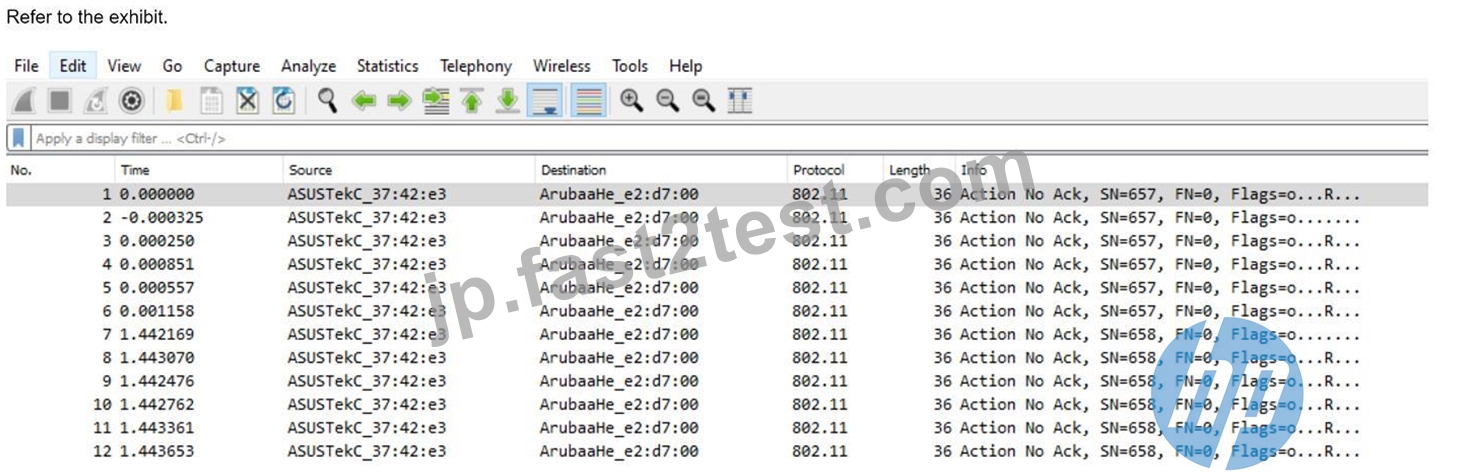
You have downloaded a packet capture that you generated on HPE Aruba Networking Central. When you open the capture in Wireshark, you see the output shown in the exhibit.
What should you do in Wireshark so that you can better interpret the packets?
- A. Edit preferences for IEEE 802.11 and chose to ignore the Protection bit with IV.
- B. Edit the Enabled Protocols and make sure that 802.11, GRE, and Aruba_ERM are enabled.
- C. Choose to decode UDP port 5555 packets as ARUBA_ERM and set the Aruba ERM Type to 0.
- D. Apply the following display filter: wlan.fc.type == 1.
正解:C
解説:
To better interpret the packets shown in the Wireshark capture, you should choose to decode UDP port 5555 packets as ARUBA_ERM and set the Aruba ERM Type to 0. This configuration will allow Wireshark to properly decode and display the Aruba-specific encapsulated remote mirroring (ERM) packets, providing a clearer understanding of the traffic.
1.Decoding Protocols: Selecting the correct protocol decoding in Wireshark ensures that the captured packets are interpreted correctly, displaying the relevant information.
2.Aruba ERM: The packets in the capture are likely encapsulated remote mirroring (ERM) packets specific to Aruba, which require proper decoding settings in Wireshark.
3.Clear Interpretation: By setting the Aruba ERM Type to 0 and decoding the packets as ARUBA_ERM, you can view the encapsulated data accurately.
質問 # 32
You need to set up HPE Aruba Networking ClearPass Policy Manager (CPPM) to provide certificate-based authentication of 802.1X supplicants.
How should you upload the root CA certificate for the supplicants' certificates?
- A. As a Trusted CA with the AD/LDAP usage
- B. As a ClearPass Server certificate with the RADIUS/EAP usage
- C. As a ClearPass Server certificate with the Database usage
- D. As a Trusted CA with the EAP usage
正解:D
解説:
To set up HPE Aruba Networking ClearPass Policy Manager (CPPM) for certificate-based authentication of
802.1X supplicants, you need to upload the root CA certificate as a Trusted CA with the EAP usage. This configuration allows the ClearPass server to validate the certificates presented by the supplicants during the
802.1X authentication process. By marking the certificatefor EAP usage, ClearPass can properly authenticate the supplicant devices using the trusted certificate authority (CA) that issued their certificates.
質問 # 33
A company uses HPE Aruba Networking ClearPass Policy Manager (CPPM) and HPE Aruba Networking ClearPass Device Insight (CPDI) and has integrated the two. CPDI admins have created a tag. CPPM admins have created rules that use that tag in the wired 802.1X and wireless 802.1X services' enforcement policies.
The company requires CPPM to apply the tag-based rules to a client directly after it learns that the client has that tag.
What is one of the settings that you should verify on CPPM?
- A. Both 802.1X services have the "Use cached Role and Posture attributes from the previous sessions" setting.
- B. The "Polling Interval" is set to 1 in the ClearPass Device Insight Integration settings.
- C. The "Device Sync" setting is set to 1 in the ClearPass Device Insight Integration settings.
- D. Both 802.1X services have the "Profile Endpoints" option enabled and an appropriate CoA profile selected in the Profiler tab.
正解:D
解説:
To ensure that HPE Aruba Networking ClearPass Policy Manager (CPPM) applies tag-based rules to a client immediately after learning the client has that tag, verify that both 802.1X services have the "Profile Endpoints" option enabled and an appropriate Change of Authorization (CoA) profile selected in the Profiler tab. This setup ensures that when a device is profiled and tagged, CPPM can immediately enforce the updated policies through CoA.
1.Profile Endpoints: Enabling this option ensures that endpoint profiling is active, allowing CPPM to gather and use device information dynamically.
2.CoA Profile: Selecting an appropriate CoA profile ensures that CPPM can push policy changes immediately to the network devices, applying the new rules without delay.
3.Real-Time Enforcement: This configuration allows for the immediate application of new tags and associated policies, ensuring compliance with security requirements.
質問 # 34 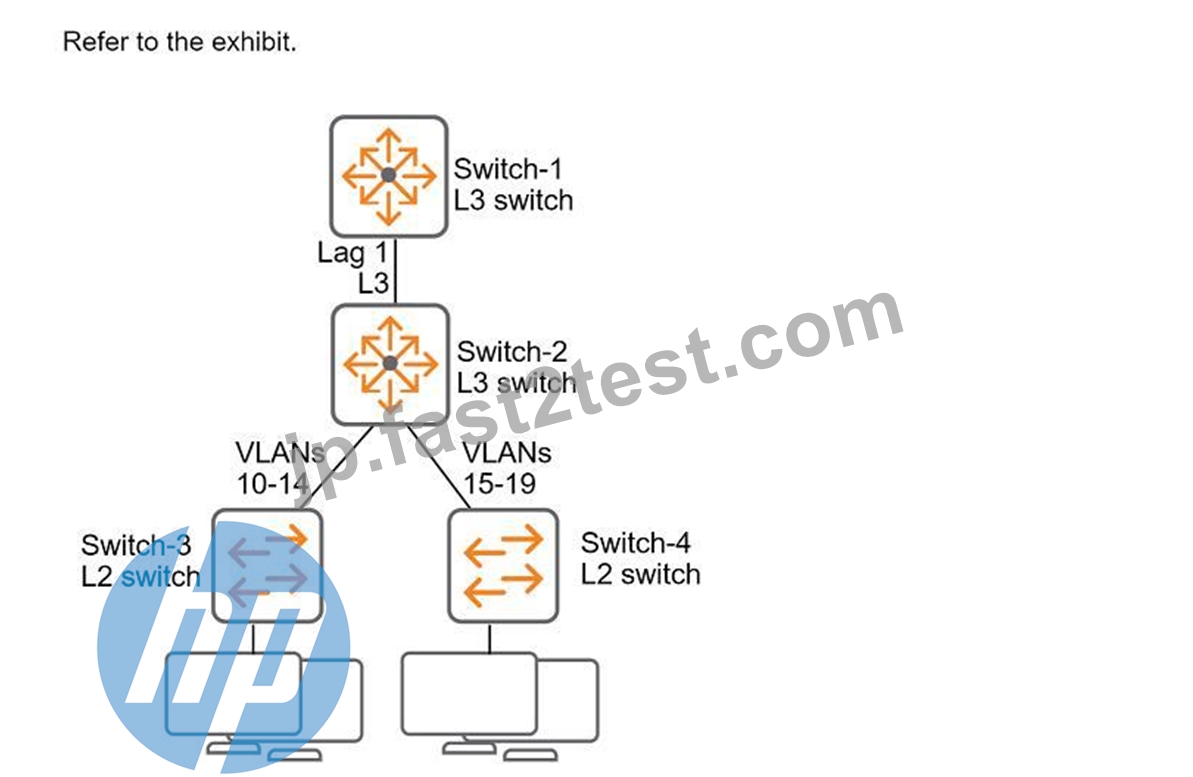
All of the switches in the exhibit are AOS-CX switches.
What is the preferred configuration on Switch-2 for preventing rogue OSPF routers in this network?
- A. Configure passive-interface as the OSPF default and disable OSPF passive on Lag 1.
- B. Disable OSPF entirely on VLANs 10-19.
- C. Configure OSPF authentication on VLANs 10-19 in password mode.
- D. Configure OSPF authentication on Lag 1 in MD5 mode.
正解:D
解説:
To prevent rogue OSPF routers in the network shown in the exhibit, the preferred configuration on Switch-2 is to configure OSPF authentication on Lag 1 in MD5 mode. This setup enhances security by ensuring that only routers with the correct MD5 authentication credentials can participate in the OSPF routing process.
This method protects the OSPF sessions against unauthorized devices that might attempt to introduce rogue routing information into the network.
1.OSPF Authentication: Implementing MD5 authentication on Lag 1 ensures that OSPF updates are secured with a cryptographic hash. This prevents unauthorized OSPF routers from establishing peering sessions and injecting potentially malicious routing information.
2.Secure Communication: MD5 authentication provides a higher level of security compared to simple password authentication, as it uses a more robust hashing algorithm.
3.Applicability: Lag 1 is the primary link between Switch-1 and Switch-2, and securing this link helps protect the integrity of the OSPF routing domain.
質問 # 35
A company lacks visibility into the many different types of user and loT devices deployed in its internal network, making it hard for the security team to address those devices.
Which HPE Aruba Networking solution should you recommend to resolve this issue?
- A. HPE Aruba Networking ClearPass OnBoard
- B. HPE Aruba Networking Mobility Conductor
- C. HPE Aruba Networking ClearPass Device Insight (CPDI)
- D. HPE Aruba Networking Network Analytics Engine (NAE)
正解:C
質問 # 36
A company has AOS-CX switches and HPE Aruba Networking APs, which run AOS-10 and bridge their SSIDs. Company security policies require 802.1X on all edge ports, some of which connect to APs.
How should you configure the auth-mode on AOS-CX switches?
- A. Configure all edge ports in device auth-mode.
- B. Leave all edge ports in device auth-mode and configure client auth-mode in the AP role.
- C. Configure all edge ports in client auth-mode.
- D. Leave all edge ports in client auth-mode and configure device auth-mode in the AP role.
正解:C
解説:
For a company with AOS-CX switches and HPE Aruba Networking APs running AOS-10, where 802.1X authentication is required on all edge ports, you should configure all edge ports in clientauth-mode. This mode ensures that each client connecting through the APs is authenticated individually, maintaining the security policy requirements for 802.1X authentication on all connections.
質問 # 37
A company has HPE Aruba Networking APs (AOS-10), which authenticate clients to HPE Aruba Networking ClearPass Policy Manager (CPPM). CPPM is set up to receive a variety of information about clients' profile and posture. New information can mean that CPPM should change a client's enforcement profile.
What should you set up on the APs to help the solution function correctly?
- A. In the RADIUS server settings for CPPM, enable Dynamic Authorization.
- B. In the WLAN profiles, enable interim RADIUS accounting.
- C. In the security settings, configure dynamic denylisting.
- D. In the RADIUS server settings for CPPM, enable querying the authentication status.
正解:A
解説:
To ensure that HPE Aruba Networking APs (AOS-10) properly interact with HPE Aruba Networking ClearPass Policy Manager (CPPM) and dynamically update a client's enforcement profile based on new profile and posture information, you should enable Dynamic Authorization in the RADIUSserver settings for CPPM. This allows ClearPass to send Change of Authorization (CoA) requests to the APs, prompting them to reapply the appropriate enforcement profiles based on updated information.
1.Dynamic Authorization: Enabling this feature allows ClearPass to dynamically push changes to the APs whenever there is new relevant information about a client's profile or posture.
2.Change of Authorization (CoA): This mechanism ensures that clients are assigned the correct enforcement profiles in real-time, based on the latest data.
3.Enhanced Policy Enforcement: This setup helps in maintaining accurate and up-to-date policy enforcement for clients on the network.
質問 # 38
An AOS-CX switch has been configured to implement UBT to a cluster of three HPE Aruba Networking gateways.
How does the switch determine to which gateways to tunnel UBT users' traffic?
- A. The switch tunnels all users' traffic to the gateway assigned as the switch's active device designated gateway.
- B. The switch load balances client traffic across the primary and standby gateway configured in the UBT zone.
- C. The switch tunnels all users' traffic to the gateway configured as the primary gateway in the UBT zone, unless that gateway fails.
- D. The switch tunnels each user's traffic to the particular gateway assigned as that user's active user designed gateway.
正解:D
解説:
When an AOS-CX switch implements User-Based Tunneling (UBT) to a cluster of three HPE Aruba Networking gateways, the switch determines to which gateway to tunnel each user's traffic based on the particular gateway assigned as that user's active user designated gateway. This ensures that traffic is efficiently distributed and managed according to the designated gateway for each user.
1.User Designated Gateway: Each user's traffic is tunneled to a specific gateway that has been designated for that user, ensuring efficient handling of traffic.
2.Traffic Distribution: This method allows for balanced distribution of user traffic across multiple gateways, enhancing network performance and reliability.
3.Gateway Assignment: The switch uses the assigned gateway for each user to determine the tunneling path, ensuring that traffic is directed to the appropriate gateway.
質問 # 39
......
更新されたのはHP HPE7-A02問題集PDFオンラインエンジン:https://jp.fast2test.com/HPE7-A02-premium-file.html
HPE7-A02.PDFで問題解答PDFサンプル問題信頼され続ける:https://drive.google.com/open?id=1vBSp2s7kKiVwdQ70yigtHJCJZhOW7Ao2