

100%無料CCDAK試験問題集リアルConfluent Certified Developer問題集260解答を掴み取れ!
あなたを余裕でCCDAK試験合格させます!100%試験高合格率保証 [2025]
質問 # 133
I am producing Avro data on my Kafka cluster that is integrated with the Confluent Schema Registry. After a schema change that is incompatible, I know my data will be rejected. Which component will reject the data?
- A. The Kafka Broker
- B. The Confluent Schema Registry
- C. The Kafka Producer itself
- D. Zookeeper
正解:B
解説:
The Confluent Schema Registry is your safeguard against incompatible schema changes and will be the component that ensures no breaking schema evolution will be possible. Kafka Brokers do not look at your payload and your payload schema, and therefore will not reject data
質問 # 134
A consumer starts and has auto.offset.reset=none, and the topic partition currently has data for offsets going from 45 to 2311. The consumer group has committed the offset 10 for the topic before. Where will the consumer read from?
- A. offset 45
- B. offset 2311
- C. it will crash
- D. offset 10
正解:C
解説:
auto.offset.reset=none means that the consumer will crash if the offsets it's recovering from have been deleted from Kafka, which is the case here, as 10 < 45
質問 # 135
What happens when broker.rack configuration is provided in broker configuration in Kafka cluster?
- A. Replicas for a partition are placed in the same rack
- B. Each rack contains all the topics and partitions, effectively making Kafka highly available
- C. You can use the same broker.id as long as they have different broker.rack configuration
- D. Replicas for a partition are spread across different racks
正解:D
解説:
Partitions for newly created topics are assigned in a rack alternating manner, this is the only change broker.rack does
質問 # 136
You have an existing topic t1 with four partitions.
Which statement is correct about changing the number of partitions for this topic?
- A. You may increase the partition count and Kafka will leave the existing data on the original partitions.
- B. You may increase the partition count and Kafka will ensure the message ordering remains the same.
- C. You may decrease the partition count if you change the partitioning algorithm.
- D. You may decrease the partition count if you increase the replication count.
正解:A
質問 # 137
How do you read a table or stream from the beginning of a topic?
- A. id as paymentId
FROM orders o
INNER JOIN payments p WITHIN 1 HOURS ON p.id = o.id
INNER JOIN shipments s WITHIN 2 HOURS ON s.id
= o.id; - B. id as orderId
- C. SET 'auto.offset.reset' = 'latest';
SELECT STRUCT(f1 := v1, f2 := v2) FROM s1 EMIT CHANGES; - D. SET 'auto.offset.reset' = 'earliest';
SELECT STRUCT(f1 := v1, f2 := v2) FROM s1 EMIT CHANGES; - E. id as shipmentId,
- F. CREATE STREAM shipped_orders AS
SELECT - G. SELECT STRUCT(f1 := v1, f2 := v2) FROM s1 EMIT CHANGES;
- H. itemId as itemId,
正解:D
質問 # 138
Match the topic configuration setting with the reason the setting affects topic durability.
(You are given settings like unclean.leader.election.enable=false, replication.factor, min.insync.replicas=2)
正解:
解説:
* unclean.leader.election.enable=false# Prevents data loss by only considering in-sync replicas when rebalancing.
* replication.factor# Specifies how many redundant copies of partitions are distributed across brokers.
* min.insync.replicas=2# Sets the standard for the number of partition instances that must keep up with the latest committed message.
* unclean.leader.election.enable=false ensures that onlyin-sync replicascan be elected as leaders. If disabled, an out-of-sync replica may become leader, potentially leading to data loss.
* replication.factor defineshow many brokerswill maintain copies of each partition, directly impacting durability and availability.
* min.insync.replicas determineshow many replicas must acknowledgea write when acks=all is used, enforcing write durability.
Reference:Apache Kafka Topic Configuration Documentation
質問 # 139
How will you find out all the partitions without a leader?
- A. kafka-topics.sh --zookeeper localhost:2181 --describe --under-replicated-partitions
- B. kafka-topics.sh --zookeeper localhost:2181 --describe --unavailable-partitions
- C. kafka-topics.sh --broker-list localhost:9092 --describe --under-replicated-partitions
- D. kafka-topics.sh --bootstrap-server localhost:2181 --describe --unavailable-partitions
正解:B
解説:
Please note that as of Kafka 2.2, the --zookeeper option is deprecated and you can now usekafka-topics.sh --bootstrap-server localhost:9092 --describe --unavailable-partitions
質問 # 140
There are 3 producers writing to a topic with 5 partitions. There are 5 consumers consuming from the topic. How many Controllers will be present in the cluster?
- A. 0
- B. 1
- C. 2
- D. 3
正解:B
解説:
There is only one controller in a cluster at all times.
質問 # 141
If I want to send binary data through the REST proxy to topic "test_binary", it needs to be base64 encoded. A consumer connecting directly into the Kafka topic
- A. binary data
- B. avro data
- C. base64 encoded data, it will need to decode it
- D. json data
- E. "test_binary" will receive
正解:A
解説:
On the producer side, after receiving base64 data, the REST Proxy will convert it into bytes and then send that bytes payload to Kafka. Therefore consumers reading directly from Kafka will receive binary data.
質問 # 142
Which two statements are correct about transactions in Kafka?
(Select two.)
- A. Consumers can consume both committed and uncommitted transactions.
- B. Transactions are only possible when writing messages to a topic with single partition.
- C. All messages from a failed transaction will be deleted from a Kafka topic.
- D. Information about producers and their transactions is stored in the _transaction_state topic.
- E. Transactions guarantee at least once delivery of messages.
正解:A、D
解説:
Comprehensive and Detailed Explanation From Exact Extract:
* #C. Consumers can consume both committed and uncommitted transactions.By default,Kafka consumers only read committed messagesif they are configured with isolation.level=read_committed.
However, if configured as read_uncommitted, theycan also consume uncommitted (potentially aborted) transactional messages.
From Kafka Documentation:
"The isolation.level setting controls whether the consumer will read only committed messages or all messages, including uncommitted messages from ongoing or aborted transactions."
* #D. Information about producers and their transactions is stored in the _transaction_state topic.
Kafka uses an internal topic named__transaction_stateto maintain metadata about producer transactions. This topic is essential for tracking thetransaction lifecycle, fencing, and recovery.
From Kafka Internals:
"Kafka stores the state of active and completed transactions in an internal topic called __transaction_state."
質問 # 143
Which actions will trigger partition rebalance for a consumer group? (select three)
- A. Add a new consumer to consumer group
- B. Remove a broker from the cluster
- C. A consumer in a consumer group shuts down
- D. Increase partitions of a topic
正解:A、C、D
解説:
Add a broker to the cluster
Explanation:
Rebalance occurs when a new consumer is added, removed or consumer dies or paritions increased.
質問 # 144
A customer has many consumer applications that process messages from a Kafka topic. Each consumer application can only process 50 MB/s. Your customer wants to achieve a target throughput of 1 GB/s. What is the minimum number of partitions will you suggest to the customer for that particular topic?
- A. 0
- B. 1
- C. 2
- D. 3
正解:D
解説:
each consumer can process only 50 MB/s, so we need at least 20 consumers consuming one partition so that 50 * 20 = 1000 MB target is achieved.
質問 # 145
You need to configure a sink connector to write records that fail into a dead letter queue topic.
Requirements:
* Topic name: DLQ-Topic
* Headers containing error context must be added to the messagesWhich three configuration parameters are necessary?(Select three.)
- A. errors.log.enable=true
- B. errors.tolerance=none
- C. errors.deadletterqueue.context.headers.enable=true
- D. errors.tolerance=all
- E. errors.deadletterqueue.topic.name=DLQ-Topic
- F. errors.log.include.messages=true
正解:C、D、E
解説:
To send failed records to adead letter queue (DLQ), you must configure:
* errors.tolerance=all: Tells the connector tonot failon errors but handle them (e.g., send to DLQ).
* errors.deadletterqueue.topic.name=DLQ-Topic: Specifies the DLQ topic.
* errors.deadletterqueue.context.headers.enable=true: Includes error context in message headers.
FromKafka Connect Error Handling Docs:
"Kafka Connect supports directing problematic records to a separate topic (DLQ) using errors.* configs.
Headers can include failure metadata."
Options D, E, F are related tologging, not DLQ behavior.
Reference:Kafka Connect Configurations > Error Handling
質問 # 146
Match the testing tool with the type of test it is typically used to perform.
正解:
解説:
Explanation:
* Unit Testing# MockProducer
* Integration Testing# Testcontainers
* Performance Testing# Trogdor
* Mock Data Generation# Connect Datagen
* MockProducer: Simulates a Kafka producer in unit tests (no real broker interaction).
* Testcontainers: Spawns Kafka in Docker forreal environment testing.
* Trogdor: Kafka's built-inperformance load testingframework.
* Connect Datagen: Createssample source recordsfor test and demo purposes.
FromKafka Developer Tools Guide:
"Kafka developers commonly use MockProducer for unit tests, Testcontainers for integration, and Trogdor for performance tests." Reference:Kafka Testing and Tools Overview
質問 # 147
while (true) {
ConsumerRecords<String, String> records = consumer.poll(100);
try {
consumer.commitSync();
} catch (CommitFailedException e) {
log.error("commit failed", e)
}
for (ConsumerRecord<String, String> record records)
{
System.out.printf("topic = %s, partition = %s, offset =
%d, customer = %s, country = %s
",
record.topic(), record.partition(),
record.offset(), record.key(), record.value());
}
}
What kind of delivery guarantee this consumer offers?
- A. At-most-once
- B. Exactly-once
- C. At-least-once
正解:A
解説:
Here offset is committed before processing the message. If consumer crashes before processing the message, message will be lost when it comes back up.
質問 # 148
Once sent to a topic, a message can be modified
- A. No
- B. Yes
正解:A
解説:
Kafka logs are append-only and the data is immutable
質問 # 149
How will you read all the messages from a topic in your KSQL query?
- A. KSQL reads from the end of a topic. This cannot be changed.
- B. KSQL reads from the beginning of a topic, by default.
- C. Use KSQL CLI to set auto.offset.reset property to earliest
正解:C
解説:
Consumers can set auto.offset.reset property to earliest to start consuming from beginning. For KSQL, SET 'auto.offset.reset'='earliest';
質問 # 150
Refer to the producer code below. It features a 'Callback' class with a method called 'onCompletion()'.
In the 'on Completion*.)' method, what does the 'metadata.offset()' value represent?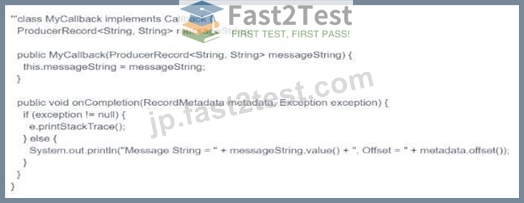
producer.send(record, new MyCallback(record));
- A. The id of the partition that the message was committed to
- B. The number of bytes that overflowed beyond a producer batch of messages
- C. Its position in the producer's batch of messages
- D. The sequential id of the message is committed into a partition
正解:D
質問 # 151
If you enable an SSL endpoint in Kafka, what feature of Kafka will be lost?
- A. Cross-cluster mirroring
- B. Support for Avro format
- C. Zero copy
- D. Exactly-once delivery
正解:C
解説:
With SSL, messages will need to be encrypted and decrypted, by being first loaded into the JVM, so you lose the zero copy optimization. See more information herehttps://twitter.com/ijuma/status
/1161303431501324293?s=09
質問 # 152
What are two examples of performance metrics?
(Select two.)
- A. incoming-byte-rate
- B. total-login-attempts
- C. Number of active users
- D. Time of last failed login
- E. fetch-rate
- F. Number of active user sessions
正解:A、E
解説:
* fetch-rate: Measures how frequently consumers fetch data - critical for monitoring throughput.
* incoming-byte-rate: Shows how much data is being written to the broker per second - a key producer-side metric.
FromKafka JMX Metrics Guide:
"fetch-rate, incoming-byte-rate, request-latency are key performance metrics for producers and consumers."
* B, C, E, and F areapplication-layer business metrics, not Kafka performance metrics.
Reference:Kafka Monitoring > JMX Metrics
質問 # 153
What happens if you write the following code in your producer? producer.send(producerRecord).get()
- A. Compression will be increased
- B. Throughput will be decreased
- C. Batching will be increased
- D. It will force all brokers in Kafka to acknowledge the producerRecord
正解:B
解説:
Using Future.get() to wait for a reply from Kafka will limit throughput.
質問 # 154
You need to set alerts on key broker metrics to trigger notifications when the cluster is unhealthy.
Which are three minimum broker metrics to monitor?
(Select three.)
- A. kafka.controller:type=ControllerStats,name=UncleanLeaderElectionsPerSec
- B. kafka.controller:type=KafkaController,name=LastCommittedRecordOffset
- C. kafka.controller:type=KafkaController,name=ActiveControllerCount
- D. kafka.controller:type=KafkaController,name=OfflinePartitionsCount
- E. kafka.controller:type=KafkaController,name=TopicsToDeleteCount
正解:A、C、D
解説:
These three metrics are critical for cluster health:
* OfflinePartitionsCount: Indicates partitions without active leaders - a sign of broker failure.
* ActiveControllerCount: There should beexactly one active controller. A count # 1 signals controller failure.
* UncleanLeaderElectionsPerSec: Tracks leader elections where out-of-sync replicas were selected - risky for data loss.
FromKafka Monitoring Documentation:
"Offline partitions and unclean leader elections should trigger alerts. Also, ensure a single active controller is running."
* A is about topics pending deletion - not critical.
* E is a per-topic record metric, not broker-level.
Reference:Kafka Monitoring > Key JMX Metrics
質問 # 155
A Zookeeper ensemble contains 5 servers. What is the maximum number of servers that can go missing and the ensemble still run?
- A. 0
- B. 1
- C. 2
- D. 3
正解:A
解説:
majority consists of 3 zk nodes for 5 nodes zk cluster, so 2 can fail
質問 # 156
What is a consequence of increasing the number of partitions in an existing Kafka topic?
- A. Consumers will need to process data from more partitions which will significantly increase consumer lag.
- B. Records with the same key could be located in different partitions.
- C. Existing data will be redistributed across the new number of partitions temporarily increasing cluster load.
- D. The acknowledgment process will increase latency for producers using acks=all.
正解:A
解説:
Increasing partitions increasesparallelism, but also means:
* Consumers in a group may have to handlemore partitions, especially if the number of consumers is lower than the number of partitions.
* This can result inincreased lag, especially under high load.
FromKafka Topic Management Docs:
"Increasing the number of partitions increases consumer work, and if consumers can't keep up, lag can accumulate."
* A is false:existing data is not redistributed.
* B is false:records with the same key always map to the same partitionbased on hash.
* D is not directly impacted by the partition count.
Reference:Kafka Topic Management > Adding Partitions
質問 # 157
A consumer wants to read messages from a specific partition of a topic. How can this be achieved?
- A. Call subscribe(String topic, int partition) passing the topic and partition number as the arguments
- B. Call assign() passing a Collection of TopicPartitions as the argument
- C. Call subscribe() passing TopicPartition as the argument
正解:B
解説:
assign() can be used for manual assignment of a partition to a consumer, in which case subscribe() must not be used. Assign() takes a collection of TopicPartition object as an argument https://kafka.apache.org/23/javadoc/org/apache/kafka/clients/consumer/KafkaConsumer.html#assign-java.util.Collection-
質問 # 158
......
学習材料は有効CCDAK効率的問題集:https://jp.fast2test.com/CCDAK-premium-file.html
CCDAK問題集本日限定!無料アクセス可能に!:https://drive.google.com/open?id=1eLCDJa7uFFToxa3FYS8U1ik1I3I_GJkO