

試験高合格率保証2025年07月12日 NSE6_FSW-7.2試験問題と正確な回答!
テストエンジン練習問題NSE6_FSW-7.2有効最新の問題集
質問 # 10
In which two ways can you assign a FortiSwitch port to a VDOM using multi-tenancy setup? (Choose two.)
- A. Create a virtual port pool on the FortiGate CLI.
- B. Assign a port to a VDOM directly on the managed FortiSwitch.
- C. Remove the managed FortiSwitch and allocate ports directly on FortiSwitch.
- D. Switch the FortiLink interface to the target VDOM.
正解:A、D
解説:
In a multi-tenancy setup on FortiGate, you can assign a FortiSwitch port to a VDOM in two primary ways:
Switch the FortiLink Interface to the Target VDOM (A): This method involves configuring the FortiLink interface, which is the dedicated interface used to manage FortiSwitch units from FortiGate, to operate within a specific VDOM. This effectively assigns all ports on the FortiSwitch, managed through that FortiLink interface, to the designated VDOM.
Create a Virtual Port Pool on the FortiGate CLI (C): Virtual port pools are created on FortiGate and allow ports from FortiSwitch to be grouped and assigned to a VDOM. This method is more granular and flexible, as it allows specific ports on the FortiSwitch to be dedicated to different VDOMs without requiring the entire switch or FortiLink interface to be dedicated to a single VDOM.
質問 # 11
Exhibit.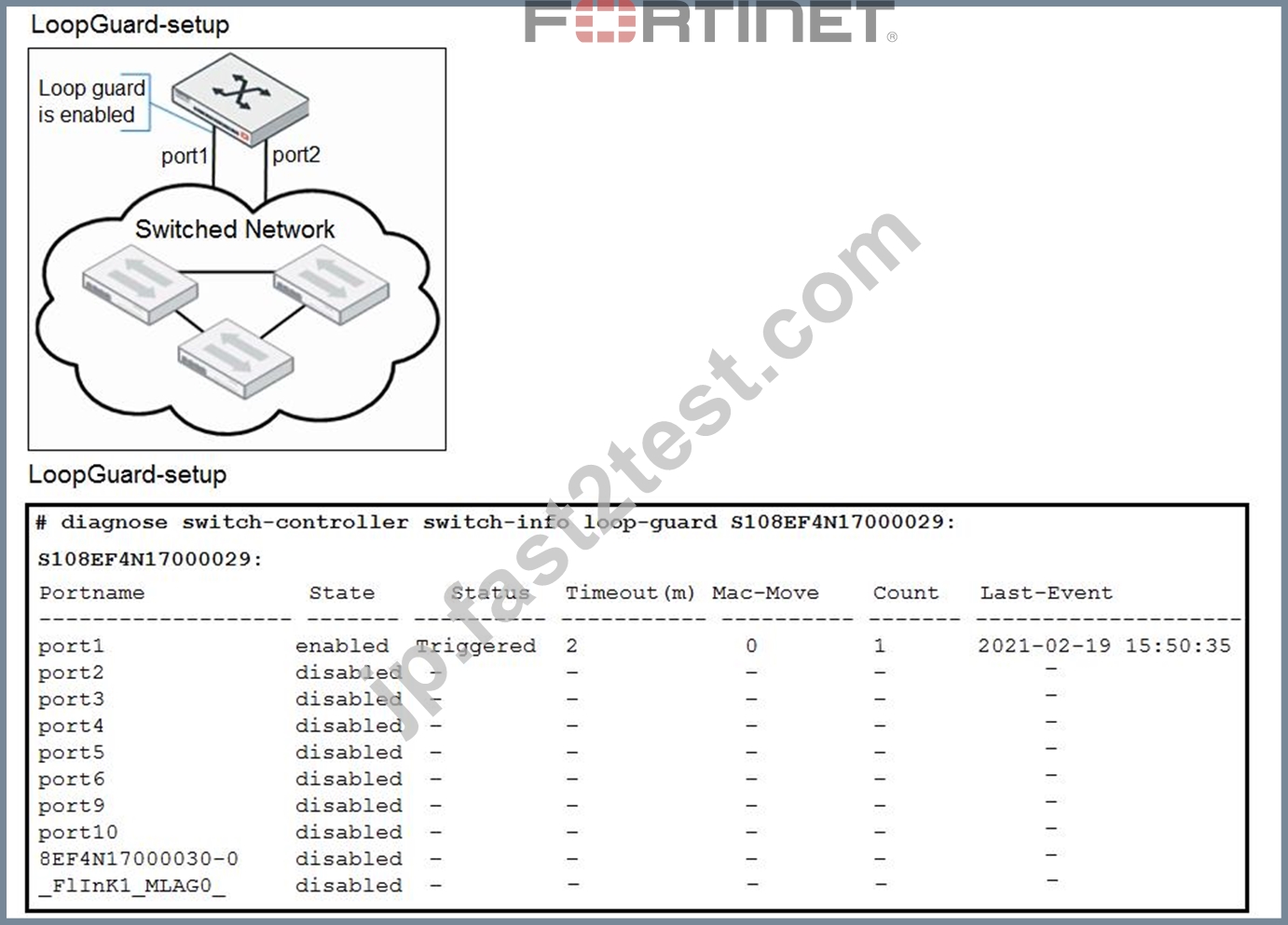
port1 and port2 are the only ports configured with the same native VLAN 10.
What are two reasons that can trigger port1 to shut down? (Choose two.)
- A. An endpoint sent a BPDU on port1 that it received from another interface.
- B. Loop guard frame sourced from port1 was received on port1.
- C. port1 was shut down by loop guard protection.
- D. STP triggered a loop and applied loop guard protection on port1.
正解:B、C
質問 # 12
Exhibit.
Two routes are not installed in the forwarding information base (FIB) as shown in the exnibit. Which two statements about these two route entries are true? (Choose two.)
- A. These two routes are available in the hardware routing table.
- B. These two routes have a higher administrative distance value available to the destination networks.
- C. These two routes will be used as load-balancing routes.
- D. These two routes will become primary, if the best routes are removed.
正解:B、D
解説:
From the exhibit and the details given about the routes not installed in the FIB:
These two routes have a higher administrative distance value available to the destination networks (Option A): Administrative distance is a measure used by routers to select the best path when there are two or more different routes to the same destination from two different routing protocols. A higher administrative distance means that the route is considered less trustworthy, thus not selected for the FIB unless the more preferred routes fail.
These two routes will become primary, if the best routes are removed (Option B): In routing, if the currently installed routes (which are considered the best due to reasons like lower administrative distance) are removed or become unavailable, the next best routes based on administrative distance will be used. This behavior ensures redundancy and maintains network connectivity in diverse scenarios.
Reference:
This approach is aligned with standard routing protocol behavior as documented in networking protocols and Fortinet's routing mechanisms which prioritize routes based on administrative distance and other metrics to maintain efficient and reliable network routing.
質問 # 13
Which LLDP-MED Type-Length-Values does FortiSwitch collect from endpoints to track network devices and determine their characteristics?
- A. Power management
- B. Inventory management
- C. Network policy
- D. Location
正解:B
質問 # 14
An administrator needs to deploy managed FortiSwitch devices in a remote location where multiple VLANs must be utilized to segment devices. No Layer 3 switch or router is present. The the only WAN connectivity is the router provided by the ISP connected to the public internet.
Which two items will the administrator need to use? (Choose two.)
- A. A FortiSwitch interface connected to the ISP router configured with fortilink-13-mode enabled.
- B. FortiSwitch devices that have the required internal hardware for this configuration.
- C. FortiSwitch and FortiGate devices configured with VXLAN interfaces.
- D. FortiSwitch and FortiGate devices configured with IPsec interfaces.
- E. FortiSwitch devices configured with NAT disabled.
正解:C、E
質問 # 15
Which statement about the IGMP snooping querier when enabled on a VLAN is true?
- A. Active multicast receiver entries are aging on each IGMP query sent on the VLAN
- B. The setting can only be enabled using the FortiSwitch CLI.
- C. IGMP reports on the VLAN are forwarded to all switch ports.
- D. All other indirectly connected switches will be unable to get IGMP multicast traffic.
正解:D
質問 # 16
Which drop policy mode, if assigned to a congested port, will drop incoming packets until there is no congestion on the egress port?
- A. Strict mode
- B. Weighted round robin mode.
- C. Random early detection mode
- D. Tail-drop mode
正解:D
質問 # 17
Which is a requirement to enable SNMP v2c on a managed FortiSwitch?
- A. Create an SNMP user to use for authentication and encryption.
- B. Enable an SNMP v3 to handle traps messages with SNMP hosts.
- C. Specify an SNMP host to send traps to.
- D. Configure SNMP agent and communities.
正解:D
質問 # 18
Which QoS mechanism maps packets with specific CoS or DSCP markings to an egress queue?
- A. Rate limiting for egress traffic
- B. Marking for ingress traffic
- C. Queuing for egress traffic
- D. Classification for ingress traffic
正解:D
質問 # 19
Which QoS mechanism maps packets with specific CoS or DSCP markings to an egress queue?
- A. Rate limiting for egress traffic
- B. Marking for ingress traffic
- C. Queuing for egress traffic
- D. Classification for ingress traffic
正解:D
解説:
"Classification: FortiSwitch maps packets with a given CoS or DSCP marking to an egress queue. There are eight egress queues on each port: queues 0 to 7." In Quality of Service (QoS) mechanisms, the process of mapping packets with specific CoS (Class of Service) or DSCP (Differentiated Services Code Point) markings to an egress queue involves two key steps: classification and queuing .
Classification : This occurs on the ingress side (incoming traffic). The switch examines the packet headers (e.g., CoS or DSCP values) to determine how the traffic should be treated. Based on this classification, the switch assigns the packet to a specific priority level or queue.
Queuing : Once the packet is classified, it is mapped to an egress queue based on its priority level. The egress queues are used to manage how traffic is transmitted out of the switch.
Option A (Queuing for egress traffic) refers to managing how packets leave the switch, but it does not involve the initial mapping of CoS/DSCP values to a queue.
Option C (Rate limiting for egress traffic) is about controlling the rate of outgoing traffic, which is unrelated to CoS/DSCP mapping.
Option D (Marking for ingress traffic) involves modifying the CoS or DSCP values of packets as they enter the switch, but it does not map them to an egress queue.
Thus, classification for ingress traffic is the mechanism that identifies and maps packets with specific CoS or DSCP markings to an appropriate egress queue.
質問 # 20
Refer to the exhibit.
The exhibit shows the current status of the ports on the managed FortiSwitch. Access-1.
Why would FortiGate display a serial number in the Native VLAN column associated with the port23 entry?
- A. port23 is configured as the dedicated management interface.
- B. port23 is a member of a trunk that uses the Access-1 FortiSwitch serial number as the name of the trunk.
- C. Ports connected to adjacent FortiSwitch devices show their serial number as the native VLAN.
- D. A standalone switch with the shown serial number is connected on port23.
正解:D
解説:
The information in the "Native VLAN" column for port23 on the FortiSwitch indicates that a standalone switch is connected to it. This is because the column displays "$424MPTF20000027," which matches the format of a Fortinet device serial number.
Here's a breakdown of the evidence in the image:
Native VLAN: The "Native VLAN" column typically displays the VLAN ID for untagged traffic on a trunk port. However, in this case, it shows a serial number format ("$424MPTF20000027").
No Trunk Information: The "Trunk" column is blank for port23, indicating it's not configured as a trunk member.
Other Ports: Port1 and port2 show "default" in the "Native VLAN" column, which is the expected behavior for access ports.
Fortinet FortiSwitch devices typically don't display the serial number of adjacent FortiSwitch devices in the "Native VLAN" column. This column is reserved for VLAN information on trunk ports.
質問 # 21
Refer to the exhibits.

Port1 and port2 are the only ports configured with the same native VLAN 10.
What are two reasons that can trigger port1 to shut down? (Choose two.)
- A. An endpoint sent a BPDU on port1 that it received from another interface.
- B. port1 was shut down by loop guard protection.
- C. STP triggered a loop and applied loop guard protection on port1.
- D. Loop guard frame sourced from port 1 was received on port 1.
正解:B、C
解説:
When loop guard is enabled on port1 and port2 configured with the same native VLAN (VLAN 10), there are specific scenarios under which port1 can be shut down due to loop guard operation:
A . port1 was shut down by loop guard protection. Loop guard is a specific feature used in network environments to prevent alternative or redundant loops. When loop guard is active, it can shut down a port if it stops receiving BPDU (Bridge Protocol Data Units) on a port that is expected to receive them, assuming a loop or link failure and putting the port into an inconsistent state to prevent potential loops.
B . STP triggered a loop and applied loop guard protection on port1. If the Spanning Tree Protocol (STP) detects a loop or loss of BPDU transmissions while loop guard is enabled, it will proactively shut down the port to prevent network instability or a broadcast storm. This is an essential function of loop guard within the context of STP, providing additional protection against topology changes that could introduce loops.
Reference:
Additional details about loop guard functionality and STP interaction can be found in the FortiSwitch administration guides, accessible via Fortinet Documentation.
質問 # 22
Refer to the diagnostic output:
Two entries in the exhibit show that the same MAC address has been used in two different VLANs. Which MAC address is shown in the above output?
- A. It is a MAC address of FortiLink interface on FortiGate.
- B. It is a MAC address of an upstream FortiSwitch.
- C. It is a MAC address of FortiGate in HA configuration.
- D. It is a MAC address of a switch that accepts multiple VLANs.
正解:D
質問 # 23
In which two ways can you assign a FortiSwitch port to a VDOM using multi-tenancy setup? (Choose two.)
- A. Assign a port to a VDOM directly on the managed FortiSwitch.
- B. Create a virtual port pool on the FortiGate CLI.
- C. Remove the managed FortiSwitch and allocate ports directly on FortiSwitch.
- D. Switch the FortiLink interface to the target VDOM.
正解:A、B
質問 # 24
Which statement about the IGMP snooping querier when enabled on a VLAN is true?
- A. Active multicast receiver entries are aging on each IGMP query sent on the VLAN
- B. The setting can only be enabled using the FortiSwitch CLI.
- C. IGMP reports on the VLAN are forwarded to all switch ports.
- D. All other indirectly connected switches will be unable to get IGMP multicast traffic.
正解:A
解説:
Active multicast receiver entries are aging on each IGMP query sent on the VLAN (A): When IGMP snooping querier is enabled on a VLAN, it functions to manage multicast traffic within the VLAN by keeping track of multicast group memberships. The IGMP querier sends queries to determine which ports require the multicast traffic. The multicast receiver entries, which are entries that indicate which devices have requested the multicast data, age or time out based on these IGMP queries. Each query refreshes active connections but ages out entries that no longer respond, helping to ensure that multicast traffic is only sent to ports with active receivers.
質問 # 25
Which two statements about managing a FortiSwitch stack on FortiGate are true? (Choose two.)
- A. Only a hardware-based FortiGate can manage a FortiSwitch stack.
- B. FortiSwitch must be operating in standalone mode before authorization.
- C. A FortiLink interface must be enabled on FortiGate.
- D. The switch controller feature must be enabled on FortiGate.
正解:C、D
解説:
A FortiLink interface must be enabled on FortiGate (A): To manage a FortiSwitch stack, a dedicated FortiLink interface on the FortiGate is required. This interface is used to manage the communication between FortiGate and the FortiSwitch stack, enabling centralized control and configuration of the switches directly from the FortiGate.
The switch controller feature must be enabled on FortiGate (B): Enabling the switch controller feature on FortiGate allows it to manage connected FortiSwitch units. This feature provides tools and interfaces on the FortiGate for overseeing FortiSwitch configurations, monitoring switch status, and managing network policies across the stack.
質問 # 26
Which interfaces on FortiSwitch send out FortiLink discovery frames by default in order to detect a FortiGate with an enabled FortiLink interface?
- A. The ports with auto-discovery enabled by default are dependent upon the FortiSwitch model.
- B. The last four switch ports on FortiSwitch have auto-discovery enabled by default.
- C. No ports are enabled by default for auto-discovery. This must be configured under config switch interface.
- D. All ports have auto-discovery enabled by default.
正解:D
質問 # 27
Which two statements about 802.1X authentication on FortiSwitch ports are true? (Choose two.)
- A. A local user database must be used to authenticate devices using the 802.1X authentica-tion protocol.
- B. A security policy is used to apply 802.1 authentication on a port.
- C. All devices connecting to FortiSwitch must support 802.1X authentication.
- D. All hosts behind an authenticated port are allowed access after a successful authentica-tion.
正解:B、D
質問 # 28
Which two types of Layer 3 interfaces can participate in dynamic routing on FortiSwitch? (Choose two.)
- A. Physical interfaces
- B. Loopback interfaces
- C. Detected management interfaces
- D. Switch virtual interfaces
正解:B、D
質問 # 29
Which two statements about DHCP snooping enabled on a FortiSwitch VLAN are true? (Choose two.)
- A. Settings related to DHCP option 82 are only configurable through the CLI
- B. By default, all FortiSwitch ports are set to forward client DHCP requests to untrusted ports.
- C. switch-controller-dhcp-snooping-verify-mac verifies the destination MAC address to protect against DHCP exhaustion attacks.
- D. Enabling DHCP snooping on a FortiSwitch VLAN ensures requests and replies are seen by all DHCP servers.
正解:A、C
解説:
Switch-controller-dhcp-snooping-verify-mac verifies the destination MAC address to protect against DHCP exhaustion attacks (B): This feature of DHCP snooping helps prevent DHCP exhaustion attacks by ensuring that the destination MAC addresses in DHCP packets match the MAC addresses learned by the switch. This check helps prevent attackers from overwhelming the DHCP server with requests from spoofed MAC addresses.
Settings related to DHCP option 82 are only configurable through the CLI (D): DHCP Option 82 is used for "agent information," and it's typically used in network environments where additional information between DHCP clients and servers is necessary for policy and billing purposes. Configuration of these settings in FortiSwitch is only available through the Command Line Interface (CLI), not the Graphical User Interface (GUI).
質問 # 30
......
試験解答NSE6_FSW-7.2最新版とテストエンジン:https://jp.fast2test.com/NSE6_FSW-7.2-premium-file.html