

良質なData-Management-FoundationsのPDF問題集でData-Management-Foundations試験問題を試せます
一番最新のWGU Data-Management-Foundations試験問題集PDF2025年更新
質問 # 28
What is the role of the transaction manager within the database system architecture?
- A. The transaction manager uses information from the catalog to perform query optimization.
- B. The transaction manager is composed of a query processor, storage manager, transaction manager, log, and catalog.
- C. The transaction manager translates the query processor instructions into filesystem commands and uses an index to quickly locate the requested data.
- D. The transaction manager logs insert, update, and delete queries, and the result is sent back to the application.
正解:D
解説:
ATransaction ManagerensuresACID (Atomicity, Consistency, Isolation, Durability)properties in database transactions. It manages concurrent transactions, ensuring no conflicts occur and logs modifications to support recovery mechanisms.
* Option A (Incorrect):Query optimization is managed by thequery processor, not the transaction manager.
* Option B (Incorrect):The transaction manager is a component of the database architecture but is not composed of the entire system (query processor, storage manager, etc.).
* Option C (Correct):The transaction manager logs transactions like INSERT, UPDATE, and DELETE, ensuring consistency and recoverability.
* Option D (Incorrect):Thestorage manageris responsible for translating queries into filesystem commands.
質問 # 29
Which entity in a table is a measurable object in the real world?
- A. Conceptual entity
- B. Virtual entity
- C. Logical entity
- D. Tangible entity
正解:D
解説:
Atangible entityis a real-world object that can bemeasured and storedin a database.
Example Usage:
* In an inventory system,tangible entitiesinclude:
Products, Orders, Customers
Why Other Options Are Incorrect:
* Option A (Logical entity) (Incorrect):Exists logically butmay not have a physical presence(e.g., views, categories).
* Option C (Virtual entity) (Incorrect):Existsonly in queries or reports, not stored as real data.
* Option D (Conceptual entity) (Incorrect):Abstract idea used indesign modeling, not astored entity.
Thus, the correct answer isTangible entity, as it representsmeasurable, real-world objects.
質問 # 30
What is a common error made while inserting an automatically incrementing primary key?
- A. Failing to set a numeric value in a newly inserted row
- B. Designating multiple primary keys
- C. Forgetting to specify which is the auto-increment column
- D. Inserting a value and overriding auto-increment for a primary key
正解:D
解説:
In databases, primary keys are oftenset to auto-incrementso that new rows automatically receive unique values. However,one common error is manually inserting a value into an auto-incremented primary key column, whichoverrides the automatic numberingand may cause conflicts.
Example of Auto-Increment Setup:
sql
CREATE TABLE Users (
UserID INT AUTO_INCREMENT PRIMARY KEY,
Username VARCHAR(50)
);
Incorrect Insert (Error-Prone Approach):
sql
INSERT INTO Users (UserID, Username) VALUES (100, 'Alice');
* Thismanually overrides the auto-increment, which can lead toduplicate key errors.
Correct Insert (Avoiding Errors):
sql
INSERT INTO Users (Username) VALUES ('Alice');
* Thedatabase assigns UserID automatically, preventing conflicts.
Why Other Options Are Incorrect:
* Option B (Failing to set a numeric value) (Incorrect):The databaseautomatically assignsvalues when AUTO_INCREMENT is used.
* Option C (Designating multiple primary keys) (Incorrect):Whileincorrect, most databases will prevent this at creation time.
* Option D (Forgetting to specify which is the auto-increment column) (Incorrect):If AUTO_INCREMENT is set, the database handles numbering automatically.
Thus, the most common error isInserting a value and overriding auto-increment, which can cause duplicate key errors and data inconsistencies.
質問 # 31
What is shown on the "many" side of a relationship between two tables?
- A. Binary relationship
- B. Weak entity
- C. Reflexive relationship
- D. Foreign key
正解:D
解説:
In aone-to-many (1:M) relationship, theforeign keyis placed in thetable on the "many" sideto establish the relationship with theprimary keyof the "one" side.
Example Usage:
A screenshot of a computer AI-generated content may be incorrect.
CREATE TABLE Departments (
DeptID INT PRIMARY KEY,
DeptName VARCHAR(50)
);
CREATE TABLE Employees (
EmpID INT PRIMARY KEY,
Name VARCHAR(50),
DeptID INT, -- Foreign key on the "many" side
FOREIGN KEY (DeptID) REFERENCES Departments(DeptID)
);
* Eachdepartmentcan havemany employees# DeptID is aforeign keyin Employees.
Why Other Options Are Incorrect:
* Option A (Reflexive relationship) (Incorrect):Refers tounary (self-referential) relationships, not 1:
M relationships.
* Option B (Binary relationship) (Incorrect):A binary relationship involvestwo entities, but does not define where the foreign key is stored.
* Option C (Weak entity) (Incorrect):Weak entitiesdepend on a strong entity, but not all "many" sides are weak entities.
Thus, the correct answer isForeign key, as it is placed on the "many" side of the relationship.
質問 # 32
What does the aggregate function do?
- A. It eliminates one or more columns of a table.
- B. It computes values over a set of rows.
- C. It selects rows that appear in one table but not another.
- D. It lists combinations of rows in two tables.
正解:B
解説:
Anaggregate functionperforms acalculation over multiple rowsand returns asingle value. Examples include SUM(), AVG(), MAX(), MIN(), and COUNT()in SQL.
* Option A (Correct):Aggregate functions compute values over aset of rows, like summingtotal sales or averaging grades.
* Option B (Incorrect):Selecting rows that appear in one table but not another is done usingset operations (EXCEPT or MINUS in SQL).
* Option C (Incorrect):Eliminating columns is done using thePROJECToperation orSELECT with specific columns.
* Option D (Incorrect):Combining rows from two tables refers to aJOIN operation, not aggregation.
質問 # 33
Which property of an entity can become a column in a table?
- A. Modality
- B. Attribute
- C. Non-null values
- D. Uniqueness
正解:B
解説:
Indatabase design,attributesof an entity becomecolumnsin a relational table.
Example Usage:
For anEmployee entity, attributes might include:
CREATE TABLE Employees (
EmployeeID INT PRIMARY KEY,
Name VARCHAR(50),
Salary DECIMAL(10,2),
DepartmentID INT
);
* Eachattribute(e.g., Name, Salary) becomes acolumnin the table.
Why Other Options Are Incorrect:
* Option A (Modality) (Incorrect):Describesoptional vs. mandatoryrelationships, not table structure.
* Option B (Uniqueness) (Incorrect):Ensuresdistinct valuesbutis not a column property.
* Option D (Non-null values) (Incorrect):Ensures thatcolumns must contain databut doesnot define attributes.
Thus, the correct answer isAttribute, as attributes of entities becometable columns.
質問 # 34
Which property is associated with a one-field primary key?
- A. Duplicate
- B. Composite
- C. Simple
- D. Numeric
正解:C
解説:
Aprimary keyuniquely identifies each row in a table. When a primary key consists ofonly one field, it is called aSimple Primary Key.
Types of Primary Keys:
* Simple Primary Key (Correct Answer):
* Contains onlyone column.
* Example:
sql
CREATE TABLE Students (
StudentID INT PRIMARY KEY,
Name VARCHAR(50)
);
* Composite Primary Key:
* Usesmultiple columnsto ensure uniqueness.
* Example:
sql
CREATE TABLE Orders (
OrderID INT,
ProductID INT,
PRIMARY KEY (OrderID, ProductID)
);
* Surrogate Primary Key:
* A system-generatedunique identifier(e.g., UUID or AUTO_INCREMENT).
Why Other Options Are Incorrect:
* Option B (Duplicate) (Incorrect):A primary keymust be unique, so itcannot be duplicate.
* Option C (Numeric) (Incorrect):While primary keyscan be numeric, they can also be alphanumeric (VARCHAR).
* Option D (Composite) (Incorrect):Acompositekey consists ofmultiple fields, whereas a simple key is a single field.
Thus, the correct answer isSimple, since aone-field primary keyis a simple primary key.
質問 # 35
Which clause from a SELECT statement immediately accompanies the SELECT clause in MySQL?
- A. FROM
- B. VALUE
- C. TABLE
- D. WHERE
正解:A
解説:
InSQL syntax, the FROM clause is the first clause that follows SELECT. It specifies the table(s) from which the data will be retrieved.
Example:
sql
SELECT name, salary FROM Employees;
* Option A (Correct):The FROM clauseimmediately followsthe SELECT clause in MySQL.
* Option B (Incorrect):VALUE is not a valid clause in MySQL SELECT statements.
* Option C (Incorrect):WHERE is used to filter recordsafter specifying the table in FROM.
* Option D (Incorrect):TABLE is not a valid clause following SELECT in SQL.
質問 # 36
Which elements are represented by attributes in the database design documents?
- A. Repositories
- B. Relationships
- C. Synonyms
- D. Names
正解:D
解説:
Attributesin a databaserepresent the properties (names, values, or characteristics) of an entity.
Example Usage:
* In aStudentstable, attributes might include:
StudentID (Primary Key), Name, Age, Major
* Here,Name is an attributedescribing the entityStudent.
Why Other Options Are Incorrect:
* Option A (Synonyms) (Incorrect):Synonyms in SQL allow different names for the same object but are not attributes.
* Option C (Repositories) (Incorrect):A repository stores data butdoes not define attributes.
* Option D (Relationships) (Incorrect):Relationships defineconnections between entities, not their attributes.
Thus, the correct answer isNames, asattributes define entity properties.
質問 # 37
Which type of join selects all the rows from both the left and right table, regardless of match?
- A. Outer Join
- B. Full Join
- C. Cross Join
- D. Inner Join
正解:B
解説:
AFull Join (FULL OUTER JOIN)selectsall records from both tables, filling in NULL values where there is no match. This ensures that no data is lost from either table.
Example Usage:
sql
SELECT Employees.Name, Departments.DepartmentName
FROM Employees
FULL OUTER JOIN Departments ON Employees.DeptID = Departments.ID;
* This query retrievesall employees and all departments, even if an employeehas no assigned departmentor a departmenthas no employees.
Types of Joins:
* FULL OUTER JOIN (Correct Answer)# Includesall rows from both tables, filling missing values with NULL.
* LEFT JOIN (Incorrect)# Includesall rows from the left tableandmatching rows from the right table.
* RIGHT JOIN (Incorrect)# Includesall rows from the right tableandmatching rows from the left table.
* CROSS JOIN (Incorrect)# Produces aCartesian product(each row from one table is combined with every row from another table).
Thus, the correct answer isFULL JOIN, whichensures that all rows from both tables appear in the result.
質問 # 38
Which syntax feature classifies the explicit string, numeric, or binary values used in SQL queries?
- A. Keywords
- B. Comments
- C. Literals
- D. Identifiers
正解:C
解説:
In SQL,literalsrepresent explicit values such asnumbers, strings, or binary datadirectly written into queries.
For example:
SELECT * FROM Employees WHERE Salary > 50000;
Here, 50000 is anumeric literal.
* Option A (Correct):Literalsare explicit values used in SQL queries, such as 123, 'John Doe', and TRUE.
* Option B (Incorrect):Commentsare non-executable text used for documentation within SQL code, typically denoted by -- or /* ... */.
* Option C (Incorrect):Identifiersare names oftables, columns, or other database objects, such as EmployeeID.
* Option D (Incorrect):Keywordsare reserved words in SQL (e.g., SELECT, FROM, WHERE) that define operations and syntax.
質問 # 39
Which characteristic is true for non-relational databases?
- A. They store data in tables, columns, and rows, similar to a spreadsheet.
- B. They support the SQL query language.
- C. They are ideal for databases that require an accurate record of transactions.
- D. They are optimized for big data.
正解:D
解説:
Non-relational databases(also calledNoSQL databases) are designed for handlingbig dataandunstructured dataefficiently. They are optimized forhorizontal scaling, making them ideal forlarge-scale distributed systems.
* Option A (Correct):Non-relational databases areoptimized for big data, handling massive volumes of data across distributed architectures.
* Option B (Incorrect):NoSQL databases donotuse SQL as their primary query language. They often use JSON-based queries (e.g., MongoDB).
* Option C (Incorrect):Transaction-heavy applications requireACID compliance, which relational databases (SQL) handle better than NoSQL databases.
* Option D (Incorrect):NoSQL databases usedocument, key-value, graph, or column-family storage models, nottables, columns, and rowslike relational databases.
質問 # 40
Which main characteristic is used to differentiate between strong and weak entities in the process of database design?
- A. Primary key
- B. Association
- C. Foreign key
- D. Cardinality
正解:A
解説:
Indatabase design, an entity is classified asstrong or weakbased on whether it has aprimary keythat uniquely identifies its records.
Differences Between Strong and Weak Entities: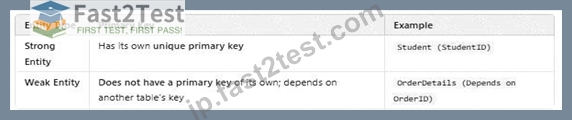
CREATE TABLE Orders (
OrderID INT PRIMARY KEY,
CustomerID INT
);
CREATE TABLE OrderDetails (
OrderDetailID INT,
OrderID INT,
ProductID INT,
PRIMARY KEY (OrderDetailID, OrderID),
FOREIGN KEY (OrderID) REFERENCES Orders(OrderID)
);
* Orders is astrong entity(has OrderID as its own primary key).
* OrderDetails is aweak entity(depends on OrderID for uniqueness).
Why Other Options Are Incorrect:
* Option A (Association) (Incorrect):Associations describerelationshipsbut do not define strong/weak entities.
* Option C (Foreign key) (Incorrect):Weak entitiesdepend on foreign keys, butprimary keysdefine their status.
* Option D (Cardinality) (Incorrect):Cardinality definesrelationship constraintsbut doesnot differentiate entity types.
Thus, the correct answer isPrimary key, as it is the defining characteristic betweenstrong and weak entities.
質問 # 41
Which type of join is demonstrated by the following query?
sql
SELECT *
FROM Make, Model
WHERE Make.ModelID = Model.ID;
- A. EQUIJOIN
- B. SELF JOIN
- C. CROSS JOIN
- D. NON-EQUIJOIN
正解:A
解説:
This query performs ajoin operationwhere records from the Make table and Model table are combined based on the condition Make.ModelID = Model.ID. This conditiontests for equality, which is the definition of an EQUIJOIN.
Types of Joins in SQL:
* EQUIJOIN (Correct Answer):
* Uses an equality operator (=) to match rows between tables.
* Equivalent to an INNER JOIN ON condition.
* Example:
sql
SELECT *
FROM Employees
JOIN Departments ON Employees.DeptID = Departments.ID;
* NON-EQUIJOIN (Incorrect):
* Usescomparison operators other than =(e.g., <, >, BETWEEN).
* Example:
sql
SELECT *
FROM Employees e
JOIN Salaries s ON e.Salary > s.MedianSalary;
* SELF JOIN (Incorrect):
* A table is joined withitselfusing table aliases.
* Example:
sql
SELECT e1.Name, e2.Name AS Manager
FROM Employees e1
JOIN Employees e2 ON e1.ManagerID = e2.ID;
* CROSS JOIN (Incorrect):
* ProducesCartesian product(each row from Table A combines with every row from Table B).
* Example:
sql
SELECT *
FROM Employees
CROSS JOIN Departments;
Thus, since our given query uses anequality condition (=) to join two tables, it is anEQUIJOIN.
質問 # 42
How can a primary key constraint be added after the table is created?
- A. By using an UPDATE clause
- B. By using the CREATE TABLE statement
- C. By using an INSERT INTO clause
- D. By using an ALTER clause
正解:D
解説:
Toadd a primary key constraint after table creation, we use theALTER TABLEstatement.
Example Usage:
sql
ALTER TABLE Employees
ADD CONSTRAINT PK_Employees PRIMARY KEY (EmpID);
* Thisaddsa primary key to the EmpID columnafter the table was created.
Why Other Options Are Incorrect:
* Option B (CREATE TABLE) (Incorrect):Used for defining constraintsduringtable creation, not after.
* Option C (UPDATE) (Incorrect):Modifiesrow values, not constraints.
* Option D (INSERT INTO) (Incorrect):Used toadd datato a table, not modify constraints.
Thus, the correct answer isALTER TABLE, as itmodifies table structure to add a primary key constraint.
質問 # 43
Which object relates an entity to itself in an entity-relationship model?
- A. Reflexive relationship
- B. Attribute
- C. Relationship instance
- D. Repository
正解:A
解説:
Areflexive relationship(also called aunary relationship) occurs when anentity is related to itself.
Example Usage:
A screenshot of a computer AI-generated content may be incorrect.
CREATE TABLE Employees (
EmpID INT PRIMARY KEY,
Name VARCHAR(50),
ManagerID INT,
FOREIGN KEY (ManagerID) REFERENCES Employees(EmpID)
);
* ManagerIDrefers to another employeewithin the same table.
Why Other Options Are Incorrect:
* Option A (Repository) (Incorrect):A data storage structure, not a relationship type.
* Option B (Relationship instance) (Incorrect):Describesa specific connection between entities, not a reflexive relationship.
* Option D (Attribute) (Incorrect):Attributes storecharacteristics, butdo not define relationships.
Thus, the correct answer isReflexive relationship, as it relates an entity to itself.
質問 # 44
Which designation is an individual value, such as a salary?
- A. Attribute type
- B. Entity type
- C. Relationship
- D. Glossary
正解:A
解説:
Anattribute typerefers to asingle, specific valuewithin a table, such as Salary, Age, or Price.
Example Usage:
A screenshot of a computer AI-generated content may be incorrect.
CREATE TABLE Employees (
EmpID INT PRIMARY KEY,
Name VARCHAR(50),
Salary DECIMAL(10,2)
);
* Salary is anattribute typewith individual values for each employee.
Why Other Options Are Incorrect:
* Option A (Glossary) (Incorrect):Refers todocumentation, not database values.
* Option B (Entity type) (Incorrect):Representsa class of objects(e.g., Employees), not individual values.
* Option D (Relationship) (Incorrect):Definesconnections between entities, not attributes.
Thus, the correct answer isAttribute type, as it represents anindividual data value.
質問 # 45
How is the primary key indicated in a table?
- A. By using a formula in SQL
- B. By using bold typeface in the appropriate column
- C. By using a diamond symbol inserted into the table
- D. By using an SQL keyword
正解:D
解説:
In SQL, aprimary key is explicitly defined using the PRIMARY KEY keywordwhen creating a table.
Example Usage:
sql
CREATE TABLE Products (
ProductID INT PRIMARY KEY,
Name VARCHAR(100),
Price DECIMAL(10,2)
);
* Here,PRIMARY KEY is the SQL keyword that designates ProductID as the primary key.
Why Other Options Are Incorrect:
* Option A (Formula in SQL) (Incorrect):SQLdoes not use formulas to define primary keys.
* Option C (Bold typeface) (Incorrect):SQL syntax does not rely on text formatting.
* Option D (Diamond symbol) (Incorrect):ER diagramsmight use symbols, but SQLdoes not use diamonds to indicate keys.
Thus, the correct answer isSQL keyword, as primary keys are explicitly defined using PRIMARY KEY.
質問 # 46
Which keyword or clause indicates the desired sequence when displaying a set of records returned from a SELECT statement?
- A. LIKE
- B. DISTINCT
- C. BETWEEN
- D. ORDER BY
正解:D
解説:
TheORDER BYclause in SQL is used tosort query resultsinascending (ASC) or descending (DESC) order
.
Example Usage:
sql
SELECT Name, Salary FROM Employees ORDER BY Salary DESC;
* This retrieves all employees, sorted bysalary in descending order.
Why Other Options Are Incorrect:
* Option A (BETWEEN) (Incorrect):Used for filtering ranges butdoes not order results.
* Option B (DISTINCT) (Incorrect):Removes duplicate rows butdoes not control order.
* Option D (LIKE) (Incorrect):Used forpattern matching, not sorting.
Thus,ORDER BY is the correct choicefor defining the sequence of query results.
質問 # 47
Which SQL command uses the correct syntax to add a new employee "John Doe" to the Employee table?
- A. INSERT INTO Employee (Name) VALUES ("John Doe");
- B. INSERT Employee (Name) Values ("John Doe");
- C. INSERT Employee { "John Doe" };
- D. INSERT INTO Employee ("John Doe");
正解:A
解説:
Thecorrect syntaxfor inserting a new row into a table follows this structure:
Standard SQL INSERT Syntax:
sql
INSERT INTO TableName (Column1, Column2, ...)
VALUES (Value1, Value2, ...);
For this scenario:
sql
INSERT INTO Employee (Name) VALUES ('John Doe');
Why Other Options Are Incorrect:
* Option A (Incorrect):Uses incorrect syntax { ... }, which isnot valid SQL syntax.
* Option C (Incorrect):Does not specify the column name, whichcauses an error.
* Option D (Incorrect):Misses theINTOkeyword, which is required in standard SQL.
Thus, the correct syntax isOption B, ensuring aproperly formatted insert statement.
質問 # 48
Which statement uses valid syntax for the DELETE statement in SQL?
- A. DELETE FROM table_name WHERE condition;
- B. DELETE * FROM table_name WHERE condition;
- C. DELETE FROM table_name;
- D. DELETE table_name WHERE condition;
正解:A
解説:
Thecorrect syntaxfor deleting records from a table in SQL is:
sql
DELETE FROM table_name WHERE condition;
This deletesonly the rowsthat match the condition.
Example Usage:
sql
DELETE FROM Employees WHERE Salary < 30000;
* Deletesall employees earning less than $30,000.
Why Other Options Are Incorrect:
* Option A (Incorrect):Missing FROMkeyword. The correct syntax is DELETE FROM table_name.
* Option C (Partially Correct):DELETE FROM table_name;deletes all rows, but it lacks a WHERE clause.
* Option D (Incorrect):DELETE *is not validin SQL. The correct command is just DELETE FROM.
Thus, the correct answer isDELETE FROM table_name WHERE condition;.
質問 # 49
Which constraint propagates primary key changes to foreign keys?
- A. RESTRICT
- B. CASCADE
- C. SET NULL
- D. SET DEFAULT
正解:B
解説:
TheCASCADEconstraint ensures thatupdates or deletions in the primary key table automatically reflect in the foreign key table.
Example Usage:
sql
CREATE TABLE Departments (
DeptID INT PRIMARY KEY,
DeptName VARCHAR(50)
);
CREATE TABLE Employees (
EmpID INT PRIMARY KEY,
Name VARCHAR(50),
DeptID INT,
FOREIGN KEY (DeptID) REFERENCES Departments(DeptID) ON UPDATE CASCADE ON DELETE CASCADE );
* If DeptIDchangesin Departments, itautomatically updatesin Employees.
* If a DeptID isdeleted, all employees in that departmentare also deleted.
Why Other Options Are Incorrect:
* Option A (SET DEFAULT) (Incorrect):Sets foreign key values to adefaultvalue, rather than propagating changes.
* Option B (SET NULL) (Incorrect):When the referenced key is deleted, dependent records areset to NULLinstead of being updated/deleted.
* Option C (RESTRICT) (Incorrect):Prevents deletion of a referenced row if dependent foreign key rows exist.
Thus, the correct answer isCASCADE, as itpropagates primary key changes to dependent foreign keys.
質問 # 50
......
100%無料Courses and Certificates Data-Management-Foundations問題集PDFお試しサンプル認定ガイドカバー率:https://jp.fast2test.com/Data-Management-Foundations-premium-file.html