

無料UiPath UiPath-ASAPv1試験問題と解答トレーニングを提供しています
トップクラスUiPath UiPath-ASAPv1オンライン問題集
質問 # 50
According to the solution design principles, what does 'Maintainability' primary focus on when designing an RPA solution?
- A. Ensuring exception handling and error reporting are comprehensive.
- B. Create a clear code structure in accordance with development standards.
- C. Adhering to meaning names for workflow file: activities arguments, and variables.
- D. Prioritizing complex configurations and dependencies for flexibility.
正解:B
解説:
Maintainability is one of the solution design principles that aims to ensure that the automation solution can be easily modified, updated, and repaired in the future. One of the key aspects of maintainability is to create a clear code structure in accordance with development standards, such as the UiPath Robotic Enterprise Framework, the UiPath Automation Implementation Methodology, and the UiPath Development Guidelines. A clear code structure helps to improve the readability, reusability, and scalability of the automation solution, as well as to reduce the complexity, duplication, and technical debt. A clear code structure also facilitates the testing, debugging, and documentation of the automation solution, as well as the knowledge transfer and collaboration among the development team. (https://docs.uipath.com/studio/docs/automation-best-practices) Reference:
Automation Best Practices - UiPath Studio
UiPath Robotic Enterprise Framework Template
UiPath Automation Implementation Methodology
UiPath Development Guidelines
質問 # 51
The interaction between UiPath Studio and the UiPath Robot Service performs which of the following functions?
- A. triggers unattended processes
- B. Process version control (git SVN etc.)
- C. Sends the heartbeat and logs
- D. Executes or debugs a process
正解:D
解説:
The interaction between UiPath Studio and the UiPath Robot Service performs the function of executing or debugging a process. UiPath Studio is the design tool that allows users to create, edit, and test automation workflows. UiPath Robot Service is the component that runs the automation workflows on the machine. It communicates through an inter-process communication channel with Studio, the UiPath Assistant, and Robot Command Line Interface to receive and process information, and then to provide the necessary instructions to the Robot Executor. When a user wants to execute or debug a process from Studio, the Robot Service receives the command and launches the Robot Executor in the appropriate mode and session. The Robot Executor then performs the actions defined in the workflow and sends back the status and logs to the Robot Service, which in turn relays them to Studio. References:
Robot - Robot Service - UiPath Documentation Portal
Studio - Debugging - UiPath Documentation Portal
Robot - Executing Processes - UiPath Documentation Portal
質問 # 52
What is the purpose of the "Resumed" process status in UiPath Action Center?
- A. It signals the completion of an intermediary process or the addition of Human input
- B. It represents a paused process awaiting further instructions
- C. It indicates the process is terminated
- D. It signals that the process is successfully completed
正解:A
解説:
UiPath Action Center is a feature that enables human intervention in long-running unattended workflows. The
"Resumed" process status indicates that the workflow execution has been resumed after a human input was provided through a task in Action Center. For example, a document understanding process may require a human to validate the extracted data from a document and then resume the automation. The "Resumed" status shows that the human validation action has been completed and the workflow is continuing with the next steps. References:
Action Center - Introduction
Action Center - Wait for Document Validation Action and Resume
質問 # 53
In regards to UiPath Automation Cloud licensing- what happens when the Trail plan's evaluation period ends?
- A. After the trial expires; your organization is automatically downgraded to the free plan.
- B. You need to manually choose a plan, or your UiPath cloud account will be suspended.
- C. After the trial expires; your organization will be changed for the pro plan unless you downgrade manually.
- D. The pro Trial plan will automatically renew itself for another 60 days
正解:A
解説:
The Pro Trial plan is a plan intended solely for internal non-production purposes, such as evaluation and testing, while fully complying with the Acceptable Use Policy outlined in the Terms of Use. It is available free of charge for a limited amount of time. You can upgrade to the Pro Trial plan if you want to experiment with more robotic power and premium services. With a Pro Trial plan, you can try the extended platform capabilities that come with a paid Pro plan. The evaluation period is limited to 60 days. After the trial expires, your organization is automatically downgraded to the Free plan1.
References:
Automation Cloud - About licensing
質問 # 54
Which scope activity is needed in order to use any document classification algorithm in UiPath Studio?
- A. Train Extractors Scope
- B. Train Classifiers Scope
- C. Classify Document Scope
- D. Data Extraction Scope
正解:C
解説:
Option B is the most suitable approach for the process described above, as it uses the Robotic Enterprise Framework (ReFramework) template with TransactionItem set as DataRow and TransactionData as DataTable. This template provides a robust and scalable structure for transactional processes, with built-in mechanisms for exception handling, logging, retrying, and reporting. By setting the TransactionItem as DataRow and the TransactionData as DataTable, the process can read the invoice numbers from the CSV file and process them one by one in a loop. The template also allows the use of queues to store the transaction data and status, which enables the process to resume from the last successful transaction in case of a system exception. This way, the process can ensure that each invoice number is processed only once in each application, and avoid duplicate or skipped transactions. The template also integrates with UiPath Orchestrator, which provides centralized management, monitoring, and scheduling of the process. The template also supports the use of long-running workflows, which can handle human intervention scenarios using UiPath Action Center. The template also complies with the UiPath Automation Solution Architect best practices and standards, such as naming conventions, modularity, reusability, and maintainability. References:
UiPath Studio - Robotic Enterprise Framework Template
UiPath Studio - Working with Queues in the ReFramework
UiPath Studio - Long Running Workflow Template with UiPath Tasks
[UiPath Automation Solution Architect - Course Overview]
[UiPath Automation Solution Architect - Best Practices and Standards]
質問 # 55
What are the two main delivery options for the UiPath Platform?
- A. UiPath Automaton Cloud and UiPath Automaton Suite
- B. UiPath Automaton Web and UiPath Automaton Desktop
- C. UiPath Automaton Studio and UiPath Automation Hub
- D. UiPath Automaton Enterprise and UiPath Automaton Express
正解:A
解説:
UiPath offers two main delivery options for the UiPath Platform, which are designed to provide customers with flexibility and choice on how to deploy and manage their automation solutions. These options are:
UiPath Automation Cloud: This is a cloud-based service that provides the complete UiPath Platform as a software as a service (SaaS) offering. Customers can access all the UiPath products and services from a single web portal, without having to worry about infrastructure, maintenance, or updates. UiPath Automation Cloud is scalable, secure, and compliant with various standards and regulations.
UiPath Automation Suite: This is a self-hosted solution that delivers the same cloud-native platform architecture and functionality as UiPath Automation Cloud, but on-premises or in a public cloud of the customer's choice. Customers can install and configure UiPath Automation Suite on Linux-based hardware or virtual machines, and benefit from the containerized and microservices-based design, the unified user experience, and the platform services. UiPath Automation Suite also includes tools for managing and monitoring the Kubernetes and Linux infrastructure, as well as periodic updates for the entire package.
質問 # 56
What are the differences between rule based and model based extractions?
- A. The rule-based extraction is used for documents with a fixed format relies on rules (like regular expressions) and templates and ensures high accuracy for already known documents The model-based extraction is used tor semi-structured documents and relies on pre-trained models (like invoices receipts purchase orders etc) as well as on custom models
- B. The rule-based extraction uses methods like regex extractor and forms Al. on documents with a fared format, while the model-based extraction uses the machine learning extractor on semi structured documents
- C. The model-based extraction is used for documents with a fixed format, relies on regular expressions and templates and ensures high accuracy for already known documents The rule-based extraction is used for semi-structured documents and relies on pre-trained models as we" as on custom models
- D. The rub-based extraction uses methods like regex extractor and form extractor on semi-structured documents while the model based extraction uses the forma Al and machine learning on documents with fixed formal
正解:A
解説:
The rule-based extraction and the model-based extraction are two different methods of data extraction that target different types of documents. The rule-based extraction is suitable for structured documents that have a fixed format and layout, such as forms, tax returns, or certificates. This method relies on rules (such as regular expressions) and templates (such as position or occurrence patterns) to identify and extract the data of interest from the document. The rule-based extraction ensures high accuracy and speed for already known documents, but it requires manual configuration and maintenance of the rules and templates, and it cannot handle variations or changes in the document format. The model-based extraction is suitable for semi-structured documents that have varying formats and layouts, but contain similar types of information, such as invoices, receipts, or purchase orders. This method relies on pre-trained models (such as machine learning or artificial intelligence models) or custom models (such as user-defined models) to analyze and extract the data of interest from the document. The model-based extraction can handle variations and changes in the document format, and it can learn from feedback and improve over time, but it requires training data and validation, and it may not achieve the same level of accuracy and speed as the rule-based extraction for some documents. Reference:
Data Extraction Overview - UiPath Document Understanding
Document Processing with Improved Data Extraction | UiPath
Document Understanding - Machine Learning Extractor - UiPath
質問 # 57
The interaction between UiPath Studio and the UiPath Robot Service performs which of the following functions?
- A. triggers unattended processes
- B. Process version control (git SVN etc.)
- C. Sends the heartbeat and logs
- D. Executes or debugs a process
正解:D
解説:
The interaction between UiPath Studio and the UiPath Robot Service performs the function of executing or debugging a process. UiPath Studio is the design tool that allows users to create, edit, and test automation workflows. UiPath Robot Service is the component that runs the automation workflows on the machine. It communicates through an inter-process communication channel with Studio, the UiPath Assistant, and Robot Command Line Interface to receive and process information, and then to provide the necessary instructions to the Robot Executor. When a user wants to execute or debug a process from Studio, the Robot Service receives the command and launches the Robot Executor in the appropriate mode and session. The Robot Executor then performs the actions defined in the workflow and sends back the status and logs to the Robot Service, which in turn relays them to Studio. Reference:
Robot - Robot Service - UiPath Documentation Portal
Studio - Debugging - UiPath Documentation Portal
Robot - Executing Processes - UiPath Documentation Portal
質問 # 58
Exhibit.
Consider the following diagram:
What is the problem with the way the solution architect designed it?
- A. The processing steps are too detailed which lowers readability.
- B. There is no exception handling included for any of the steps.
- C. The diagram is not built using unified Modeling language shapes.
- D. The chosen colors do not align with the client organization's corporate identity.
正解:B
解説:
The diagram shows a flowchart of a process that involves logging into two applications, extracting and filling information from one application to another, and looping through multiple claims. However, the diagram does not include any exception handling for any of the steps, which means that the process will fail if any error or unexpected situation occurs. For example, what if the login to Application1 or Application2 fails due to system error or invalid credentials? What if the browser cannot open or verify the title? What if the claim information cannot be exported or filled in correctly? What if the search or extraction in Application2 fails or returns incorrect results? These are some of the possible scenarios that could cause the process to stop or produce incorrect outcomes, and the diagram does not show how to handle them gracefully. Exception handling is an essential part of designing a robust and reliable RPA solution, as it allows the process to recover from errors, log the issues, notify the users, and continue with the next steps or transactions.
Reference:
Exception Handling - UiPath Studio
Global Exception Handler - UiPath Studio
RPA Solution Architect Learning Plans
質問 # 59
Why we stability and standardization crucial factors when assessing the technical feasibility of process automaton?
- A. To facilitate easier development and maintenance of the automation solution
- B. To improve the user interface of the automaton protect
- C. To evaluate the accuracy of process documentation
- D. To assess the level of collaboration required within the learn
正解:A
解説:
Stability and standardization are important factors to consider when assessing the technical feasibility of process automation, because they affect how easy or difficult it is to develop and maintain the automation solution. A stable and standardized process has fewer exceptions, variations, and changes, which means it can be automated more reliably and efficiently. A process that is unstable or non-standardized may require more complex logic, exception handling, and frequent updates, which can increase the development time and cost, as well as the maintenance effort and risk. Therefore, stability and standardization are indicators of how suitable a process is for automation and how likely it is to deliver the expected benefits. (https://docs.uipath.com/automation-hub/docs/technical-feasibility) Reference:
UiPath Automation Hub - Technical Feasibility
UiPath Academy - RPA Solution Architecture Fundamentals
UiPath Certified Professional Automation Solution Architect
質問 # 60
Consider a process a that has a dependency Library B. Library B has defined an Object Repository for the application C where UI objects are stored.
Assuming a developer wants to use a UI Object defined in the Object Repository for application C insider process A, what is the best solution for that?
- A. Export the Object Repository for the application C as an UI library and import in it process A. Then one can access the UI Objects defined.
- B. Define a new Object Repository for application C in process A and reference the elements from there.
- C. Since process A already references Library B which has the Object Repository for the application C, one can directly access the UI Objects from the Object Repository for the application C.
- D. Avoid referencing the UI object since it has already been defined and just use the selector.
正解:C
解説:
This answer is correct because the Object Repository allows for creating and reusing UI taxonomies inside and across automation projects. By referencing Library B, which contains the Object Repository for application C, process A can reuse the UI elements defined there without creating a new Object Repository or using selectors. This way, process A can benefit from the centralized management, reusability, and reliability of the UI elements in the Object Repository12 Reference:
Studio - About Object Repository - UiPath Documentation Portal
Object Repository | UiPath UI Library | UiPath Academy
質問 # 61
Consider the following estimation. What criteria from the below is not taken into account?
- A. Number of applications used: 2 (ACME System 1, Excel).
- B. Integration with ACME System 1 App tested successfully.
- C. Number of sub-processes:2 (Dispatcher and performer).
- D. Number of clicks in the application(s).
正解:D
解説:
The estimation table in the image shows the breakdown of hours required for different sub-processes and components in a UiPath automation project. The criteria that are taken into account are the number of sub-processes, the number of applications used, the integration and functional tests, and the contingency. The number of clicks in the application(s) is not a relevant criterion for the estimation, as it does not reflect the complexity or the effort of the automation. Moreover, the number of clicks may vary depending on the selectors, the UI elements, and the data inputs.
Reference:
UiPath Automation Solution Architect Course, Module 3: Estimation and Planning Roles of a Solution Architect in Automation, RPA Setting, section: The importance of solution architecture
質問 # 62
What is the correct flow from a high level design standpoint in UiPath Test Manager1?
Instructions: Drag me Description found on the left and drop on Via correct Step Sequence found on the right.
正解:
解説:
Reference:
2: UiPath Test Manager - UiPath Documentation Portal
3: Task Capture - UiPath Test Manager - UiPath Documentation Portal
1: Test Manager Overview Demo - Test Automation Case | UiPath
質問 # 63
What is the purpose of using a standard business process model and notations when creating a high-level solution design?
- A. To ensure consistency and understanding across different process diagrams
- B. To show the sequence of steps in the solution without focusing on details
- C. To reduce the time spent on designing the solution by using obvious symbols
- D. To make the diagrams visually appealing and engaging tor stakeholders
正解:A
解説:
A standard business process model and notation (BPMN) is a graphical representation of the business processes and workflows in a solution. It helps to communicate the logic, flow, and interactions of the activities and actors involved in the solution. By using a standard BPMN, the solution architect can ensure that the solution design is consistent, clear, and understandable across different process diagrams, regardless of the level of detail or complexity. A standard BPMN also facilitates the alignment and integration of the solution with other systems and platforms, as well as the validation and verification of the solution requirements and functionality. References: UiPath Automation Solution Architect Learning Plan, Module 4: High-Level Solution Design1; UiPath Automation Suite - Deployment Architecture2; UiPath Academy - Roles of a Solution Architect in Automation, RPA Setting3.
質問 # 64
Which of the following is listed under the use cases of Al Center for handling unstructured data?
- A. Inventory Forecasts
- B. Loan Defaults
- C. Language Translation
- D. Image Classification
正解:D
解説:
Image classification is one of the use cases of AI Center for handling unstructured data, as it allows robots to identify and categorize images based on their content and features. For example, image classification can be used to automate tasks such as sorting documents, detecting defects, or recognizing faces. AI Center provides pre-built models for image classification, as well as the option to upload custom models or use third-party models. Image classification can be integrated into RPA workflows using the ML Skill activity in UiPath Studio. Reference: RPA & AI Integration with AI Center | UiPath, AI Center - Using AI Center - UiPath Documentation Portal, [Image Classification :: AI Center].
質問 # 65
What can be slated as tactual when it comes to Multi-node HA-ready production deployment?
- A. A multi-node HA-ready production deployment involves 3 or more server nodes behind a toad balancer
- B. A multi-node HA-ready production deployment has a knitted number of agent nodes
- C. A multi-node HA-ready production deployment involves a single-server node
- D. A multi node HA ready production deployment involves one server node behind a toad balancer
正解:A
解説:
A multi-node HA-ready production deployment is the only configuration supported for production use by UiPath Automation Suite. It ensures that the cluster can handle increased workloads and demand, as well as provide resilience and availability in case of node failures or disasters. A multi-node HA-ready production deployment requires at least 3 server nodes behind a load balancer, which distributes the incoming requests among the nodes and manages the cluster state. The number of agent nodes, which run the UiPath products and shared components, is optional and depends on the actual usage and capacity. A specialized agent node with GPU support is recommended for running special tasks like Task Mining analysis and Document Understanding pipelines, which require high computational power. References: Automation Suite - Deployment architecture - UiPath, Automation Suite - Manual: Multi-node HA-ready production profile requirements and installation - UiPath.
質問 # 66
A user is designing a solution lot a business process that uses the following Personal Identifiable Information (Pll):
Employee Name and Employee Date of Birth
Taking into consideration that PH should not be accessible to Database Administrators how should the details be stored in UiPath Orchestrator Queues?
- A. Store Employee Name and Date of Birth in Transaction item Specific Content and set "Store in encrypted format" as True
- B. Store Employee Name and Date of Birth as Transaction item Reference and set "Store in encrypted format as True
- C. Store Employee Name and Date of Birth as Transaction item Reference so the business users can search by name
- D. Store the Employee Name and Date of Birth in Transaction Item Specific Content
正解:A
解説:
Personal Identifiable Information (PII) is any data that potentially identifies a specific individual, allows for distinctions to be made between individuals, or could be used to de-anonymize anonymous data1. PII should be handled with care and protected from unauthorized access or disclosure. UiPath Orchestrator Queues are a way to store and process data items for automation projects. Queues have two types of data: Reference and Specific Content. Reference is a unique identifier for the data item, while Specific Content is a collection of key-value pairs that store the actual data2. To store PII in UiPath Orchestrator Queues, the best option is to use Specific Content and enable the "Store in encrypted format" option. This option encrypts the data using AES-256 encryption and prevents anyone, including database administrators, from viewing the data in plain text. Only the robots that have access to the queue can decrypt and process the data3. This ensures the security and privacy of the PII data.
質問 # 67
What type of applications can be built using UiPath Apps?
- A. Applications primarily targeting data analyse and machine learning
- B. Custom business applications tor data access and complex business log*:
- C. Simple applications with base user interaction and limited functionality
- D. Application focused on Integrating and managing UiPath RPA automations
正解:B
解説:
UiPath Apps is a low-code platform for developing user interfaces for RPA projects built with UiPath.
It allows you to create apps using a web browser, a rich library of drag-and-drop controls, and automations from the UiPath Platform. UiPath Apps supports APIs, legacy applications, and data sources that are not easily programmable. You can build custom business applications that connect to data in any underlying cloud or on-premises system using the power of automation. You can also design apps that run in multiple form factors, such as a full-page console, a sidebar, or any other size for either desktop or mobile devices. You can use UiPath Apps to create simple or complex applications with base user interaction and advanced functionality, such as conditional logic, data validation, and error handling. You can also integrate and manage UiPath RPA automations within your apps, using attended or unattended robots to interact with back-end systems. UiPath Apps is not primarily focused on data analysis and machine learning, although you can use UiPath activities and integrations to perform such tasks within your automations. Reference:
Apps - Introduction - UiPath Documentation Portal
Introducing UiPath Apps: A Robot-Powered Low-Code Platform
UiPath Apps
質問 # 68
What are the benefits of having the UiPath Document Understanding Process templates as part of an End-to-end Business Process (Upstream Automation > DU Process > Downstream Automation), and enabling the one-job-Per-File approach?
- A. This approach simplifies the way a DU Process is being implemented, without any effect on the license consumption or development time.
- B. It prevents external issues from impacting the DU Process and unneeded license consumption due to re-execution. At the same time, it offers a better overview of the workload and robot utilization and it is easier to scale.
- C. Having the one-job-Per-File approach simplifies the End-to-End Business process tasking out the need for having a Dispatcher in place for running any DU Process. This simplifies the overall architecture and reduces the time needed to bring the implementation into production.
- D. There is no real benefit but it offers a better separation between the existing UiPath Frameworks based on their purpose or area of expertise, it is always nice to have a dedicated tool for a specific task rather than having to reorganize a generic tool to fit your needs.
正解:B
解説:
This answer is correct because the one-job-per-file approach is a recommended architecture for Document Understanding processes that allows for processing each document as a separate job, regardless of the source or the trigger. This approach has several benefits, such as:
It simplifies the development, debugging, and deployment of the DU Process, as it does not require any looping logic or complex exception handling.
It enables the use of Orchestrator queues to store and manage the documents to be processed, which provides better visibility, tracking, and reporting of the process status and performance.
It reduces the license consumption and re-execution costs, as each document is processed only once and any errors or exceptions are handled at the individual document level, without affecting the rest of the documents.
It supports both attended and unattended scenarios, as well as human-in-the-loop validation via Action Center, using the same workflows and logic.
It allows for easy scaling and load balancing of the process, as multiple robots can process documents in parallel from the same queue, without any conflicts or dependencies12 Reference:
RPA Framework for Document Understanding - UiPath Community Forum
The Business Process for Document Understanding - UiPath Studio Template Explained
質問 # 69
When statement below accurately identifies the correct option regarding the various types of deployment?
- A. Single-node deployment option is recommended for evaluation and demo scenarios
- B. Single-node deployment option is recommended tor production use
- C. A single-node deployment involves 3 or more server nodes behind a load balancer
- D. In a single-node deployment High Availability (HA) is enabled by default
正解:A
解説:
The single-node deployment option is recommended for evaluation and demo scenarios because it is simpler and faster to set up and requires less resources. It involves installing the Automation Suite on a single server node, which hosts both the cluster management services and the UiPath products and shared components. This option is not suitable for production use, as it does not provide high availability, scalability, or fault tolerance.
It also does not support special workloads that require GPU capabilities, such as Task Mining analysis and Document Understanding pipelines. References:
Automation Suite - Deployment architecture - UiPath
Automation Suite - Supported use cases for single-node and multi-node installations - UiPath
質問 # 70
What functionality does the Package Explorer offer?
- A. Explore the graphical representation of any .xml file without having access to the variables, arguments, and imports that are part of any package version.
- B. Explore the graphical representation of nay .xml file as well as the variables, arguments, and imports that are part of any package version.
- C. Explorer the graphical representation of only the entry xml file as well as the variables, arguments, and imports that are part of the latest package version.
- D. Explore the graphical representation of only the entry xml file without having access to the variable, arguments, and imports that are part of any package version.
正解:B
解説:
Package Explorer is a feature that enables you to view the contents of any package version uploaded to Orchestrator. You can access it from the Packages page, by clicking the Explore button next to the package name. Package Explorer displays a graphical representation of the entry .xml file of the package, as well as the variables, arguments, and imports that are part of it. You can also view the properties of each activity, such as selectors, text, or output variables. Package Explorer can help you troubleshoot errors, compare different versions of a package, or inspect the logic of a package without opening it in Studio.
Reference:
Package Explorer
New package Explorer options with 2019.10 Beta
質問 # 71
Which trigger should be used for ''E3L''?
- A.

- B.
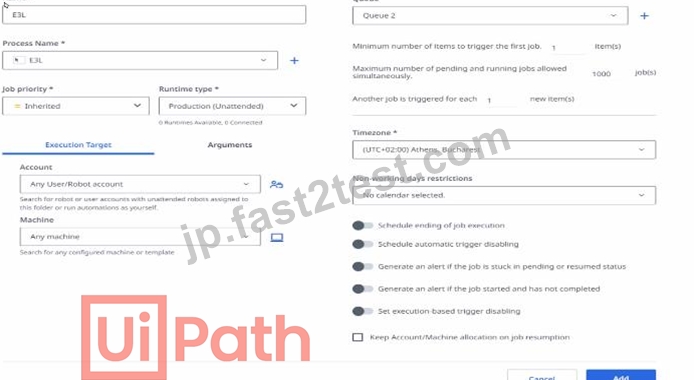
- C.

- D.

正解:C
解説:
Reference:
Orchestrator - Queue Triggers
Orchestrator - UI Automation Triggers
Orchestrator - Form Triggers
Orchestrator - Event Triggers
質問 # 72
Which of the following feeds can be used to deploy a package? Select the option that members all that apply:
- A. Tenant feed, External feed.
- B. Tenant feed, Folder feed, Personal workspace feed. Custom feed.
- C. Tenant feed, External feed, Custom feed.
- D. Tenant feed, custom feed
正解:B
解説:
According to the UiPath documentation and the UiPath Academy course, there are four types of feeds that can be used to deploy a package in Orchestrator:
Tenant feed: This is the default feed for all tenants in Orchestrator. It is hosted on the Orchestrator server and can store both processes and libraries. It can be accessed by all users within the tenant12.
Folder feed: This is a feed that can be configured for a specific folder in Orchestrator. It can store only processes and can be accessed only by users within the folder. It can be useful for isolating packages for different environments or projects13.
Personal workspace feed: This is a feed that can be configured for a personal workspace in Orchestrator.
It can store only processes and can be accessed only by the user who owns the workspace. It can be useful for testing and debugging packages before publishing them to other feeds14.
Custom feed: This is a feed that can be configured by adding an external source, such as Azure DevOps, Artifactory, MyGet, etc. It can store both processes and libraries and can be accessed by users who have the credentials for the external source. It can be useful for integrating with third-party tools or services1 .
References:
Automation Ops - Orchestrator Feeds - UiPath Documentation Portal1
Queues and Transactions - UiPath Documentation Portal2
Folders - UiPath Documentation Portal3
Personal Workspaces - UiPath Documentation Portal4
External Feed For Packages - UiPath Community Forum
質問 # 73
......
最新(2024)UiPath UiPath-ASAPv1試験問題集:https://jp.fast2test.com/UiPath-ASAPv1-premium-file.html