

無料で使えるDP-201試験ブレーン問題集認定ガイド問題と解答
DP-201認定概要最新のDP-201のPDF問題集
質問 77
You are designing a solution that will use Azure Table storage. The solution will log records in the following entity.
You are evaluating which partition key to use based on the following two scenarios:
* Scenario1: Minimize hotspots under heavy write workloads.
* Scenario2: Ensure that date lookups are as efficient as possible for read workloads.
Which partition key should you use for each scenario? To answer, select the appropriate options in the answer area.
NOTE: Each correct selection is worth one point.
正解:
解説:
Explanation
References:
https://docs.microsoft.com/en-us/rest/api/storageservices/designing-a-scalable-partitioning-strategy-for-azure-tab
質問 78
You are designing an application that will have an Azure virtual machine. The virtual machine will access an Azure SQL database. The database will not be accessible from the Internet You need to recommend a solution to provide the required level of access to the database.
What should you include in the recommendation?
- A. Add an application gateway to the virtual network that contains the Azure virtual machine.
- B. Deploy an On-premises data gateway.
- C. Add a virtual network to the Azure SQL server that hosts the database.
- D. Add a virtual network gateway to the virtual network that contains the Azure virtual machine.
正解: C
解説:
Explanation
When you create an Azure virtual machine (VM), you must create a virtual network (VNet) or use an existing VNet. You also need to decide how your VMs are intended to be accessed on the VNet.
質問 79
You need to design a solution that meets the business requirements of Health Insights.
What should you include in the recommendation?
- A. Azure Cosmos DB that uses the SQL API
- B. Azure Databricks
- C. Azure Cosmos DB that uses the Gremlin
- D. Azure Data Factory
正解: B
解説:
Azure SQL Data Warehouse is a cloud-based enterprise data warehouse that leverages massively parallel processing (MPP) to quickly run complex queries across petabytes of data. Use SQL Data Warehouse as a key component of a big data solution.
You can access Azure SQL Data Warehouse (SQL DW) from Databricks using the SQL Data Warehouse connector (referred to as the SQL DW connector), a data source implementation for Apache Spark that uses Azure Blob Storage, and PolyBase in SQL DW to transfer large volumes of data efficiently between a Databricks cluster and a SQL DW instance.
Scenario: ADatum identifies the following requirements for the Health Insights application:
* The new Health Insights application must be built on a massively parallel processing (MPP) architecture that will support the high performance of joins on large fact tables Reference:
https://docs.databricks.com/data/data-sources/azure/sql-data-warehouse.html
質問 80
You are evaluating data storage solutions to support a new application.
You need to recommend a data storage solution that represents data by using nodes and relationships in graph structures.
Which data storage solution should you recommend?
- A. HDInsight
- B. Cosmos DB
- C. Data Lake Store
- D. Blob Storage
正解: B
解説:
Explanation/Reference:
Explanation:
For large graphs with lots of entities and relationships, you can perform very complex analyses very quickly. Many graph databases provide a query language that you can use to traverse a network of relationships efficiently.
Relevant Azure service: Cosmos DB
References:
https://docs.microsoft.com/en-us/azure/architecture/guide/technology-choices/data-store-overview
質問 81
Note: This question is part of a series of questions that present the same scenario. Each question
in the series contains a unique solution that might meet the stated goals. Some question sets
might have more than one correct solution, while others might not have a correct solution.
After you answer a question in this section, you will NOT be able to return to it. As a result, these
questions will not appear in the review screen.
You are designing an HDInsight/Hadoop cluster solution that uses Azure Data Lake Gen1 Storage.
The solution requires POSIX permissions and enables diagnostics logging for auditing.
You need to recommend solutions that optimize storage.
Proposed Solution: Ensure that files stored are larger than 250MB.
Does the solution meet the goal?
- A. No
- B. Yes
正解: B
解説:
Explanation/Reference:
Explanation:
Depending on what services and workloads are using the data, a good size to consider for files is 256 MB
or greater. If the file sizes cannot be batched when landing in Data Lake Storage Gen1, you can have a
separate compaction job that combines these files into larger ones.
Note: POSIX permissions and auditing in Data Lake Storage Gen1 comes with an overhead that becomes
apparent when working with numerous small files. As a best practice, you must batch your data into larger
files versus writing thousands or millions of small files to Data Lake Storage Gen1. Avoiding small file sizes
can have multiple benefits, such as:
Lowering the authentication checks across multiple files
Reduced open file connections
Faster copying/replication
Fewer files to process when updating Data Lake Storage Gen1 POSIX permissions
References:
https://docs.microsoft.com/en-us/azure/data-lake-store/data-lake-store-best-practices
質問 82
You need to design the solution for analyzing customer data.
What should you recommend?
- A. Azure Cognitive Services
- B. Azure SQL Data Warehouse
- C. Azure Databricks
- D. Azure Batch
- E. Azure Data Lake Storage
正解: C
解説:
Explanation/Reference:
Explanation:
Customer data must be analyzed using managed Spark clusters.
You create spark clusters through Azure Databricks.
References:
https://docs.microsoft.com/en-us/azure/azure-databricks/quickstart-create-databricks-workspace-portal
Testlet 3
Case study
This is a case study. Case studies are not timed separately. You can use as much exam time as you
would like to complete each case. However, there may be additional case studies and sections on this
exam. You must manage your time to ensure that you are able to complete all questions included on this
exam in the time provided.
To answer the questions included in a case study, you will need to reference information that is provided in
the case study. Case studies might contain exhibits and other resources that provide more information
about the scenario that is described in the case study. Each question is independent of the other question
on this case study.
At the end of this case study, a review screen will appear. This screen allows you to review your answers
and to make changes before you move to the next sections of the exam. After you begin a new section,
you cannot return to this section.
To start the case study
To display the first question on this case study, click the Next button. Use the buttons in the left pane to
explore the content of the case study before you answer the questions. Clicking these buttons displays
information such as business requirements, existing environment, and problem statements. If the case
study has an All Information tab, note that the information displayed is identical to the information
displayed on the subsequent tabs. When you are ready to answer a question, click the Question button to
return to the question.
Background
Current environment
The company has the following virtual machines (VMs):
Requirements
Storage and processing
You must be able to use a file system view of data stored in a blob.
You must build an architecture that will allow Contoso to use the DB FS filesystem layer over a blob store.
The architecture will need to support data files, libraries, and images. Additionally, it must provide a web-
based interface to documents that contain runnable command, visualizations, and narrative text such as a
notebook.
CONT_SQL3 requires an initial scale of 35000 IOPS.
CONT_SQL1 and CONT_SQL2 must use the vCore model and should include replicas. The solution must
support 8000 IOPS.
The storage should be configured to optimized storage for database OLTP workloads.
Migration
You must be able to independently scale compute and storage resources.
You must migrate all SQL Server workloads to Azure. You must identify related machines in the on-
premises environment, get disk size data usage information.
Data from SQL Server must include zone redundant storage.
You need to ensure that app components can reside on-premises while interacting with components
that run in the Azure public cloud.
SAP data must remain on-premises.
The Azure Site Recovery (ASR) results should contain per-machine data.
Business requirements
You must design a regional disaster recovery topology.
The database backups have regulatory purposes and must be retained for seven years.
CONT_SQL1 stores customers sales data that requires ETL operations for data analysis. A solution is
required that reads data from SQL, performs ETL, and outputs to Power BI. The solution should use
managed clusters to minimize costs. To optimize logistics, Contoso needs to analyze customer sales
data to see if certain products are tied to specific times in the year.
The analytics solution for customer sales data must be available during a regional outage.
Security and auditing
Contoso requires all corporate computers to enable Windows Firewall.
Azure servers should be able to ping other Contoso Azure servers.
Employee PII must be encrypted in memory, in motion, and at rest. Any data encrypted by SQL Server
must support equality searches, grouping, indexing, and joining on the encrypted data.
Keys must be secured by using hardware security modules (HSMs).
CONT_SQL3 must not communicate over the default ports
Cost
All solutions must minimize cost and resources.
The organization does not want any unexpected charges.
The data engineers must set the SQL Data Warehouse compute resources to consume 300 DWUs.
CONT_SQL2 is not fully utilized during non-peak hours. You must minimize resource costs for during
non-peak hours.
質問 83
You need to recommend a security solution to grant anonymous users permission to access the blobs in a specific container only.
What should you include in the recommendation?
- A. access keys for the storage account
- B. Role assignments
- C. shared access signatures (SAS)
- D. the public access level for the blobs service
正解: D
解説:
Explanation
You can enable anonymous, public read access to a container and its blobs in Azure Blob storage. By doing so, you can grant read-only access to these resources without sharing your account key, and without requiring a shared access signature (SAS).
Public read access is best for scenarios where you want certain blobs to always be available for anonymous read access.
References:
https://docs.microsoft.com/en-us/azure/storage/blobs/storage-manage-access-to-resources
質問 84
You need to design the data loading pipeline for Planning Assistance.
What should you recommend? To answer, drag the appropriate technologies to the correct locations. Each technology may be used once, more than once, or not at all. You may need to drag the split bar between panes or scroll to view content.
NOTE: Each correct selection is worth one point.
正解:
解説:
Explanation
Box 1: SqlSink Table
Sensor data must be stored in a Cosmos DB named treydata in a collection named SensorData Box 2: Cosmos Bulk Loading Use Copy Activity in Azure Data Factory to copy data from and to Azure Cosmos DB (SQL API).
Scenario: Data from the Sensor Data collection will automatically be loaded into the Planning Assistance database once a week by using Azure Data Factory. You must be able to manually trigger the data load process.
Data used for Planning Assistance must be stored in a sharded Azure SQL Database.
References:
https://docs.microsoft.com/en-us/azure/data-factory/connector-azure-cosmos-db
質問 85
A company is designing a solution that uses Azure Databricks.
The solution must be resilient to regional Azure datacenter outages.
You need to recommend the redundancy type for the solution.
What should you recommend?
- A. Geo-redundant storage
- B. Zone-redundant storage
- C. Read-access geo-redundant storage
- D. Locally-redundant storage
正解: A
解説:
If your storage account has GRS enabled, then your data is durable even in the case of a complete regional outage or a disaster in which the primary region isn't recoverable.
Reference:
https://medium.com/microsoftazure/data-durability-fault-tolerance-resilience-in-azure-databricks-
95392982bac7
質問 86
A company has locations in North America and Europe. The company uses Azure SQL Database to support business apps.
Employees must be able to access the app data in case of a region-wide outage. A multi-region availability solution is needed with the following requirements:
* Read-access to data in a secondary region must be available only in case of an outage of the primary region.
* The Azure SQL Database compute and storage layers must be integrated and replicated together.
You need to design the multi-region high availability solution.
What should you recommend? To answer, select the appropriate values in the answer area.
NOTE: Each correct selection is worth one point.
正解:
解説:
Explanation
Box 1: Standard
The following table describes the types of storage accounts and their capabilities:
Box 2: Geo-redundant storage
If your storage account has GRS enabled, then your data is durable even in the case of a complete regional outage or a disaster in which the primary region isn't recoverable.
Note: If you opt for GRS, you have two related options to choose from:
GRS replicates your data to another data center in a secondary region, but that data is available to be read only if Microsoft initiates a failover from the primary to secondary region.
Read-access geo-redundant storage (RA-GRS) is based on GRS. RA-GRS replicates your data to another data center in a secondary region, and also provides you with the option to read from the secondary region. With RA-GRS, you can read from the secondary region regardless of whether Microsoft initiates a failover from the primary to secondary region.
References:
https://docs.microsoft.com/en-us/azure/storage/common/storage-introduction
https://docs.microsoft.com/en-us/azure/storage/common/storage-redundancy-grs
質問 87
You plan to create a real-time monitoring app that alerts users when a device travels more than 200 meters away from a designated location.
You need to design an Azure Stream Analytics job to process the data for the planned app. The solution must minimize the amount of code developed and the number of technologies used.
What should you include in the Stream Analytics job? To answer, select the appropriate options in the answer area.
NOTE: Each correct selection is worth one point.
正解:
解説:
Explanation:
Input type: Stream
You can process real-time IoT data streams with Azure Stream Analytics.
Input source: Azure IoT Hub
In a real-world scenario, you could have hundreds of these sensors generating events as a stream. Ideally, a gateway device would run code to push these events to Azure Event Hubs or Azure IoT Hubs.
Function: Geospatial
With built-in geospatial functions, you can use Azure Stream Analytics to build applications for scenarios such as fleet management, ride sharing, connected cars, and asset tracking.
Reference:
https://docs.microsoft.com/en-us/azure/stream-analytics/stream-analytics-get-started-with-azure-stream-analytics-to-process-data-from-iot-devices
https://docs.microsoft.com/en-us/azure/stream-analytics/geospatial-scenarios
質問 88
You need to recommend a solution for storing customer data.
What should you recommend?
- A. Azure Databricks
- B. Azure SQL Database
- C. Azure Stream Analytics
- D. Azure Synapse Analytics
正解: A
解説:
From the scenario:
Customer data must be analyzed using managed Spark clusters.
All cloud data must be encrypted at rest and in transit. The solution must support: parallel processing of customer data.
Reference:
https://www.microsoft.com/developerblog/2019/01/18/running-parallel-apache-spark-notebook-workloads-on- azure-databricks/ Design Azure data storage solutions Testlet 3 Case study This is a case study. Case studies are not timed separately. You can use as much exam time as you would like to complete each case. However, there may be additional case studies and sections on this exam. You must manage your time to ensure that you are able to complete all questions included on this exam in the time provided.
To answer the questions included in a case study, you will need to reference information that is provided in the case study. Case studies might contain exhibits and other resources that provide more information about the scenario that is described in the case study. Each question is independent of the other questions in this case study.
At the end of this case study, a review screen will appear. This screen allows you to review your answers and to make changes before you move to the next section of the exam. After you begin a new section, you cannot return to this section.
To start the case study
To display the first question in this case study, click the Next button. Use the buttons in the left pane to explore the content of the case study before you answer the questions. Clicking these buttons displays information such as business requirements, existing environment, and problem statements. If the case study has an All Information tab, note that the information displayed is identical to the information displayed on the subsequent tabs. When you are ready to answer a question, click the Question button to return to the question.
Background
Current environment
The company has the following virtual machines (VMs):
Requirements
Storage and processing
You must be able to use a file system view of data stored in a blob.
You must build an architecture that will allow Contoso to use the DB FS filesystem layer over a blob store. The architecture will need to support data files, libraries, and images. Additionally, it must provide a web-based interface to documents that contain runnable command, visualizations, and narrative text such as a notebook.
CONT_SQL3 requires an initial scale of 35000 IOPS.
CONT_SQL1 and CONT_SQL2 must use the vCore model and should include replicas. The solution must support 8000 IOPS.
The storage should be configured to optimized storage for database OLTP workloads.
Migration
* You must be able to independently scale compute and storage resources.
* You must migrate all SQL Server workloads to Azure. You must identify related machines in the on- premises environment, get disk size data usage information.
* Data from SQL Server must include zone redundant storage.
* You need to ensure that app components can reside on-premises while interacting with components that run in the Azure public cloud.
* SAP data must remain on-premises.
* The Azure Site Recovery (ASR) results should contain per-machine data.
Business requirements
* You must design a regional disaster recovery topology.
* The database backups have regulatory purposes and must be retained for seven years.
* CONT_SQL1 stores customers sales data that requires ETL operations for data analysis. A solution is required that reads data from SQL, performs ETL, and outputs to Power BI. The solution should use managed clusters to minimize costs. To optimize logistics, Contoso needs to analyze customer sales data to see if certain products are tied to specific times in the year.
* The analytics solution for customer sales data must be available during a regional outage.
Security and auditing
* Contoso requires all corporate computers to enable Windows Firewall.
* Azure servers should be able to ping other Contoso Azure servers.
* Employee PII must be encrypted in memory, in motion, and at rest. Any data encrypted by SQL Server must support equality searches, grouping, indexing, and joining on the encrypted data.
* Keys must be secured by using hardware security modules (HSMs).
* CONT_SQL3 must not communicate over the default ports
Cost
* All solutions must minimize cost and resources.
* The organization does not want any unexpected charges.
* The data engineers must set the SQL Data Warehouse compute resources to consume 300 DWUs.
* CONT_SQL2 is not fully utilized during non-peak hours. You must minimize resource costs for during non- peak hours.
質問 89
You need to recommend a storage solution for a sales system that will receive thousands of small files per minute. The files will be in JSON, text, and CSV formats. The files will be processed and transformed before they are loaded into an Azure data warehouse. The files must be stored and secured in folders.
Which storage solution should you recommend?
- A. Azure Data Lake Storage Gen2
- B. Azure Blob storage
- C. Azure Cosmos DB
- D. Azure SQL Database
正解: A
解説:
Explanation
Azure provides several solutions for working with CSV and JSON files, depending on your needs. The primary landing place for these files is either Azure Storage or Azure Data Lake Store.1 Azure Data Lake Storage is an optimized storage for big data analytics workloads.
質問 90
You design data engineering solutions for a company.
You must integrate on-premises SQL Server data into an Azure solution that performs Extract-Transform-Load (ETL) operations have the following requirements:
* Develop a pipeline that can integrate data and run notebooks.
* Develop notebooks to transform the data.
* Load the data into a massively parallel processing database for later analysis.
You need to recommend a solution.
What should you recommend? To answer, select the appropriate options in the answer area.
NOTE: Each correct selection is worth one point.
正解:
解説:
Explanation

質問 91
You are designing a solution to process data from multiple Azure event hubs in near real-time.
Once processed, the data will be written to an Azure SQL database.
The solution must meet the following requirements:
* Support the auditing of resource and data changes.
* Support data versioning and rollback.
What should you recommend? To answer, select the appropriate options in the answer area.
NOTE: Each correct selection is worth one point.
正解:
解説:
Explanation
Box 1: Azure Stream Analytics
Users can now ingest, process, view, and analyze real-time streaming data into a table directly from a database in Azure SQL Database. They do so in the Azure portal using Azure Stream Analytics.
In the Azure portal, you can select an events source (Event Hub/IoT Hub), view incoming real-time events, and select a table to store events.
Stream Analytics leverages versioning of reference data to augment streaming data with the reference data that was valid at the time the event was generated. This ensures repeatability of results.
Box 2: Replay
Reference data is versioned, enabling to always get the same results, even when we "replay" the stream.
Reference:
https://docs.microsoft.com/en-us/azure/azure-sql/database/stream-data-stream-analytics-integration
https://azure.microsoft.com/en-us/updates/additional-support-for-managed-identity-and-new-features-in-azure-st
質問 92
You have a data model that you plan to implement in an Azure SQL data warehouse as shown in the following exhibit.
All the dimension tables will be less than 5 GB after compression, and the fact table will be approximately 6 TB.
Which type of table should you use for each table? To answer, select the appropriate options in the answer area.
NOTE: Each correct selection is worth one point.
正解:
解説:
Explanation:
Box 1: Replicated
Replicated tables are ideal for small star-schema dimension tables, because the fact table is often distributed on a column that is not compatible with the connected dimension tables. If this case applies to your schema, consider changing small dimension tables currently implemented as round-robin to replicated.
Box 2: Replicated
Box 3: Replicated
Box 4: Hash-distributed
For Fact tables use hash-distribution with clustered columnstore index. Performance improves when two hash tables are joined on the same distribution column.
References:
https://azure.microsoft.com/en-us/updates/reduce-data-movement-and-make-your-queries-more-efficient-with-the-general-availability-of-replicated-tables/
https://azure.microsoft.com/en-us/blog/replicated-tables-now-generally-available-in-azure-sql-data-warehouse/
質問 93
A company has many applications. Each application is supported by separate on-premises databases.
You must migrate the databases to Azure SQL Database. You have the following requirements:
Organize databases into groups based on database usage.
Define the maximum resource limit available for each group of databases.
You need to recommend technologies to scale the databases to support expected increases in demand.
What should you recommend?
- A. Managed instances
- B. Database sharding
- C. Read scale-out
- D. Elastic pools
正解: D
解説:
Explanation
SQL Database elastic pools are a simple, cost-effective solution for managing and scaling multiple databases that have varying and unpredictable usage demands. The databases in an elastic pool are on a single Azure SQL Database server and share a set number of resources at a set price.
You can configure resources for the pool based either on the DTU-based purchasing model or the vCorebased purchasing model.
質問 94
You have an Azure event hub named retailhub that has 16 partitions. Transactions are posted to retailhub. Each transaction includes the transaction ID, the individual line items, and the payment details. The transaction ID is used as the partition key.
You are designing an Azure Stream Analytics job to identify potentially fraudulent transactions at a retail store. The job will use retailhub as the input. The job will output the transaction ID, the individual line items, the payment details, a fraud score, and a fraud indicator.
You plan to send the output to an Azure event hub named fraudhub.
You need to ensure that the fraud detection solution is highly scalable and processes transactions as quickly as possible.
How should you structure the output of the Stream Analytics job? To answer, select the appropriate options in the answer area.
NOTE: Each correct selection is worth one point.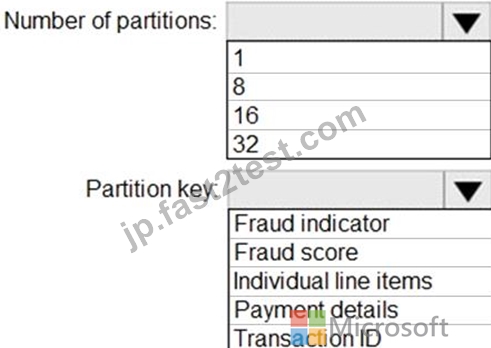
正解:
解説:
Reference:
https://docs.microsoft.com/en-us/azure/event-hubs/event-hubs-features#partitions
質問 95
......
ベストなMicrosoft DP-201学習ガイドと問題集には2021:https://jp.fast2test.com/DP-201-premium-file.html