

無料でゲット!2025年最新のに更新されたFortinet FCP_ZCS-AD-7.4試験問題と解答
FCP_ZCS-AD-7.4問題集PDFとテストエンジン試験問題
質問 # 11
You want to take advantage of Azure availability zones for your cloud-based Fortinet deployment.
Which two benefits do Azure availability zones provide? (Choose two.)
- A. Improve database performance and reliability
- B. Enhanced protection for application and data in a single Azure region
- C. Protect applications and data through high availability with fault isolation and redundancy
- D. Protect applications and data across multiple Azure regions
正解:B、C
解説:
Enhanced protection for application and data in a single Azure region - Availability Zones provide physical separation of infrastructure within a single Azure region, protecting against datacenter-level failures.
Protect applications and data through high availability with fault isolation and redundancy - They offer fault isolation and redundancy, enabling high availability for applications and services by distributing them across multiple zones within the same region.
質問 # 12
When you deploy a single FortiGate VM using the available template from the Azure Marketplace, several other resources are also created.
Which two resources, among others, are created during the process? (Choose two.)
- A. Two virtual NICs
- B. One VM Scale set
- C. One new route table
- D. One NSG for each interface
正解:A、D
解説:
Two virtual NICs - The FortiGate Azure Marketplace template deploys the VM with at least two network interfaces: one for the external/public interface and one for the internal/private interface.
One NSG for each interface - The deployment creates separate Network Security Groups (NSGs) attached to each NIC to control inbound and outbound traffic as per Fortinet's best practices.
質問 # 13
Why would you use a user-defined route in Azure?
- A. To allow communication between FortiGate VMs on two subnets in the same VNET
- B. To allow inbound management access to FortiGate VMs
- C. To have the traffic from the other VMs inspected by FortiGate
- D. To manage user authentication and access control
正解:C
解説:
Auser-defined route (UDR)in Azure is used toredirect trafficfrom other VMsthrough a FortiGate VM for inspection. By modifying the routing table, you ensure that outbound or inter-subnet traffic issent to the FortiGate as the next hop, enablingtraffic filtering, logging, and security enforcement.
質問 # 14
How does Azure ExpressRoute contribute to achieving predictable latency for network traffic?
- A. By prioritizing Azure ExpressRoute traffic over other network traffic
- B. By establishing dedicated private connections to Azure data centers
- C. By using public internet connections for enhanced routing flexibility
- D. By relying on load balancing to dynamically optimize latency
正解:B
解説:
Azure ExpressRouteprovidesdedicated private connectionsbetween on-premises infrastructure and Azure data centers, bypassing the public internet. This results inmore predictable latency, higher reliability, and better security, making it ideal for mission-critical workloads.
質問 # 15
In Microsoft Entra ID, what is the primary administrative unit that represents an organization and its relationship with Microsoft's cloud services?
- A. Microsoft Entra domain
- B. Microsoft Entra subscription
- C. Microsoft Entra tenant
- D. Microsoft Entra organization
正解:C
解説:
AMicrosoft Entra tenantis theprimary administrative unitthat represents an organization within Microsoft' s identity platform. It defines theboundary for identity management, access control, and resource governance, and serves as the core entity that connects the organization to Microsoft's cloud services such as Azure and Microsoft 365.
質問 # 16
Refer to the exhibit.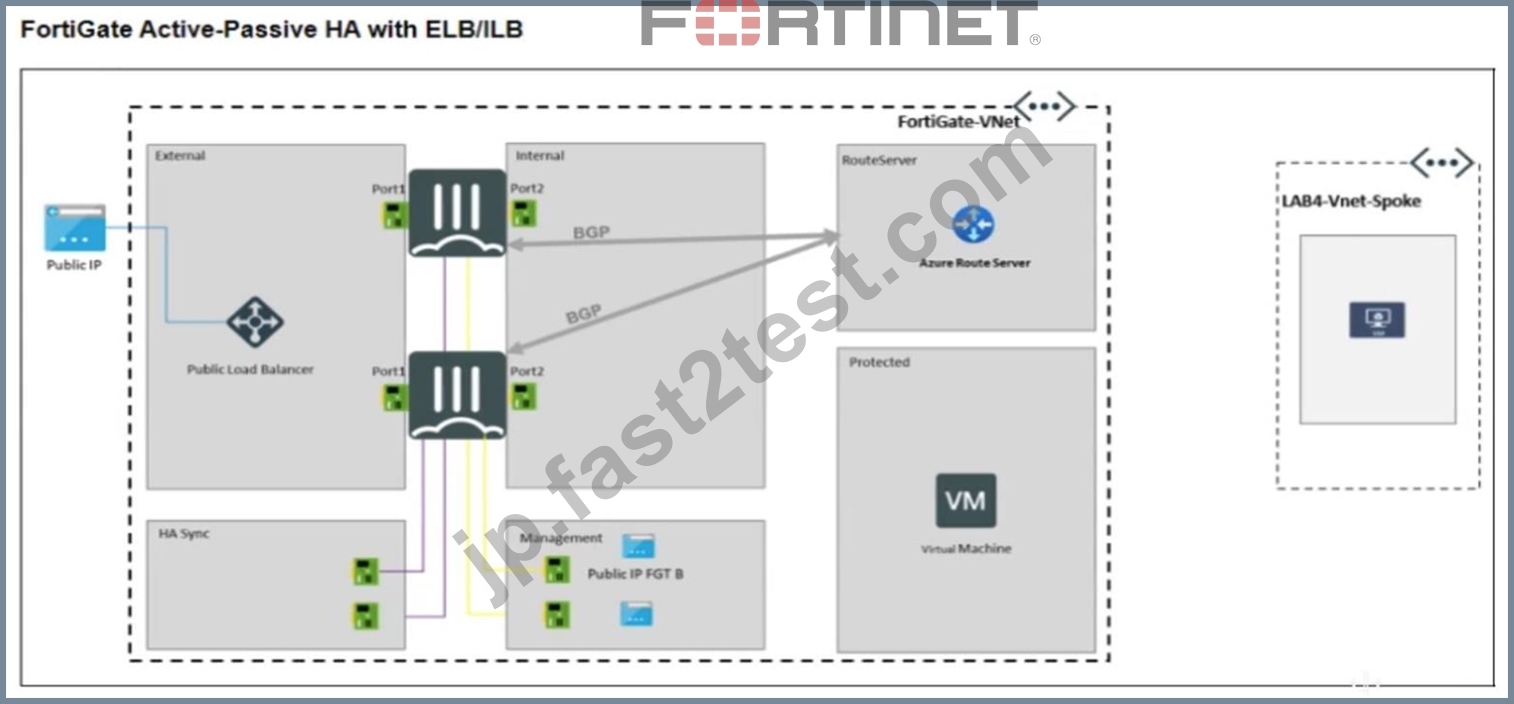
An Azure Route Server and an active-passive FortiGate with Elastic Load Balancing (ELB) and Internal Load Balancing (ILB) have been deployed successfully and they are sharing and populating BGP routes in the Protected VNet.
A Linux server has been deployed in a new VNet spoke. It is expected that Azure Route Server should inject the FortiGate BGP routes into the Linux server but that failed.
How can you diagnose the problem?
- A. Review FortiGate BGP neighbors
- B. Monitor effective routes on the Azure network interface (NIC) of the Linux server
- C. Verify the BGP setup on Azure Route Server
- D. Linux server doesn't support BGP negotiation with Azure Route Server
正解:B
解説:
TheLinux server in the spoke VNet cannot directly peer BGP with the Azure Route Server, as it is not a BGP-enabled device. Instead,Azure propagates routes to VMs through the effective route tables associated with theirnetwork interfaces (NICs). Therefore, to diagnose why BGP routes are notreaching the Linux VM, you shouldmonitor the effective routes on the NICto verify if the routes from the FortiGate (via the Route Server) are being injected properly.
質問 # 17
What is a key distinction between Azure Firewall and FortiGate VM in terms of their primary functions?
- A. Azure Firewall focuses on network traffic inspection, while FortiGate VM is primarily a web application firewall.
- B. Azure Firewall and FortiGate VM have identical primary functions, and no features differentiation.
- C. Azure Firewall is designed exclusively for application layer filtering, while FortiGate VM is suitable for both on-premises and cloud environments.
- D. Azure Firewall is a cloud-native network security service, while FortiGate VM is a network virtual appliance (NVA) that provides comprehensive security functions.
正解:D
解説:
Azure Firewallis acloud-native, fully managednetwork security servicedesigned to control and log network traffic using Azure policies. In contrast, theFortiGate VMis anetwork virtual appliance (NVA)that delivers comprehensive security features, including firewalling, IPS, antivirus, VPN, and application control, suitable forboth on-premises and cloud deployments.
質問 # 18
In the context of Azure Route Server, what is a primary function of the route server subnet?
- A. Hosting virtual machines for routing propagation purposes
- B. Providing DNS resolution for on-premises networks
- C. Serving as the hub for the exchange of routing information
- D. Acting as a dedicated subnet to host network virtual appliances (NVAs) with routing propagation capabilities
正解:C
解説:
Theroute server subnetin Azure is adedicated subnetthat hosts theAzure Route Server, which functions as thehub for dynamic routing information exchangebetween Azure virtual networks and BGP-enabled network virtual appliances (NVAs) or on-premises routers. It enables seamless and centralized route propagation.
質問 # 19
How does Azure ExpressRoute contribute to achieving predictable latency for network traffic?
- A. By prioritizing Azure ExpressRoute traffic over other network traffic
- B. By establishing dedicated private connections to Azure data centers
- C. By using public internet connections for enhanced routing flexibility
- D. By relying on load balancing to dynamically optimize latency
正解:B
解説:
Azure ExpressRouteprovidesdedicated private connectionsbetween on-premises infrastructure and Azure data centers, bypassing the public internet. This results inmore predictable latency, higher reliability, and better security, making it ideal for mission-critical workloads.
質問 # 20
What is a limitation of the Network Security Groups (NSGs) in Azure?
- A. NSGs cannot be applied to individual virtual machines.
- B. NSGs operate at the application layer, limiting their effectiveness in the network layer.
- C. NSGs are applied only to vNICs.
- D. NSGs allow the filtering of inbound traffic only.
正解:C
解説:
Alimitation of NSGsis that they are applied only at thesubnet level or to network interfaces (vNICs), not directly to other resources like load balancers or application gateways. This meansgranular application- layer filteringis not supported, andNSGs primarily operate at Layers 3 and 4.
質問 # 21
Refer to the exhibits.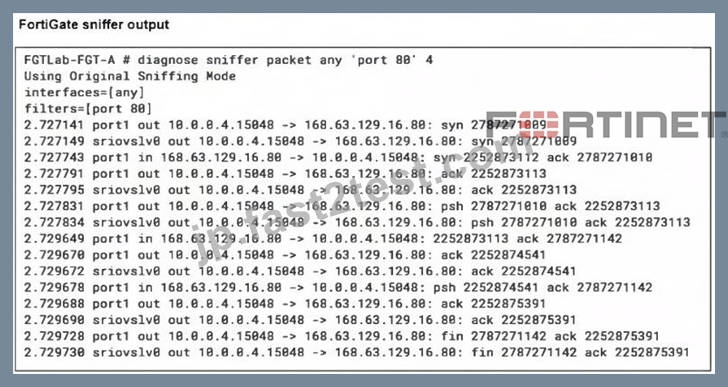
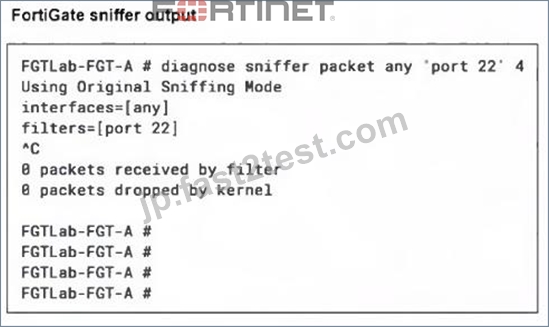
A high availability (HA) active-active FortiGate with Elastic Load Balancing (ELB) and Internal Load Balancing (ILB) was deployed with a default setup to filter traffic to a Linux server running Apache server.
Ports 80 and 22 are open on the Linux server, and on FortiGate a VIP and firewall policy are configured to allow traffic through ports 80 and 22. Traffic on port 80 is successful, but traffic on port 22 is not detected by FortiGate.
What configuration changes could you perform to allow SSH traffic?
- A. Include the Linux server in the back-end pool options
- B. Add a new Inbound NAT rule
- C. Add a new Azure load balancing rule
- D. Configure a customized port under the Frontend IP configuration
正解:B
解説:
Sinceport 80 traffic is reaching the FortiGate(as shown in the sniffer output) butport 22 traffic is not, the issue liesbefore the FortiGate, at theAzure Load Balancer level. Azure Load Balancers require anInbound NAT ruleto forward specific ports (like SSH on port 22) to a specific backend VM. Creating a newInbound NAT rule for port 22will allow SSH traffic to be properly routed to the FortiGate VM.
質問 # 22
What are two characteristics of Azure standard public IP addresses? (Choose two.)
- A. They can be used with load balancers of any SKU
- B. They require the configuration of NSGs for inbound traffic
- C. They can be dynamic or static
- D. They support the use of availability zones
正解:C、D
解説:
They support the use of availability zones - Standard public IP addresses are zone-redundant and support availability zone deployments for high availability.
They can be dynamic or static - Azure standard public IPs can be configured as static or dynamic, offering flexibility based on deployment needs.
質問 # 23
Your organization is planning to deploy FortiWeb in Azure to provide a web application security solution to its web servers. One of the requirements is to have granular control of the number of vCPUs and memory assigned to this resource.
Which cloud model could meet this requirement?
- A. Software-as-a-Service (SaaS)
- B. Platform-as-a-Service (PaaS)
- C. Infrastructure-as-a-Service (IaaS)
- D. Function-as-a-Service (FaaS)
正解:C
解説:
Infrastructure-as-a-Service (IaaS)allows you to deploy FortiWeb as a virtual machine in Azure, giving you granular control over vCPU and memory allocation. This model provides full flexibility over the compute resources and network configuration, which is essential for deploying and scaling security appliances like FortiWeb.
質問 # 24
Refer to the exhibit.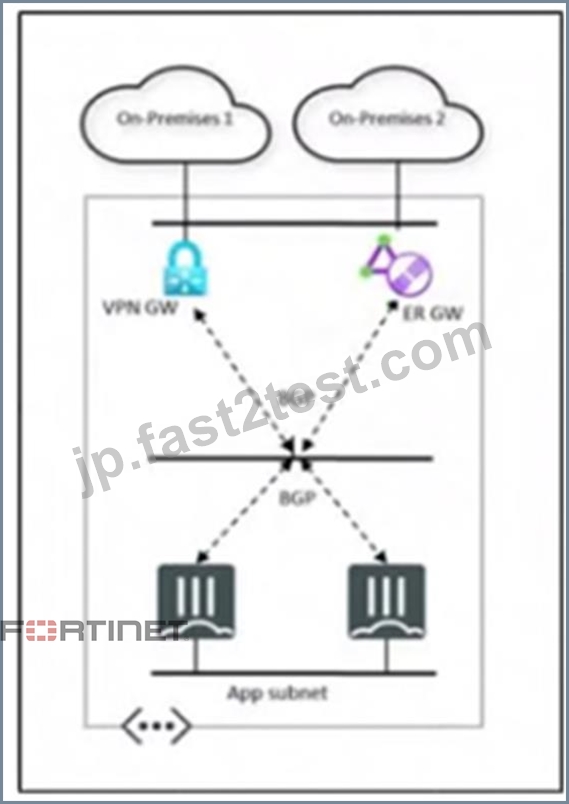
In an expanding corporation, the different branches share resources connecting to Azure through Azure VPN Gateway and ExpressRoute Gateway.
Which Azure solution can you implement to simplify and centralize the seamless sharing of the dynamic routing between FortiGate VMs and branches?
- A. Azure Route Server
- B. Azure Traffic Manager
- C. Azure Virtual Hub
- D. Azure Virtual WAN
正解:A
解説:
Azure Route Serversimplifies dynamic routing by allowing yourFortiGate VMsto exchange BGP routes directly with Azure's networking fabric. This eliminates the need to manually update route tables and enables seamless, centralized communication between on-premises branches and Azure resources through bothVPN GatewayandExpressRoute Gateway.
質問 # 25
Which statement about deploying VMs in a gateway subnet is true?
- A. VMs can be deployed in a gateway subnet only after you deploy the VPN Gateway
- B. VMs are required in a gateway subnet
- C. VMs are not allowed in a gateway subnet
- D. VMs are automatically deployed in a gateway subnet
正解:C
解説:
Azure does not allow the deployment of virtual machines (VMs) in a gateway subnet.The gateway subnet is specifically reserved forAzure VPN Gateway or ExpressRoute Gateway instances, and deploying other resources in it can causegateway deployment or operation failures.
質問 # 26
......
検証済みのFCP_ZCS-AD-7.4テスト問題集と解答で正確な37問題と解答あります:https://jp.fast2test.com/FCP_ZCS-AD-7.4-premium-file.html
最新をゲットせよ!FCP_ZCS-AD-7.4認定有効な試験問題集解答:https://drive.google.com/open?id=1byr_M2gIStd2rDCDwPVxamMAWmYcnPUV