

検証済みSSCP日本語問題集と解答100%合格はここにFast2test
合格させるSSCP日本語試験一発合格保証2024問題集!
質問 # 517
リスク評価レポートを作成する場合、次の項目のうちどれを含めるべきですか?
(該当するものをすべて選択してください)
- A. 使用された攻撃方法
- B. 頻繁なセキュリティ違反者の名前
- C. 脆弱性レベル
- D. データ機密レベル
- E. ALE 計算
正解:C、D、E
質問 # 518
TCSEC (オレンジブック) で裁量的保護として定義されているクラスは次のうちどれですか?
- A. A
- B. D
- C. B
- D. C
正解:D
質問 # 519
論理リンク制御サブレイヤーは、次のうちどれの一部ですか?
- A. 変更管理コントロール
- B. ISO/OSI データ リンク層
- C. TCP/IP スタック モデルのトランスポート層
- D. 参照モニター
正解:A
解説:
The MAC address is 48 bits long, 24 of which identify the vendor, as provided by the IEEE.
The other 24 bits are provided by the vendor.
A media access control address (MAC address) is a unique identifier assigned to network interfaces for communications on the physical network segment. MAC addresses are used for numerous network technologies and most IEEE 802 network technologies, including Ethernet.
Logically, MAC addresses are used in the media access control protocol sublayer of the OSI reference model.
MAC addresses are most often assigned by the manufacturer of a network interface card (NIC) and are stored in its hardware, such as the card's read-only memory or some other firmware mechanism. If assigned by the manufacturer, a MAC address usually encodes the manufacturer's registered identification number and may be referred to as the burned-in address. It may also be known as an Ethernet hardware address (EHA), hardware address or physical address. This is can be contrasted to a programmed address, where the host device issues commands to the NIC to use an arbitrary address. An example is many SOHO routers, where the ISP grants access to only one MAC address (used previously to inserting the router) so the router must use that MAC address on its Internet-facing NIC. Therefore the router administrator configures a MAC address to override the burned-in one.
A network node may have multiple NICs and each must have one unique MAC address per NIC.
See diagram below from Wikipedia showing the format of a MAC address. :
MAC Address format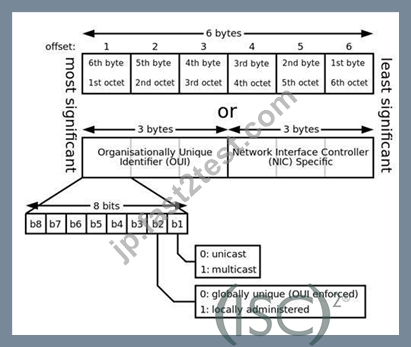
質問 # 520
セッション監視が行われていることを外部ユーザーに通知するのに最も適切なのは、次のうちどれですか?
- A. 同意書
- B. 従業員ハンドブック
- C. ログオン バナー
- D. ウォールポスター
正解:C
解説:
Banners at the log-on time should be used to notify external users of any monitoring that is being conducted. A good banner will give you a better legal stand and also makes it obvious the user was warned about who should access the system and if it is an unauthorized user then he is fully aware of trespassing.
This is a tricky question, the keyword in the question is External user.
There are two possible answers based on how the question is presented, this question could either apply to internal users or ANY anonymous user.
Internal users should always have a written agreement first, then logon banners serve as a constant reminder.
Anonymous users, such as those logging into a web site, ftp server or even a mail server; their only notification system is the use of a logon banner.
References used for this question:
KRUTZ, Ronald L. & VINES, Russel D., The CISSP Prep Guide: Mastering the Ten Domains of Computer Security, 2001, John Wiley & Sons, Page 50. and Shon Harris, CISSP All-in-one, 5th edition, pg 873
質問 # 521
エンド システム間でパケットがルーティングされる方法を定義する層はどれですか?
- A. ネットワーク層
- B. セッション層
- C. データリンク層
- D. トランスポート層
正解:A
解説:
The data link layer (layer 2) establishes the communications link between individual devices over a physical link or channel. It also ensures that messages are delivered to the proper device and translates the messages from layers above into bits for the physical layer (layer 1) to transmit.
質問 # 522
コンピュータ化された情報システムが頻繁にユーザーのニーズを満たさない理由を最もよく説明しているのは、次のうちどれですか?
- A. 不十分な品質保証 (QA) ツール。
- B. ユーザーのニーズは絶えず変化しています。
- C. 不適切なプロジェクト管理。
- D. システムの要件を定義する際のユーザーの参加が不十分です。
正解:D
解説:
Inadequate user participation in defining the system's requirements. Most projects fail to meet the needs of the users because there was inadequate input in the initial steps of the project from the user community and what their needs really are.
The other answers, while potentially valid, are incorrect because they do not represent the most common problem assosciated with information systems failing to meet the needs of users.
References: All in One pg 834
Only users can define what their needs are and, therefore, what the system should accomplish. Lack of adequate user involvement, especially in the systems requirements phase, will usually result in a system that doesn't fully or adequately address the needs of the user. Source: Information Systems Audit and Control Association, Certified Information Systems Auditor 2002 review manual, chapter 6: Business Application System Development, Acquisition, Implementation and Maintenance (page 296).
質問 # 523
次のうち、MIT の Project Athena で開発された信頼できるサード パーティ認証プロトコルはどれですか?
- A. クリプトナイト
- B. ネットSP
- C. ごま
- D. ケルベロス
正解:D
解説:
Kerberos is a trusted, third party authentication protocol that was developed under Project Athena at MIT.
Kerberos is a network authentication protocol. It is designed to provide strong authentication for client/server applications by using secret-key cryptography. A free implementation of this protocol is available from the Massachusetts Institute of Technology. Kerberos is available in many commercial products as well.
The Internet is an insecure place. Many of the protocols used in the Internet do not provide any security. Tools to "sniff" passwords off of the network are in common use by systems crackers. Thus, applications which send an unencrypted password over the network are extremely vulnerable. Worse yet, other client/server applications rely on the client program to be "honest" about the identity of the user who is using it. Other applications rely on the client to restrict its activities to those which it is allowed to do, with no other enforcement by the server.
Some sites attempt to use firewalls to solve their network security problems. Unfortunately, firewalls assume that "the bad guys" are on the outside, which is often a very bad assumption. Most of the really damaging incidents of computer crime are carried out by insiders. Firewalls also have a significant disadvantage in that they restrict how your users can use the Internet. (After all, firewalls are simply a less extreme example of the dictum that there is nothing more secure then a computer which is not connected to the network --and powered off!) In many places, these restrictions are simply unrealistic and unacceptable.
Kerberos was created by MIT as a solution to these network security problems. The Kerberos protocol uses strong cryptography so that a client can prove its identity to a server (and vice versa) across an insecure network connection. After a client and server have used Kerberos to prove their identity, they can also encrypt all of their communications to assure privacy and data integrity as they go about their business.
Kerberos is freely available from MIT, under a copyright permission notice very similar to the one used for the BSD operating and X11 Windowing system. MIT provides Kerberos in source form, so that anyone who wishes to use it may look over the code for themselves and assure themselves that the code is trustworthy. In addition, for those who prefer to rely on a professional supported product, Kerberos is available as a product from many different vendors.
In summary, Kerberos is a solution to your network security problems. It provides the tools of authentication and strong cryptography over the network to help you secure your information systems across your entire enterprise. We hope you find Kerberos as useful as it has been to us. At MIT, Kerberos has been invaluable to our Information/Technology architecture.
KryptoKnight is a Peer to Peer authentication protocol incorporated into the NetSP product from IBM.
SESAME is an authentication and access control protocol, that also supports communication confidentiality and integrity. It provides public key based authentication along with the Kerberos style authentication, that uses symmetric key cryptography. Sesame supports the Kerberos protocol and adds some security extensions like public key based authentication and an ECMA-style Privilege Attribute Service. The complete Sesame protocol is a two step process. In the first step, the client successfully authenticates itself to the Authentication Server and obtains a ticket that can be presented to the Privilege Attribute Server. In the second step, the initiator obtains proof of his access rights in the form of Privilege Attributes Certificate (PAC). The PAC is a specific form of Access Control Certificate as defined in the ECMA-219 document. This document describes the extensions to Kerberos for public key based authentication as adopted in Sesame.
SESAME, KryptoKnight, and NetSP never took off and the protocols are no longer commonly used.
References: http://www.cmf.nrl.navy.mil/CCS/people/kenh/kerberos-faq.html#whatis and Source: KRUTZ, Ronald L. & VINES, Russel D., The CISSP Prep Guide: Mastering the Ten Domains of Computer Security, 2001, John Wiley & Sons, Page 40.
質問 # 524
次のうち、脆弱性評価の結果の 1 つではないものはどれですか?
- A. 定量的損失評価
- B. 定性的損失評価
- C. クリティカル サポート エリアの定義
- D. BCP スコープと開始文書の正式承認
正解:B
解説:
A cold site is a permanent location that provide you with your own space that you can move into in case of a disaster or catastrophe. It is one of the cheapest solution available as a rental place but it is also the one that would take the most time to recover. A cold site usually takes one to two weeks for recoverey.
Although major disruptions with long-term effects may be rare, they should be accounted for in the contingency plan. The plan should include a trategy to recover and perform system operations at an alternate facility for an extended period. In general, three types of alternate sites are available:
Dedicated site owned or operated by the organization. Also called redundant or alternate sites; Reciprocal agreement or memorandum of agreement with an internal or external entity; and Commercially leased facility.
Regardless of the type of alternate site chosen, the facility must be able to support system operations as defined in the contingency plan. The three alternate site types commonly categorized in terms of their operational readiness are cold sites, warm sites, or hot sites. Other variations or combinations of these can be found, but generally all variations retain similar core features found in one of these three site types.
Progressing from basic to advanced, the sites are described below:
Cold Sites are typically facilities with adequate space and infrastructure (electric power, telecommunications connections, and environmental controls) to support information system recovery activities.
Warm Sites are partially equipped office spaces that contain some or all of the system hardware, software, telecommunications, and power sources.
Hot Sites are facilities appropriately sized to support system requirements and configured with the necessary system hardware, supporting infrastructure, and support personnel.
As discussed above, these three alternate site types are the most common. There are also variations, and hybrid mixtures of features from any one of the three. Each organization should evaluate its core requirements in order to establish the most effective solution.
Two examples of variations to the site types are:
Mobile Sites are self-contained, transportable shells custom-fitted with specific telecommunications and system equipment necessary to meet system requirements.
Mirrored Sites are fully redundant facilities with automated real-time information mirroring.
Mirrored sites are identical to the primary site in all technical respects.
There are obvious cost and ready-time differences among the options. In these examples, the mirrored site is the most expensive choice, but it ensures virtually 100 percent availability. Cold sites are the least expensive to maintain, although they may require substantial time to acquire and install necessary equipment. Partially equipped sites, such as warm sites, fall in the middle of the spectrum. In many cases, mobile sites may be delivered to the desired location within 24 hours, but the time necessary for equipment installation and setup can increase this response time. The selection of fixed-site locations should account for the time and mode of transportation necessary to move personnel and/or equipment there. In addition, the fixed site should be in a geographic area that is unlikely to be negatively affected by the same hazard as the organization's primary site.
質問 # 525
通常はログオン ID の形式で、ユーザーがシステムに対して ID を公言する行為を何と呼びますか?
- A. 認可
- B. 識別
- C. 認証
- D. 守秘義務
正解:B
解説:
Identification is the act of a user professing an identity to a system, usually in the form of a log-on ID to the system.
Identification is nothing more than claiming you are somebody. You identify yourself when you speak to someone on the phone that you don't know, and they ask you who they're speaking to. When you say, "I'm Jason.", you've just identified yourself.
In the information security world, this is analogous to entering a username. It's not analogous to entering a password. Entering a password is a method for verifying that you are who you identified yourself as.
NOTE: The word "professing" used above means: "to say that you are, do, or feel something when other people doubt what you say". This is exactly what happen when you provide your identifier (identification), you claim to be someone but the system cannot take your word for it, you must further Authenticate to the system to prove who you claim to be.
The following are incorrect answers:
Authentication: is how one proves that they are who they say they are. When you claim to be Jane Smith by logging into a computer system as "jsmith", it's most likely going to ask you for a password. You've claimed to be that person by entering the name into the username field (that's the identification part), but now you have to prove that you are really that person.
Many systems use a password for this, which is based on "something you know", i.e. a secret between you and the system.
Another form of authentication is presenting something you have, such as a driver's license, an RSA token, or a smart card.
You can also authenticate via something you are. This is the foundation for biometrics.
When you do this, you first identify yourself and then submit a thumb print, a retina scan, or another form of bio-based authentication.
Once you've successfully authenticated, you have now done two things: you've claimed to be someone, and you've proven that you are that person. The only thing that's left is for the system to determine what you're allowed to do.
Authorization: is what takes place after a person has been both identified and authenticated; it's the step determines what a person can then do on the system.
An example in people terms would be someone knocking on your door at night. You say,
"Who is it?", and wait for a response. They say, "It's John." in order to identify themselves.
You ask them to back up into the light so you can see them through the peephole. They do so, and you authenticate them based on what they look like (biometric). At that point you decide they can come inside the house.
If they had said they were someone you didn't want in your house (identification), and you then verified that it was that person (authentication), the authorization phase would not include access to the inside of the house.
Confidentiality: Is one part of the CIA triad. It prevents sensitive information from reaching the wrong people, while making sure that the right people can in fact get it. A good example is a credit card number while shopping online, the merchant needs it to clear the transaction but you do not want your informaiton exposed over the network, you would use a secure link such as SSL, TLS, or some tunneling tool to protect the information from prying eyes between point A and point B. Data encryption is a common method of ensuring confidentiality.
The other parts of the CIA triad are listed below: Integrity involves maintaining the consistency, accuracy, and trustworthiness of data over its entire life cycle. Data must not be changed in transit, and steps must be taken to ensure that data cannot be altered by unauthorized people (for example, in a breach of confidentiality). In addition, some means must be in place to detect any changes in data that might occur as a result of non-human-caused events such as an electromagnetic pulse (EMP) or server crash. If an unexpected change occurs, a backup copy must be available to restore the affected data to its correct state.
Availability is best ensured by rigorously maintaining all hardware, performing hardware repairs immediately when needed, providing a certain measure of redundancy and failover, providing adequate communications bandwidth and preventing the occurrence of bottlenecks, implementing emergency backup power systems, keeping current with all necessary system upgrades, and guarding against malicious actions such as denial-ofservice (DoS) attacks.
Reference used for this question:
http://whatis.techtarget.com/definition/Confidentiality-integrity-and-availability-CIA http://www.danielmiessler.com/blog/security-identification-authentication-and-authorization http://www.merriam-webster.com/dictionary/profess KRUTZ, Ronald L. & VINES, Russel D., The CISSP Prep Guide: Mastering the Ten Domains of Computer Security, 2001, John Wiley & Sons, Page 36.
質問 # 526
誠実さ = _______________
- A. 要求されたときにデータにアクセスする機能
- B. ソースから目的の受信者に変更されることなく配信されるデータ
- C. 権限のないユーザーからのデータの保護
- D. 答えはすべて正解です
- E. データは正しく最新に保たれています
正解:B
質問 # 527
次のうち、詐欺目的で操作を妨害するために共謀を使用または実行する機会を妨害するために使用されるものはどれですか?
- A. 知る必要の原則
- B. 最小権限の原則
- C. キーエスクロー
- D. 職務のローテーション
正解:D
解説:
Job rotations reduce the risk of collusion of activities between individuals. Companies with individuals working with sensitive information or systems where there might be the opportunity for personal gain through collusion can benefit by integrating job rotation with segregation of duties. Rotating the position may uncover activities that the individual is performing outside of the normal operating procedures, highlighting errors or fraudulent behavior.
Rotation of duties is a method of reducing the risk associated with a subject performing a (sensitive) task by limiting the amount of time the subject is assigned to perform the task before being moved to a different task.
The following are incorrect answers: Key escrow is related to the protection of keys in storage by splitting the key in pieces that will be controlled by different departments. Key escrow is the process of ensuring a third party maintains a copy of a private key or key needed to decrypt information. Key escrow also should be considered mandatory for most organization's use of cryptography as encrypted information belongs to the organization and not the individual; however often an individual's key is used to encrypt the information.
Separation of duties is a basic control that prevents or detects errors and irregularities by assigning responsibility for different parts of critical tasks to separate individuals, thus limiting the effect a single person can have on a system. One individual should not have the capability to execute all of the steps of a particular process. This is especially important in critical business areas, where individuals may have greater access and capability to modify, delete, or add data to the system. Failure to separate duties could result in individuals embezzling money from the company without the involvement of others.
The need-to-know principle specifies that a person must not only be cleared to access classified or other sensitive information, but have requirement for such information to carry out assigned job duties. Ordinary or limited user accounts are what most users are assigned. They should be restricted only to those privileges that are strictly required, following the principle of least privilege. Access should be limited to specific objects following the principle of need-to-know.
The principle of least privilege requires that each subject in a system be granted the most restrictive set of privileges (or lowest clearance) needed for the performance of authorized tasks. Least privilege refers to granting users only the accesses that are required to perform their job functions. Some employees will require greater access than others based upon their job functions. For example, an individual performing data entry on a mainframe system may have no need for Internet access or the ability to run reports regarding the information that they are entering into the system. Conversely, a supervisor may have the need to run reports, but should not be provided the capability to change information in the database.
Reference(s) used for this question:
Hernandez CISSP, Steven (2012-12-21). Official (ISC)2 Guide to the CISSP CBK, Third Edition ((ISC)2 Press) (Kindle Locations 10628-10631). Auerbach Publications. Kindle Edition. and Hernandez CISSP, Steven (2012-12-21). Official (ISC)2 Guide to the CISSP CBK, Third Edition ((ISC)2 Press) (Kindle Locations 10635-10638). Auerbach Publications. Kindle Edition. and Hernandez CISSP, Steven (2012-12-21). Official (ISC)2 Guide to the CISSP CBK, Third Edition ((ISC)2 Press) (Kindle Locations 10693-10697). Auerbach Publications. Kindle Edition. and Hernandez CISSP, Steven (2012-12-21). Official (ISC)2 Guide to the CISSP CBK, Third Edition ((ISC)2 Press) (Kindle Locations 16338-16341). Auerbach Publications. Kindle Edition.
質問 # 528
ケーブル モデムは他の加入者と共有されるため、DSL 接続よりも安全性が低くなります。
- A. 偽
- B. 真
正解:A
質問 # 529
次のテープ形式のうち、元の意図されたオーディオ用途に加えて、データ システムのバックアップに使用できるものはどれですか?
- A. デジタル ビデオ テープ (DVT)。
- B. デジタル アナログ テープ (DAT)。
- C. デジタル オーディオ テープ (DAT)。
- D. デジタル音声テープ (DVT)。
正解:A
解説:
Hierarchical Storage Management (HSM) provides a continuous on-line backup by using optical or tape "jukeboxes," similar to WORMs.
質問 # 530
バイオメトリクスでは、個人が行った身元の主張を検証するために使用される「1 対 1」の検索が考慮されます。
- A. 認可
- B. 認証
- C. 監査
- D. 識別
正解:B
解説:
Biometric devices can be use for either IDENTIFICATION or AUTHENTICATION ONE TO ONE is for AUTHENTICATION This means that you as a user would provide some biometric credential such as your fingerprint. Then they will compare the template that you have provided with the one stored in the Database. If the two are exactly the same that prove that you are who you pretend to be.
ONE TO MANY is for IDENTIFICATION A good example of this would be within airport. Many airports today have facial recognition cameras, as you walk through the airport it will take a picture of your face and then compare the template (your face) with a database full of templates and see if there is a match between your template and the ones stored in the Database. This is for IDENTIFICATION of a person.
Some additional clarification or comments that might be helpful are: Biometrics establish authentication using specific information and comparing results to expected data. It does not perform well for identification purposes such as scanning for a person's face in a moving crowd for example.
Identification methods could include: username, user ID, account number, PIN, certificate, token, smart card, biometric device or badge.
Auditing is a process of logging or tracking what was done after the identity and authentication process is completed.
Authorization is the rights the subject is given and is performed after the identity is established.
Reference OIG (2007) p148, 167
Authentication in biometrics is a "one-to-one" search to verify claim to an identity made by a person.
Source: KRUTZ, Ronald L. & VINES, Russel D., The CISSP Prep Guide: Mastering the Ten Domains of Computer Security, 2001, John Wiley & Sons, Page 38.
質問 # 531
詐欺と横領の違いは________________-です。
- A. 詐欺 = 軽犯罪。横領=重罪
- B. 横領は宣伝に関係します。詐欺は個人的な利益を目的としています
- C. 詐欺 = 金銭または商品。横領=お金だけ
- D. 違いはありません、詐欺と横領は同じです
- E. 不正行為 = ハードウェア/ソフトウェアの削除。横領 = データのみの削除
正解:C
質問 # 532
......
SSCP日本語問題集完全版解答試験学習ガイド:https://jp.fast2test.com/SSCP-JPN-premium-file.html