

検証済み!Associate-Data-Practitioner問題集と解答でAssociate-Data-Practitionerテストエンジン正確解答付き
あなたを必ず合格させるAssociate-Data-Practitioner問題集PDF2025年最新のに更新された108問あります
質問 # 51
You recently inherited a task for managing Dataflow streaming pipelines in your organization and noticed that proper access had not been provisioned to you. You need to request a Google-provided IAM role so you can restart the pipelines. You need to follow the principle of least privilege. What should you do?
- A. Request the Dataflow Viewer role.
- B. Request the Dataflow Developer role.
- C. Request the Dataflow Admin role.
- D. Request the Dataflow Worker role.
正解:B
解説:
The Dataflow Developer role provides the necessary permissions to manage Dataflow streaming pipelines, including the ability to restart pipelines. This role adheres to the principle of least privilege, as it grants only the permissions required to manage and operate Dataflow jobs without unnecessary administrative access. Other roles, such as Dataflow Admin, would grant broader permissions, which are not needed in this scenario.
質問 # 52
Your company uses Looker as its primary business intelligence platform. You want to use LookML to visualize the profit margin for each of your company's products in your Looker Explores and dashboards. You need to implement a solution quickly and efficiently. What should you do?
- A. Define a new measure that calculates the profit margin by using the existing revenue and cost fields.
- B. Create a new dimension that categorizes products based on their profit margin ranges (e.g., high, medium, low).
- C. Apply a filter to only show products with a positive profit margin.
- D. Create a derived table that pre-calculates the profit margin for each product, and include it in the Looker model.
正解:A
解説:
Comprehensive and Detailed in Depth Explanation:
Why B is correct:Defining a new measure in LookML is the most efficient and direct way to calculate and visualize aggregated metrics like profit margin.
Measures are designed for calculations based on existing fields.
Why other options are incorrect:A: Filtering doesn't calculate or visualize the profit margin itself.
C: Dimensions are for categorizing data, not calculating aggregated metrics.
D: Derived tables are more complex and unnecessary for a simple calculation like profit margin, which can be done using a measure.
質問 # 53
You recently inherited a task for managing Dataflow streaming pipelines in your organization and noticed that proper access had not been provisioned to you. You need to request a Google-provided IAM role so you can restart the pipelines. You need to follow the principle of least privilege. What should you do?
- A. Request the Dataflow Viewer role.
- B. Request the Dataflow Developer role.
- C. Request the Dataflow Admin role.
- D. Request the Dataflow Worker role.
正解:B
解説:
TheDataflow Developerrole provides the necessary permissions to manage Dataflow streaming pipelines, including the ability to restart pipelines. This role adheres to the principle of least privilege, as itgrants only the permissions required to manage and operate Dataflow jobs without unnecessary administrative access.
Other roles, such as Dataflow Admin, would grant broader permissions, which are not needed in this scenario.
質問 # 54
Your company uses Looker to generate and share reports with various stakeholders. You have a complex dashboard with several visualizations that needs to be delivered to specific stakeholders on a recurring basis, with customized filters applied for each recipient. You need an efficient and scalable solution to automate the delivery of this customized dashboard. You want to follow the Google-recommended approach. What should you do?
- A. Create a script using the Looker Python SDK, and configure user attribute filter values. Generate a new scheduled plan for each stakeholder.
- B. Create a separate LookML model for each stakeholder with predefined filters, and schedule the dashboards using the Looker Scheduler.
- C. Embed the Looker dashboard in a custom web application, and use the application's scheduling features to send the report with personalized filters.
- D. Use the Looker Scheduler with a user attribute filter on the dashboard, and send the dashboard with personalized filters to each stakeholder based on their attributes.
正解:D
解説:
Using the Looker Scheduler with user attribute filters is the Google-recommended approach to efficiently automate the delivery of a customized dashboard. User attribute filters allow you to dynamically customize the dashboard's content based on the recipient's attributes, ensuring each stakeholder sees data relevant to them. This approach is scalable, does not require creating separate models or custom scripts, and leverages Looker's built-in functionality to automate recurring deliveries effectively.
質問 # 55
Your retail company wants to predict customer churn using historical purchase data stored in BigQuery. The dataset includes customer demographics, purchase history, and a label indicating whether the customer churned or not. You want to build a machine learning model to identify customers at risk of churning. You need to create and train a logistic regression model for predicting customer churn, using the customer_data table with the churned column as the target label. Which BigQuery ML query should you use?
- A. CREATE OR REPLACE MODEL churn_prediction_model OPTIONS(model_uype='logisric_reg') AS SELECT * from cusromer_data;
- B. CREATE OR REPLACE MODEL churn_prediction_model OPTIONS (rr.odel_type=' logisric_reg *) AS select * except(churned), churned AS label FROM customer_data;
- C. CREATE OR REPLACE MODEL churn_prediction_model options (model type='logistic_reg') AS select churned as label FROM customer_data;
- D. CREATE OR REPLACE MODEL churn_prediction_model options(model_type='logistic_reg*) as select ' except(churned) FROM customer data;
正解:B
解説:
Comprehensive and Detailed in Depth Explanation:
Why B is correct:BigQuery ML requires the target label to be explicitly named label.
EXCEPT(churned) selects all columns except the churned column, which becomes the features.
churned AS label renames the churned column to label, which is required for BigQuery ML.
logistic_reg is the correct model_type option.
Why other options are incorrect:A: Does not rename the target column to label. Also has a typo in the model type.
C: Only selects the target label, not the features.
D: Has a syntax error with the single quote before except.
質問 # 56
You manage a large amount of data in Cloud Storage, including raw data, processed data, and backups. Your organization is subject to strict compliance regulations that mandate data immutability for specific data types.
You want to use an efficient process to reduce storage costs while ensuring that your storage strategy meets retention requirements. What should you do?
- A. Use object holds to enforce immutability for specific objects, and configure lifecycle management rules to transition objects to appropriate storage classes based on age and access patterns.
- B. Create a Cloud Run function to periodically check object metadata, and move objects to the appropriate storage class based on age and access patterns. Use object holds to enforce immutability for specific objects.
- C. Configure lifecycle management rules to transition objects to appropriate storage classes based on access patterns. Set up Object Versioning for all objects to meet immutability requirements.
- D. Move objects to different storage classes based on their age and access patterns. Use Cloud Key Management Service (Cloud KMS) to encrypt specific objects with customer-managed encryption keys (CMEK) to meet immutability requirements.
正解:A
解説:
Usingobject holdsandlifecycle management rulesis the most efficient and compliant strategy for this scenario because:
* Immutability: Object holds (temporary or event-based) ensure that objects cannot be deleted or overwritten, meeting strict compliance regulations for data immutability.
* Cost efficiency: Lifecycle management rules automatically transition objects to more cost-effective storage classes based on their age and access patterns.
* Compliance and automation: This approach ensures compliance with retention requirements while reducing manual effort, leveraging built-in Cloud Storage features.
質問 # 57
Your organization sends IoT event data to a Pub/Sub topic. Subscriber applications read and perform transformations on the messages before storing them in the data warehouse. During particularly busy times when more data is being written to the topic, you notice that the subscriber applications are not acknowledging messages within the deadline. You need to modify your pipeline to handle these activity spikes and continue to process the messages. What should you do?
- A. Forward unacknowledged messages to a dead-letter topic.
- B. Retry messages until they are acknowledged.
- C. Seek back to the last acknowledged message.
- D. Implement flow control on the subscribers
正解:D
解説:
Implementing flow control on the subscribers allows the subscriber applications to manage message processing during activity spikes by controlling the rate at which messages are pulled and processed. This prevents overwhelming the subscribers and ensures that messages are acknowledged within the deadline. Flow control helps maintain the stability of your pipeline during high-traffic periods without dropping or delaying messages unnecessarily.
質問 # 58
You want to process and load a daily sales CSV file stored in Cloud Storage into BigQuery for downstream reporting. You need to quickly build a scalable data pipeline that transforms the data while providing insights into data quality issues. What should you do?
- A. Load the CSV file as a table in BigQuery, and use scheduled queries to run SQL transformation scripts.
- B. Create a batch pipeline in Dataflow by using the Cloud Storage CSV file to BigQuery batch template.
- C. Create a batch pipeline in Cloud Data Fusion by using a Cloud Storage source and a BigQuery sink.
- D. Load the CSV file as a table in BigQuery. Create a batch pipeline in Cloud Data Fusion by using a BigQuery source and sink.
正解:C
解説:
Using Cloud Data Fusion to create a batch pipeline with a Cloud Storage source and a BigQuery sink is the best solution because:
Scalability: Cloud Data Fusion is a scalable, fully managed data integration service.
Data transformation: It provides a visual interface to design pipelines, enabling quick transformation of data.
Data quality insights: Cloud Data Fusion includes built-in tools for monitoring and addressing data quality issues during the pipeline creation and execution process.
質問 # 59
You have a Cloud SQL for PostgreSQL database that stores sensitive historical financial data. You need to ensure that the data is uncorrupted and recoverable in the event that the primary region is destroyed. The data is valuable, so you need to prioritize recovery point objective (RPO) over recovery time objective (RTO). You want to recommend a solution that minimizes latency for primary read and write operations. What should you do?
- A. Configure the Cloud SQL for PostgreSQL instance for multi-region backup locations.
- B. Configure the Cloud SQL for PostgreSQL instance for regional availability (HA) with synchronous replication to a secondary instance in a different zone.
- C. Configure the Cloud SQL for PostgreSQL instance for regional availability (HA) with asynchronous replication to a secondary instance in a different region.
- D. Configure the Cloud SQL for PostgreSQL instance for regional availability (HA). Back up the Cloud SQL for PostgreSQL database hourly to a Cloud Storage bucket in a different region.
正解:A
解説:
Comprehensive and Detailed In-Depth Explanation:
The priorities are data integrity, recoverability after a regional disaster, low RPO (minimal data loss), and low latency for primary operations. Let's analyze:
* Option A: Multi-region backups store point-in-time snapshots in a separate region. With automated backups and transaction logs, RPO can be near-zero (e.g., minutes), and recovery is possible post- disaster. Primary operations remain in one zone, minimizing latency.
* Option B: Regional HA (failover to another zone) with hourly cross-region backups protects against zone failures, but hourly backups yield an RPO of up to 1 hour-too high for valuable data. Manual backup management adds overhead.
* Option C: Synchronous replication to another zone ensures zero RPO within a region but doesn't protect against regional loss. Latency increases slightly due to sync writes across zones.
質問 # 60
You are constructing a data pipeline to process sensitive customer data stored in a Cloud Storage bucket. You need to ensure that this data remains accessible, even in the event of a single-zone outage. What should you do?
- A. Enable Object Versioning on the bucket.
- B. Store the data in a multi-region bucket.
- C. Set up a Cloud CDN in front of the bucket.
- D. Store the data in Nearline storaqe.
正解:B
解説:
Storing the data in amulti-region bucketensures high availability and durability, even in the event of a single- zone outage. Multi-region buckets replicate data across multiple locations within the selected region, providing resilience against zone-level failures and ensuring that the data remains accessible. This approach is particularly suitable for sensitive customer data that must remain available without interruptions.
A single-zone outage requires high availability across zones or regions. Cloud Storage offers location-based redundancy options:
* Option A: Cloud CDN caches content for web delivery but doesn't protect against underlying storage outages-it's for performance, not availability of the source data.
* Option B: Object Versioning retains old versions of objects, protecting against overwrites or deletions, but doesn't ensure availability during a zone failure (still tied to one location).
* Option C: Multi-region buckets (e.g., us or eu) replicate data across multiple regions, ensuring accessibility even if a single zone or region fails. This provides the highest availability for sensitive data in a pipeline.
質問 # 61
Your organization has a BigQuery dataset that contains sensitive employee information such as salaries and performance reviews. The payroll specialist in the HR department needs to have continuous access to aggregated performance data, but they do not need continuous access to other sensitive dat a. You need to grant the payroll specialist access to the performance data without granting them access to the entire dataset using the simplest and most secure approach. What should you do?
- A. Use authorized views to share query results with the payroll specialist.
- B. Create a table with the aggregated performance data. Use table-level permissions to grant access to the payroll specialist.
- C. Create a SQL query with the aggregated performance data. Export the results to an Avro file in a Cloud Storage bucket. Share the bucket with the payroll specialist.
- D. Create row-level and column-level permissions and policies on the table that contains performance data in the dataset. Provide the payroll specialist with the appropriate permission set.
正解:A
解説:
Using authorized views is the simplest and most secure way to grant the payroll specialist access to aggregated performance data without exposing the entire dataset. Authorized views allow you to create a view in BigQuery that contains only the query results for the aggregated performance data. The payroll specialist can query the view without being granted access to the underlying sensitive data. This approach ensures security, adheres to the principle of least privilege, and eliminates the need to manage complex row-level or column-level permissions.
質問 # 62
You are a database administrator managing sales transaction data by region stored in a BigQuery table. You need to ensure that each sales representative can only see the transactions in their region. What should you do?
- A. Grant the appropriate 1AM permissions on the dataset.
- B. Create a row-level access policy.
- C. Add a policy tag in BigQuery.
- D. Create a data masking rule.
正解:B
解説:
Creating arow-level access policyin BigQuery ensures that each sales representative can see only the transactions relevant to their region. Row-level access policies allow you to define fine-grained access control by filtering rows based on specific conditions, such as matching the sales representative's region. This approach enforces security while providing tailored data access, aligning with the principle of least privilege.
Extract from Google Documentation: From "Row-Level Security in BigQuery" (https://cloud.google.com
/bigquery/docs/row-level-security):"Row-level access policies let you restrict access to specific rows in a table based on a filter condition, such as a user's region, providing fine-grained control over data visibility without creating separate tables or views."
質問 # 63
Your team is building several data pipelines that contain a collection of complex tasks and dependencies that you want to execute on a schedule, in a specific order. The tasks and dependencies consist of files in Cloud Storage, Apache Spark jobs, and data in BigQuery. You need to design a system that can schedule and automate these data processing tasks using a fully managed approach. What should you do?
- A. Use Cloud Tasks to schedule and run the jobs asynchronously.
- B. Create directed acyclic graphs (DAGs) in Apache Airflow deployed on Google Kubernetes Engine. Use the appropriate operators to connect to Cloud Storage, Spark, and BigQuery.
- C. Create directed acyclic graphs (DAGs) in Cloud Composer. Use the appropriate operators to connect to Cloud Storage, Spark, and BigQuery.
- D. Use Cloud Scheduler to schedule the jobs to run.
正解:C
解説:
Using Cloud Composer to create Directed Acyclic Graphs (DAGs) is the best solution because it is a fully managed, scalable workflow orchestration service based on Apache Airflow. Cloud Composer allows you to define complex task dependencies and schedules while integrating seamlessly with Google Cloud services such as Cloud Storage, BigQuery, and Dataproc for Apache Spark jobs. This approach minimizes operational overhead, supports scheduling and automation, and provides an efficient and fully managed way to orchestrate your data pipelines.
質問 # 64
You are a database administrator managing sales transaction data by region stored in a BigQuery table. You need to ensure that each sales representative can only see the transactions in their region. What should you do?
- A. Grant the appropriate 1AM permissions on the dataset.
- B. Create a row-level access policy.
- C. Add a policy tag in BigQuery.
- D. Create a data masking rule.
正解:B
質問 # 65
Your retail company wants to predict customer churn using historical purchase data stored in BigQuery. The dataset includes customer demographics, purchase history, and a label indicating whether the customer churned or not. You want to build a machine learning model to identify customers at risk of churning. You need to create and train a logistic regression model for predicting customer churn, using the customer_data table with the churned column as the target label. Which BigQuery ML query should you use?
- A.
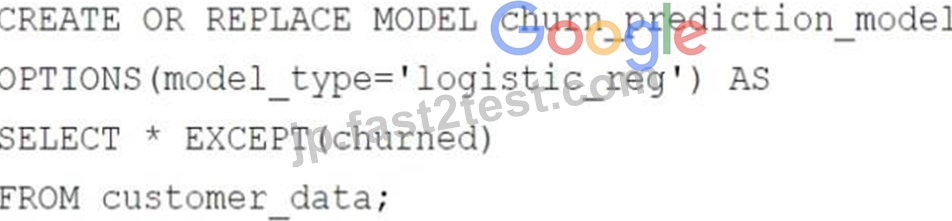
- B.

- C.
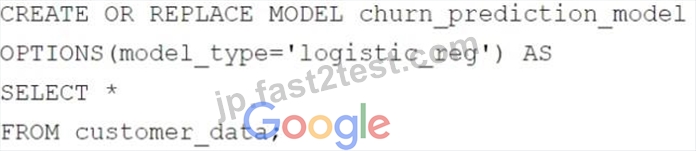
- D.

正解:B
解説:
In BigQuery ML, when creating a logistic regression model to predict customer churn, the correct query should:
Exclude the target label column (in this case, churned) from the feature columns, as it is used for training and not as a feature input.
Rename the target label column to label, as BigQuery ML requires the target column to be named label.
The chosen query satisfies these requirements:
SELECT * EXCEPT(churned), churned AS label: Excludes churned from features and renames it to label.
The OPTIONS(model_type='logistic_reg') specifies that a logistic regression model is being trained.
This setup ensures the model is correctly trained using the features in the dataset while targeting the churned column for predictions.
質問 # 66
You have created a LookML model and dashboard that shows daily sales metrics for five regional managers to use. You want to ensure that the regional managers can only see sales metrics specific to their region. You need an easy-to-implement solution. What should you do?
- A. Create a sales_region user attribute, and assign each manager's region as the value of their user attribute. Add an access_filter Explore filter on the region_name dimension by using the sales_region user attribute.
- B. Create five different Explores with the sql_always_filter Explore filter applied on the region_name dimension. Set each region_name value to the corresponding region for each manager.
- C. Create separate Looker instances for each regional manager. Copy the LookML model and dashboard to each instance. Provision viewer access to the corresponding manager.
- D. Create separate Looker dashboards for each regional manager. Set the default dashboard filter to the corresponding region for each manager.
正解:A
解説:
Using a sales_region user attribute is the best solution because it allows you to dynamically filter data based on each manager's assigned region. By adding an access_filter Explore filter on the region_name dimension that references the sales_region user attribute, each manager sees only the sales metrics specific to their region. This approach is easy to implement, scalable, and avoids duplicating dashboards or Explores, making it both efficient and maintainable.
質問 # 67
Your team uses the Google Ads platform to visualize metrics. You want to export the data to BigQuery to get more granular insights. You need to execute a one-time transfer of historical data and automatically update data daily. You want a solution that is low-code, serverless, and requires minimal maintenance. What should you do?
- A. Export the historical data as a CSV file. Import the file into BigQuery for analysis. Use Cloud Composer for daily automation.
- B. Export the historical data to Cloud Storage by using Storage Transfer Service. Use Pub/Sub to trigger a Dataflow template that loads data for daily automation.
- C. Export the historical data to BigQuery by using BigQuery Data Transfer Service. Use Cloud Composer for daily automation.
- D. Export the historical data to BigQuery by using BigQuery Data Transfer Service. Use BigQuery Data Transfer Service for daily automation.
正解:D
質問 # 68
You work for a healthcare company that has a large on-premises data system containing patient records with personally identifiable information (PII) such as names, addresses, and medical diagnoses. You need a standardized managed solution that de-identifies PII across all your data feeds prior to ingestion to Google Cloud. What should you do?
- A. Use Apache Beam to read the data and perform the necessary cleaning and transformation operations. Store the cleaned data in BigQuery.
- B. Use Cloud Data Fusion to transform the data. Store the cleaned data in BigQuery.
- C. Use Cloud Run functions to create a serverless data cleaning pipeline. Store the cleaned data in BigQuery.
- D. Load the data into BigQuery, and inspect the data by using SQL queries. Use Dataflow to transform the data and remove any errors.
正解:B
解説:
Using Cloud Data Fusion is the best solution for this scenario because:
Standardized managed solution: Cloud Data Fusion provides a visual interface for building data pipelines and includes prebuilt connectors and transformations for data cleaning and de-identification.
Compliance: It ensures sensitive data such as PII is de-identified prior to ingestion into Google Cloud, adhering to regulatory requirements for healthcare data.
Ease of use: Cloud Data Fusion is designed for transforming and preparing data, making it a managed and user-friendly tool for this purpose.
質問 # 69
You are designing an application that will interact with several BigQuery datasets. You need to grant the application's service account permissions that allow it to query and update tables within the datasets, and list all datasets in a project within your application. You want to follow the principle of least privilege. Which pre- defined IAM role(s) should you apply to the service account?
- A. roles/bigquery.admin
- B. roles/bigquery.jobUser and roles/bigquery.dataOwner
- C. roles/bigquery.user and roles/bigquery.filteredDataViewer
- D. roles/bigquery.connectionUser and roles/bigquery.dataViewer
正解:B
解説:
* roles/bigquery.jobUser:
* This role allows a user or service account to run BigQuery jobs, including queries. This is necessary for the application to interact with and query the tables.
* From Google Cloud documentation: "BigQuery Job User can run BigQuery jobs, including queries, load jobs, export jobs, and copy jobs."
* roles/bigquery.dataOwner:
* This role grants full control over BigQuery datasets and tables. It allows the service account to update tables, which is a requirement of the application.
* From Google Cloud documentation: "BigQuery Data Owner can create, delete, and modify BigQuery datasets and tables. BigQuery Data Owner can also view data and run queries."
* Why other options are incorrect:
* B. roles/bigquery.connectionUser and roles/bigquery.dataViewer:
* roles/bigquery.connectionUser is used for external connections, which is not required for this task. roles/bigquery.dataViewer only allows viewing data, not updating it.
* C. roles/bigquery.admin:
* roles/bigquery.admin grants excessive permissions. Following the principle of least privilege, this role is too broad.
* D. roles/bigquery.user and roles/bigquery.filteredDataViewer:
* roles/bigquery.user grants the ability to run queries, but not the ability to modify data. roles
/bigquery.filteredDataViewer only provides permission to view filtered data, which is not sufficient for updating tables.
* Principle of Least Privilege:
* The principle of least privilege is a security concept that states that a user or service account should be granted only the permissions necessary to perform its intended tasks.
* By assigning roles/bigquery.jobUser and roles/bigquery.dataOwner, we provide the application with the exact permissions it needs without granting unnecessary access.
* Google Cloud Documentation References:
* BigQuery IAM roles:https://cloud.google.com/bigquery/docs/access-control-basic-roles
* IAM best practices:https://cloud.google.com/iam/docs/best-practices-for-using-iam
質問 # 70
You need to create a new data pipeline. You want a serverless solution that meets the following requirements:
* Data is streamed from Pub/Sub and is processed in real-time.
* Data is transformed before being stored.
* Data is stored in a location that will allow it to be analyzed with SQL using Looker.
Which Google Cloud services should you recommend for the pipeline?
- A. 1. Dataflow
2. BigQuery - B. 1. Cloud Composer
2. Cloud SQL for MySQL - C. 1. Dataproc Serverless
2. Bigtable - D. 1. BigQuery
2. Analytics Hub
正解:A
解説:
To build a serverless data pipeline that processes data in real-time from Pub/Sub, transforms it, and stores it for SQL-based analysis using Looker, the best solution is to use Dataflow and BigQuery. Dataflow is a fully managed service for real-time data processing and transformation, while BigQuery is a serverless data warehouse that supports SQL-based querying and integrates seamlessly with Looker for data analysis and visualization. This combination meets the requirements for real-time streaming, transformation, and efficient storage for analytical queries.
質問 # 71
You have millions of customer feedback records stored in BigQuery. You want to summarize the data by using the large language model (LLM) Gemini. You need to plan and execute this analysis using the most efficient approach. What should you do?
- A. Create a BigQuery Cloud resource connection to a remote model in Vertex Al, and use Gemini to summarize the data.
- B. Export the raw BigQuery data to a CSV file, upload it to Cloud Storage, and use the Gemini API to summarize the data.
- C. Query the BigQuery table from within a Python notebook, use the Gemini API to summarize the data within the notebook, and store the summaries in BigQuery.
- D. Use a BigQuery ML model to pre-process the text data, export the results to Cloud Storage, and use the Gemini API to summarize the pre- processed data.
正解:A
解説:
Creating aBigQuery Cloud resource connectionto a remote model inVertex AIand using Gemini to summarize the data is the most efficient approach. This method allows you to seamlessly integrate BigQuery with the Gemini model via Vertex AI, avoiding the need to export data or perform manual steps. It ensures scalability for large datasets and minimizes data movement, leveraging Google Cloud's ecosystem for efficient data summarization and storage.
質問 # 72
You have a BigQuery dataset containing sales data. This data is actively queried for the first 6 months. After that, the data is not queried but needs to be retained for 3 years for compliance reasons. You need to implement a data management strategy that meets access and compliance requirements, while keeping cost and administrative overhead to a minimum. What should you do?
- A. Use BigQuery long-term storage for the entire dataset. Set up a Cloud Run function to delete the data from BigQuery after 3 years.
- B. Store all data in a single BigQuery table without partitioning or lifecycle policies.
- C. Partition a BigQuery table by month. After 6 months, export the data to Coldline storage. Implement a lifecycle policy to delete the data from Cloud Storage after 3 years.
- D. Set up a scheduled query to export the data to Cloud Storage after 6 months. Write a stored procedure to delete the data from BigQuery after 3 years.
正解:C
解説:
Partitioning the BigQuery table by month allows efficient querying of recent data for the first 6 months, reducing query costs. After 6 months, exporting the data toColdline storageminimizes storage costs for data that is rarely accessed but needs to be retained for compliance. Implementing a lifecycle policy in Cloud Storage automates the deletion of the data after 3 years, ensuring compliance while reducing administrative overhead. This approach balances cost efficiency and compliance requirements effectively.
質問 # 73
You work for an ecommerce company that has a BigQuery dataset that contains customer purchase history, demographics, and website interactions. You need to build a machine learning (ML) model to predict which customers are most likely to make a purchase in the next month. You have limited engineering resources and need to minimize the ML expertise required for the solution. What should you do?
- A. Export the data to Cloud Storage, and use AutoML Tables to build a classification model for purchase prediction.
- B. Use Colab Enterprise to develop a custom model for purchase prediction.
- C. Use BigQuery ML to create a logistic regression model for purchase prediction.
- D. Use Vertex AI Workbench to develop a custom model for purchase prediction.
正解:C
質問 # 74
......
合格できるGoogle Associate-Data-Practitioner試験情報フリー練習テスト:https://jp.fast2test.com/Associate-Data-Practitioner-premium-file.html