

最適な練習法にはIntegrated-Physical-Sciences問題集で素晴らしいIntegrated-Physical-Sciences試験問題PDF
更新された検証済みの合格させるIntegrated-Physical-Sciences試験リアル問題と解答があります
質問 # 15
Which force causes the velocity of a tossed coin to decrease when it sinks through the water in a wishing well?
- A. Gravity
- B. Friction
- C. Tension
- D. Magnetism
正解:B
解説:
As a coin sinks through the water in a wishing well, the velocity of the coin decreases due to the frictional force exerted by the water on the coin. This frictional force opposes the motion of the coin and slows it down.
References:
* Integrated Physical Sciences, Chapter 3: Forces and Motion
質問 # 16
Which question would be appropriate for an observational study?
- A. Which type of rock dissolves fastest when exposed to acid rain?
- B. How does the mass of a toy car affect how fast it rolls down a track?
- C. What is the brightest star that can be seen from Earth?
- D. Which type of glass best resists scratching?
正解:C
解説:
An observational study involves collecting data without manipulating any variables. The question "What is the brightest star that can be seen from Earth?" fits this criteria as it involves observing and recording data about stars without any experimental intervention. Other options involve controlled experiments where variables are manipulated. References:
* Integrated Physical Sciences, Chapter 2: Methods of Scientific Investigation
質問 # 17
A water molecule consists of two hydrogen atoms bonded to an oxygen atom.
Which type of substance is water?
- A. Isotope
- B. Element
- C. Compound
- D. Mixture
正解:C
解説:
* Understanding Molecular Structure:
* Water Molecule: Consists of two hydrogen atoms and one oxygen atom chemically bonded together.
* Classification of Substances:
* Element (B): A pure substance of one type of atom.
* Compound (D): A substance made of two or more different elements chemically bonded.
* Isotope (C): Variants of a particular chemical element with different neutron numbers.
* Mixture (A): A combination of substances not chemically bonded.
* Chemical Bonding in Water: The hydrogen and oxygen atoms in a water molecule are chemically bonded, forming a compound.
* Conclusion: Water is a compound.
References:
* Chemical Compounds: Definitions and examples of chemical compounds.
質問 # 18
In which scenario does gravity cause the change in the object's motion?
- A. A speed skater accelerating across the ice after the starting gun
- B. A skydiver accelerating towards the ground after jumping from a plane
- C. A truck coming to a stop after applying the brakes
- D. A book sliding across a table after being pushed by someone
正解:B
解説:
Gravity is the force that accelerates a skydiver towards the ground after they jump from a plane. In this scenario, gravity causes a significant change in the motion of the skydiver, pulling them downward and increasing their velocity until air resistance balances the force of gravity. References:
* Integrated Physical Sciences, Chapter 3: Forces and Motion
質問 # 19
A pet store worker prepares a saltwater tank for fish by pouring ocean salt into a tank of pure water.
How is the mass of the ingredients affected, according to the law of conservation of matter?
- A. Themassof thepure water and salt equals the mass of the saltwater mixture.
- B. Themassof thesalt equals the mass of the salt water mixture.
- C. Themassof thepure water equals the mass of the salt water mixture.
- D. Themassof thesalt equals the mass of the pure water.
正解:A
解説:
According to the law of conservation of matter, the mass of the reactants in a physical or chemical process must equal the mass of the products. When ocean salt is dissolved in pure water to prepare a saltwater tank, no matter is lost or gained; it is simply dispersed. Hence, the total mass of the pure water and the added salt (the reactants) will be equal to the mass of the resulting saltwater mixture (the product).
References:
* Integrated Physical Sciences resources on solutions and mixtures.
* Principles of matter conservation in physical changes.
質問 # 20
Cargo inspectors often use electromagnetic radiation to form images of objects inside large steel shipping containers like those shown below.
Which type of electromagnetic radiation is used In this way?
- A. Visible light
- B. Ultraviolet radiation
- C. Gamma rays
- D. Radio waves
正解:C
解説:
* Electromagnetic radiation: Different types of electromagnetic radiation have various properties and uses. Gamma rays are highly penetrating and can pass through thick materials, including steel.
* Cargo inspection: Inspectors use gamma rays to penetrate steel shipping containers and form images of the contents. Gamma rays can pass through dense materials and reveal hidden objects inside.
* Conclusion: The type of electromagnetic radiation used for imaging objects inside large steel shipping containers is gamma rays.
References: Integrated Physical Sciences resources on electromagnetic radiation, uses of gamma rays in industrial applications.
質問 # 21
Numerous experiments have confirmed that if the distance between a light source and an observer is doubled, the intensity of the light as viewed by the observer decreases by a factor of four.
Which type of scientific statement is this?
- A. Theory
- B. Hypothesis
- C. Law
- D. Inference
正解:C
解説:
The statement that if the distance between a light source and an observer is doubled, the intensity of the light decreases by a factor of four, describes a consistent, repeatable observation that has been confirmed through numerous experiments. This describes a scientific law, specifically the inverse square law of light. A law summarizes a pattern found in nature, whereas a hypothesis is an untested prediction, a theory is a well-substantiated explanation, and an inference is a conclusion drawn from evidence. References:
* Integrated Physical Sciences, Chapter 4: Scientific Laws and Theories
質問 # 22
Which action demonstrates a physical change?
- A. Chopping wood
- B. Iron rusting
- C. Milk becoming sour
- D. Baking cookies
正解:A
解説:
A physical change is a change in the state or properties of matter without any accompanying change in its chemical composition. Chopping wood is an example of a physical change because the wood is merely being broken into smaller pieces, and its chemical composition remains unchanged. In comparison:
* Baking cookies involves chemical reactions, changing the ingredients' composition.
* Iron rusting is a chemical change where iron reacts with oxygen to form iron oxide.
* Milk becoming sour is a chemical change due to the fermentation process.
References:
* Integrated Physical Sciences Learning Resources, Chapter on Physical and Chemical Changes
質問 # 23
In which phase change is energy being released to the surroundings?
- A. Rubbing alcohol turning into gas when it is applied to a warm surface
- B. Rain turning into ice when it hits a cold surface
- C. A solid iron bar becoming liquid as it is heated
- D. Water in sweat becoming a gas as the sweat dries
正解:B
解説:
Energy is released to the surroundings during phase changes from higher energy states to lower energy states, such as from liquid to solid (freezing). When rain turns into ice upon hitting a cold surface, it undergoes freezing, a process in which the liquid water loses energy to the surroundings, releasing heat as it becomes solid ice.
References:
* Integrated Physical Sciences documents on phase changes and energy transfer.
* Thermodynamics principles in phase transitions.
質問 # 24
Which particles are located in the nucleus of an atom?
Choose 2 answers.
- A. Neutrons
- B. Positrons
- C. Protons
- D. Electrons
正解:A、C
解説:
* Atomic Nucleus Composition: The nucleus of an atom contains protons and neutrons.
* Protons (C): Positively charged particles.
* Neutrons (A): Neutral particles with no charge.
* Electron Positioning:
* Electrons (B): Negatively charged particles that orbit the nucleus, not located within it.
* Positron Clarification:
* Positrons (D): Positively charged particles similar to electrons, but they are not typically found in the nucleus of an atom in stable matter.
* Conclusion: The particles located in the nucleus are protons and neutrons.
References:
* Atomic Nucleus: Composition and characteristics of atomic particles.
質問 # 25
Which statement describes the relationship between mass and acceleration when the net force on an object is kept constant?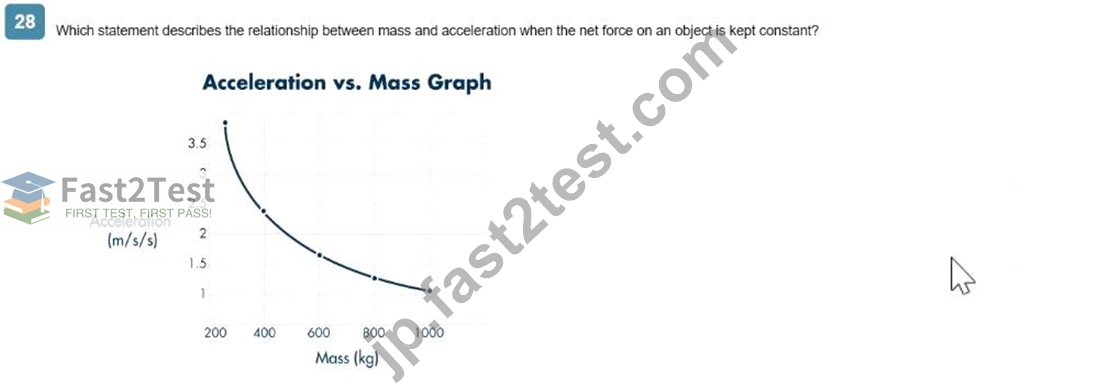
- A. Mass and acceleration are not correlated.
- B. Mass and acceleration are quadratically related.
- C. Mass and acceleration are directly proportional.
- D. Mass and acceleration are inversely proportional.
正解:D
解説:
1. **Understanding the Graph**: The graph provided shows the relationship between acceleration (in m/s²) and mass (in kg). The x-axis represents mass, and the y-axis represents acceleration. 2. **Observing the Trend**: The graph shows a decreasing curve, which indicates that as the mass increases, the acceleration decreases. 3. **Newton's Second Law of Motion**: According to Newton's Second Law of Motion, \( F = ma
\), where \( F \) is the force, \( m \) is the mass, and \( a \) is the acceleration. If the net force (\( F \)) is kept constant, then \( a = \frac{F}{m} \). 4. **Inverse Proportionality**: The equation \( a = \frac{F}{m} \) suggests that acceleration \( a \) is inversely proportional to the mass \( m \). This means that if the mass increases, the acceleration decreases proportionally. 5. **Conclusion**: Based on the graph and Newton's Second Law, the correct description of the relationship is that mass and acceleration are inversely proportional.
**References**: - Newton's Second Law of Motion: Basic principle in physics indicating the relationship between force, mass, and acceleration.
質問 # 26
What energy conversion takes place when a ball rolls up a ramp?
- A. Gravitational potential energy is converted into kinetic energy.
- B. Elastic potential energy is converted into thermal energy.
- C. Kinetic energy is converted into gravitational potential energy.
- D. Chemical potential energy is converted into gravitational potential energy.
正解:C
解説:
* Energy types: When a ball is in motion, it possesses kinetic energy. As the ball rolls up a ramp, it slows down and gains height.
* Energy conversion: As the ball ascends the ramp, its kinetic energy decreases because the ball is slowing down. Simultaneously, its gravitational potential energy increases because it is gaining height.
* Conservation of energy: The total mechanical energy (kinetic + potential) remains constant if we neglect friction. The decrease in kinetic energy is exactly balanced by the increase in gravitational potential energy.
* Conclusion: The appropriate energy conversion in this scenario is the transformation of kinetic energy into gravitational potential energy.
References: Integrated Physical Sciences textbooks on mechanics and energy conservation, principles of kinetic and potential energy.
質問 # 27
Satellites used in a Global Positioning System (GPS) orbit around Earth, sending electromagnetic waves that GPS units in cars can use to determine their location on Earth.
Which type of electromagnetic radiation is used to send information from the GPS satellites to receivers on Earth?
- A. X-rays
- B. Infrared radiation
- C. Ultraviolet radiation
- D. Microwaves
正解:D
解説:
* GPS technology: Satellites in the Global Positioning System (GPS) communicate with GPS receivers on Earth using electromagnetic waves.
* Microwaves: Microwaves are used in GPS technology because they can travel long distances and penetrate the atmosphere with minimal interference.
* Conclusion: The type of electromagnetic radiation used to send information from GPS satellites to receivers on Earth is microwaves.
References: Integrated Physical Sciences references on GPS technology, properties and applications of microwaves.
質問 # 28
Which properties will elements in group 17 share, based on location in the periodic table?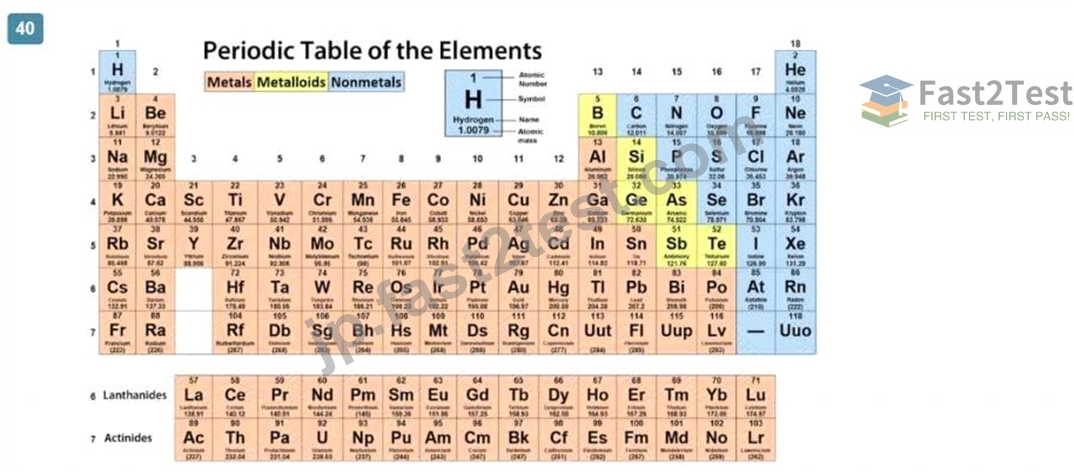
Choose 2 answers
- A. Good thermal conductivity
- B. Poor electrical conductivity
- C. Good electrical conductivity
- D. Poor thermal conductivity
正解:B、D
解説:
Elements in Group 17 of the periodic table are known as halogens. They share several properties, including:
* Poor thermal conductivity: Halogens do not conduct heat well.
* Poor electrical conductivity: Halogens are also poor conductors of electricity. In comparison:
* Good thermal conductivity and Good electrical conductivity are properties typically associated with metals, not halogens.
References:
* Integrated Physical Sciences Learning Resources, Chapter on Periodic Table Groups
質問 # 29
Which type of wave travels the slowest?
- A. Gamma waves
- B. Sound waves
- C. Visible light waves
- D. Radio waves
正解:B
解説:
1. **Wave Speeds**: The speed of different types of waves varies significantly. 2. **Gamma Waves**: These are electromagnetic waves that travel at the speed of light (approximately \( 3 \times 10^8 \) m/s). 3. **Radio Waves**: Another type of electromagnetic wave, also traveling at the speed of light. 4. **Visible Light Waves**: These are also electromagnetic waves traveling at the speed of light. 5. **Sound Waves**: Travel much slower compared to electromagnetic waves, with typical speeds in air around 343 m/s. 6.
**Conclusion**: Among the given options, sound waves travel the slowest. **References**: - Wave Speed Comparisons: Differences in propagation speeds of sound and electromagnetic waves.
質問 # 30
Which type of energy is generated by harnessing powerful ocean currents?
- A. Tidal
- B. Biofuel
- C. Geothermal
- D. Hydrogen
正解:A
解説:
Energy generated by harnessing powerful ocean currents is known as tidal energy. Tidal energy exploits the kinetic energy of moving water, caused by tidal currents, to generate electricity. Special underwater turbines are placed in areas with strong tidal flows, converting the movement of water into electrical power.
References:
* International Renewable Energy Agency (IRENA)
* "Tidal Energy: Technology Brief" - National Renewable Energy Laboratory (NREL)
質問 # 31
A scientist wants to determine how the speed of flowing water affects the size of sediment particles it can carry. The scientist places a mix of sediment particles in the bottom of a trough and runs water through the trough. The scientist varies the speed of the water and measures the sizes of the particles that the water carries away.
Which type of investigation is the scientist using?
- A. Field study
- B. Computational model
- C. Observational study
- D. Controlled experiment
正解:D
解説:
The scientist is determining how the speed of flowing water affects the size of sediment particles it can carry by varying the water speed and measuring the sediment sizes. This involves manipulating one variable (water speed) and observing the effect on another variable (sediment size), which is the essence of a controlled experiment. The setting and control of conditions ensure that the experimenter can establish a cause-and-effect relationship. References:
* Integrated Physical Sciences, Chapter 2: Methods of Scientific Investigation
質問 # 32
Consider the location of nitrogen (N) on the periodic table
Which element has chemical properties that are similar to nitrogen's7
- A. Neon (Ne)
- B. Silicon (Si)
- C. Phosphorus (P)
- D. Boron (B)
正解:C
解説:
Elements in the same group (column) of the periodic table have similar chemical properties because they have the same number of valence electrons. Phosphorus (P) is in the same group as nitrogen (N), Group 15, and thus has similar chemical properties. In comparison:
* Neon (Ne) is a noble gas in Group 18.
* Silicon (Si) is in Group 14.
* Boron (B) is in Group 13.
References:
* Integrated Physical Sciences Learning Resources, Chapter on the Periodic Table
質問 # 33
......
更新されたPDF(2024年最新)実際にある Integrated-Physical-Sciences試験問題:https://jp.fast2test.com/Integrated-Physical-Sciences-premium-file.html