

最新 [2026年03月18日]Databricks-Certified-Data-Engineer-Associate日本語試験正確解答Databricks Certified Data Engineer Associate Exam (Databricks-Certified-Data-Engineer-Associate日本語版)のPDF問題
あなたのキャリアーを稼いで飛躍せよDatabricks 156問題
質問 # 25
データ エンジニアは、Databricks SQL ダッシュボードを 1 日に 1 回更新するようにスケジュール設定したいと考えていますが、関連付けられている SQL エンドポイントは必要なときにのみ実行したいと考えています。
データ エンジニアがダッシュボードの更新スケジュールで使用される SQL エンドポイントの合計実行時間を最小限に抑えるために使用できるアプローチは次のどれですか。
- A. SQL エンドポイントの自動停止機能をオンにできます。
- B. ダッシュボードの SQL エンドポイントをサーバーレスに設定できます。
- C. ダッシュボードの SQL エンドポイントが、含まれているクエリの SQL エンドポイントの 1 つではないことを確認できます。
- D. SQL エンドポイントのクラスター サイズを縮小できます。
- E. ダッシュボードの SQL エンドポイントが各クエリの SQL エンドポイントと一致していることを確認できます。
正解:B
解説:
A serverless SQL endpoint is a compute resource that is automatically managed by Databricks and scales up or down based on the workload. A serverless SQL endpoint can be used to run queries and dashboards without requiring manual configuration or management. A serverless SQL endpoint is only active when it is needed and shuts down automatically when idle, minimizing the total running time and cost. A serverless SQL endpoint can be created and assigned to a dashboard using the Databricks SQL UI or the SQL Analytics API. References:
* Create a serverless SQL endpoint
* Assign a SQL endpoint to a dashboard
* SQL Analytics API
質問 # 26
データ エンジニアは Unity Catalog でアクセス制御を設定しており、データ アナリストのグループがテーブルをクエリすることはできるが、データを変更できないようにする必要があります。
データ エンジニアはデータ アナリストにどのような権限を与える必要がありますか?
- A. 変更
- B. 選択
- C. 挿入
- D. すべての権限
正解:B
質問 # 27
データエンジニアが、複数のタスクを含むジョブを毎晩実行しています。クラスターの起動に時間がかかるため、各タスクの実行速度が遅くなっています。
ジョブに使用されるクラスターの起動時間を改善するために、データ エンジニアが実行できるアクションは次のどれですか。
- A. 汎用クラスタの代わりにジョブクラスタを使用できる
- B. Databricks SQLで利用可能なエンドポイントを使用できる
- C. クラスタープールのクラスターを使用できる
- D. より大きなデータサイズに合わせてクラスタを自動スケールするように構成できます。
- E. クラスタを単一ノードとして構成できる
正解:C
解説:
The best action that the data engineer can perform to improve the start up time for the clusters used for the Job is to use clusters that are from a cluster pool. A cluster pool is a set of idle clusters that can be used by jobs or interactive sessions. By using a cluster pool, the data engineer can avoid the cluster creation time and reduce the latency of the tasks. Cluster pools also offer cost savings and resource efficiency, as they can be shared by multiple users and jobs.
Option A is not relevant, as endpoints available in Databricks SQL are used for creating and managing SQL analytics workloads, not for improving cluster start up time.
Option B is not correct, as jobs clusters and all-purpose clusters have similar start up times. Jobs clusters are clusters that are dedicated to run a single job and are terminated when the job is completed. All-purpose clusters are clusters that can be used for multiple purposes, such as interactive sessions, notebooks, or multiple jobs. Both types of clusters can benefit from using a cluster pool.
Option C is not advisable, as configuring the clusters to be single-node will reduce the parallelism and performance of the tasks. Single-node clusters are clusters that have only one worker node and are typically used for testing or development purposes. They are not suitable for running production jobs that require high scalability and fault tolerance.
Option E is not helpful, as configuring the clusters to autoscale for larger data sizes will not affect the start up time of the clusters. Autoscaling is a feature that allows clusters to dynamically adjust the number of worker nodes based on the workload. It can help optimize the resource utilization and cost efficiency of the clusters, but it does not speed up the cluster creation process.
Reference:
Cluster Pools
Jobs
Clusters
[Databricks Data Engineer Professional Exam Guide]
質問 # 28
データ エンジニアは、フランスに住む顧客の名前を含む新しいテーブルを作成したいと考えています。
彼らは次のコマンドを書きました:
上級データ エンジニアは、新しいテーブルに個人を特定できる情報 (PII) が含まれていることを示すテーブル プロパティを含めることが組織のポリシーであると述べています。
次のコード行のうち、上記の空白を埋めてタスクを正常に完了するものはどれですか?
- A. テーブルプロパティ PII
- B. テーブルに PII が含まれているかどうかを示す方法はありません。
- C. コメント「PII が含まれています」
- D. 追加
- E. 「コメント PII」
正解:C
解説:
In Databricks, when creating a table, you can add a comment to columns or the entire table to provide more information about the data it contains. In this case, since it's organization policy to indicate that the new table includes personally identifiable information (PII), option D is correct. The line of code would be added after defining the table structure and before closing with a semicolon. References: Data Engineer Associate Exam Guide, CREATE TABLE USING (Databricks SQL)
質問 # 29
データエンジニアリングチームには2つのテーブルがあります。1つ目のテーブル「march_transactions」は、3月のすべての小売取引のコレクションです。2つ目のテーブル「april_transactions」は、4月のすべての小売取引のコレクションです。これらのテーブル間に重複レコードはありません。
march_transactions と april_transactions のすべてのレコードを重複レコードなしで含む新しいテーブル all_transactions を作成するには、次のコマンドのどれを実行する必要がありますか?
- A. all_transactions テーブルを作成する
march_transactions から * を選択
INTERSECT SELECT * from april_transactions; - B. all_transactions テーブルを作成する
march_transactions から * を選択
外部結合 SELECT * FROM april_transactions; - C. all_transactions テーブルを作成する
march_transactions から * を選択
UNION SELECT * FROM april_transactions; - D. all_transactions テーブルを CREATE する
march_transactions から * を選択
内部結合 SELECT * FROM april_transactions; - E. すべてのトランザクションをテーブルとして作成する
march_transactions から * を選択
MERGE SELECT * FROM april_transactions;
正解:C
解説:
The correct command to create a new table that contains all records from two tables without duplicate records is to use the UNION operator. The UNION operator combines the results of two queries and removes any duplicate rows. The INNER JOIN, OUTER JOIN, and MERGE operators do not remove duplicate rows, and the INTERSECT operator only returns the rows that are common to both tables. Therefore, option B is the only correct answer. Reference: Databricks SQL Reference - UNION, Databricks SQL Reference - JOIN, Databricks SQL Reference - MERGE, [Databricks SQL Reference - INTERSECT]
質問 # 30
データエンジニアは毎日ステートメントを実行し、前日の売上をテーブルtransactionsにコピーします。各日の売上は、「/transactions/raw」という場所にある個別のファイルに保存されます。
今日、データ エンジニアは次のコマンドを実行してこのタスクを完了します。
今日コマンドを実行した後、データ エンジニアはテーブル トランザクション内のレコード数が変更されていないことに気付きました。
次のどれが、ステートメントがテーブルに新しいレコードをコピーしなかった理由を説明していますか?
- A. コピーするファイルの名前が FILES キーワードに含まれていませんでした。
- B. 前日のファイルはすでにテーブルにコピーされています。
- C. PARQUET ファイル形式は COPY INTO をサポートしていません。
- D. COPY INTO ステートメントでは、コピーされた行を表示するためにテーブルを更新する必要があります。
- E. コピーするファイルの形式が FORMAT_OPTIONS キーワードに含まれていませんでした。
正解:B
解説:
The COPY INTO statement is an idempotent operation, which means that it will skip any files that have already been loaded into the target table1. This ensures that the data is not duplicated or corrupted by multiple attempts to load the same file. Therefore, if the data engineer runs the same command every day without specifying the names of the files to be copied with the FILES keyword or a glob pattern with the PATTERN keyword, the statement will only copy the first file that matches the source location and ignore the rest. To avoid this problem, the data engineer should either use the FILES or PATTERN keywords to filter the files to be copied based on the date or some other criteria, or delete the files from the source location after they are copied into the table2. References: 1: COPY INTO | Databricks on AWS 2: Get started using COPY INTO to load data | Databricks on AWS
質問 # 31
データエンジニアがSpark SQLベースのETLプロセスを開発しています。実行に失敗しました。データエンジニアがSpark UIを確認すると、次のようなエラーが表示されました。
この問題を解決するために、データ エンジニアが実行する必要がある 2 つの修正アクションはどれですか。
2つの回答を選択してください - (Q) クエリで収集するデータを減らすためにフィルターを絞り込みます
- A. クエリパフォーマンスを向上させるためにデータセットをキャッシュする
- B. ドライバーノードのサイズを大きくし、パーティションの自動シャッフルを無効にします
- C. 割り当てを確実にするためにシャッフルパーティションを50に固定します。
- D. ワーカーノードのサイズをアップサイズし、パーティションの自動シャッフルを有効にする
正解:B、D
質問 # 32
テーブルを長い形式から広い形式に変換するにはどの SQL キーワードを使用できますか?
- A. 変換
- B. 変換
- C. 合計
- D. ピボット
正解:D
質問 # 33
次のデータ ワークロードのうち、ソースとしてゴールド テーブルを利用するものはどれですか。
- A. ダッシュボードにフィードするために設計された集計データをクエリするジョブ
- B. 不正な形式のレコードを削除してデータをクリーンアップするジョブ
- C. ストリーミングソースから生データをレイクハウスに取り込むジョブ
- D. クリーンアップされていないデータを集約して標準的な要約統計を作成するジョブ
- E. タイムスタンプを人間が読める形式に解析してデータを充実させるジョブ
正解:A
解説:
A Gold table is a table that contains highly refined and aggregated data that powers analytics, machine learning, and production applications. It represents data that has been transformed into knowledge, rather than just information. A Gold table is typically the final output of a medallion lakehouse architecture, where data flows from Bronze to Silver to Gold tables, with each layer improving the structure and quality of data. A job that queries aggregated data designed to feed into a dashboard is an example of a data workload that will utilize a Gold table as its source, as it requires data that is ready for consumption and analysis. The other options are either data workloads that will use a Bronze or Silver table as their source, or data workloads that will produce a Gold table as their output. Reference: Databricks Documentation - What is the medallion lakehouse architecture?, Databricks Documentation - What is a Medallion Architecture?, K21Academy - Delta Lake Architecture & Azure Databricks Workspace.
質問 # 34
データエンジニアは、2つのテーブルからデータを取得してリレーショナルオブジェクトを作成したいと考えています。このリレーショナルオブジェクトは、他のセッションの他のデータエンジニアが使用する必要がありません。ストレージコストを節約するため、データエンジニアは物理データのコピーと保存を避けたいと考えています。
データ エンジニアが作成する必要があるリレーショナル オブジェクトは次のどれですか。
- A. 一時ビュー
- B. 表示
- C. Spark SQL テーブル
- D. データベース
- E. デルタテーブル
正解:A
解説:
A temporary view is a relational object that is defined in the metastore and points to an existing DataFrame. It does not copy or store any physical data, but only saves the query that defines the view. The lifetime of a temporary view is tied to the SparkSession that was used to create it, so it does not persist across different sessions or applications. A temporary view is useful for accessing the same data multiple times within the same notebook or session, without incurring additional storage costs. The other options are either materialized (A, E), persistent (B, C), or not relational objects . Reference: Databricks Documentation - Temporary View, Databricks Community - How do temp views actually work?, Databricks Community - What's the difference between a Global view and a Temp view?, Big Data Programmers - Temporary View in Databricks.
質問 # 35
データ エンジニアは、/path/to/csv にある CSV ファイルのデータを使用して、Databricks にテーブルを作成する必要があります。
次のコマンドを実行します。
次のコード行のうち、上記の空白を埋めてタスクを正常に完了するものはどれですか?
- A. CSVから
- B. デルタの使用
- C. CSVの使用
- D. "path/to/csv" から
- E. これらのコード行はタスクを正常に完了するのに必要ありません
正解:C
質問 # 36
新しいデータエンジニアリングチームがELTプロジェクトに割り当てられました。新しいデータエンジニアリングチームには、プロジェクトを完全に管理するために、salesテーブルに対する完全な権限が必要です。
新しいデータ エンジニアリング チームにデータベースに対する完全な権限を付与するには、次のコマンドのどれを使用できますか?
- A. テーブル sales のすべての権限を team に付与します。
- B. テーブル sales の使用権限を team に付与します。
- C. テーブル sales に対する SELECT 権限を team に付与します。
- D. テーブル team のすべての権限を sales に付与します。
- E. テーブル sales に対する SELECT CREATE MODIFY 権限を team に付与します。
正解:A
解説:
To grant full permissions on a table to a user or a group, you can use the GRANT ALL PRIVILEGES ON TABLE statement. This statement will grant all the possible privileges on the table, such as SELECT, CREATE, MODIFY, DROP, ALTER, etc. Option A is the only code block that follows this syntax correctly. Option B is incorrect, as it does not grant all the possible privileges on the table, but only a subset of them. Option C is incorrect, as it only grants the SELECT privilege on the table, which is not enough to fully manage the project. Option D is incorrect, as it grants the USAGE privilege on the table, which is not a valid privilege for tables. Option E is incorrect, as it grants all the privileges on the table team to the user or group sales, which is the opposite of what the question asks. References: Grant privileges on a table using SQL | Databricks on AWS, Grant privileges on a table using SQL - Azure Databricks, SQL Privileges - Databricks
質問 # 37
ゴールド テーブルとシルバー テーブルの関係を説明するのは次のどれですか。
- A. ゴールド テーブルには、シルバー テーブルよりも真実のデータが含まれる可能性が高くなります。
- B. ゴールド テーブルには、シルバー テーブルよりも貴重なデータが含まれる可能性が高くなります。
- C. ゴールド テーブルには、シルバー テーブルよりもデータのビューがあまり洗練されていない可能性が高くなります。
- D. Gold テーブルには Silver テーブルよりも集計が含まれる可能性が高くなります。
- E. Gold テーブルには Silver テーブルよりも多くのデータが含まれる可能性が高くなります。
正解:D
解説:
According to the medallion lakehouse architecture, gold tables are the final layer of data that powers analytics, machine learning, and production applications. They are often highly refined and aggregated, containing data that has been transformed into knowledge, rather than just information. Silver tables, on the other hand, are the intermediate layer of data that represents a validated, enriched version of the raw data from the bronze layer. They provide an enterprise view of all its key business entities, concepts and transactions, but they may not have all the aggregations and calculations that are required for specific use cases. Therefore, gold tables are more likely to contain aggregations than silver tables. Reference:
What is the medallion lakehouse architecture?
What is a Medallion Architecture?
質問 # 38
データ エンジニアは、テーブルから読み取り、データを操作し、新しいテーブルにストリーミング書き込みを実行するように構造化ストリーミング ジョブを構成しました。
データ エンジニアが使用するコード ブロックは次のとおりです。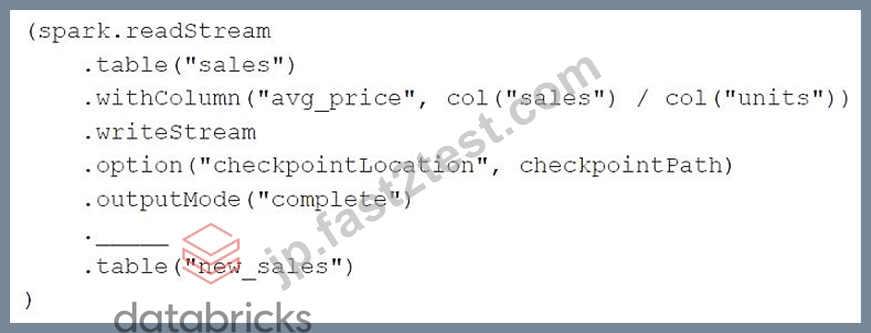
データ エンジニアが、クエリで利用可能なすべてのデータを必要な数のバッチで処理することだけを望む場合、データ エンジニアは空白を埋めるために次のどのコード行を使用する必要がありますか。
- A. トリガー(parallelBatch=True)
- B. トリガー(連続="1回")
- C. 処理時間(1)
- D. トリガー(処理時間="1回")
- E. トリガー(availableNow=True)
正解:E
解説:
https://spark.apache.org/docs/latest/api/python/reference/pyspark.ss/api/pyspark.sql.streaming.DataStreamWriter.trigger.html
質問 # 39
データ チームがクラスター プールを利用するシナリオを説明しているのは次のどれですか。
- A. 自動レポートはできるだけ早く更新する必要があります。
- B. 自動化されたレポートは、複数の共同作業者間でバージョン管理する必要があります。
- C. 自動化されたレポートは再現可能にする必要があります。
- D. 自動化されたレポートは、すべての関係者が実行できる必要があります。
- E. エラーを識別するには、自動レポートをテストする必要があります。
正解:A
解説:
Databricks cluster pools are a set of idle, ready-to-use instances that can reduce cluster start and auto-scaling times. This is useful for scenarios where a data team needs to run an automated report as quickly as possible, without waiting for the cluster to launch or scale up. Cluster pools can also help save costs by reusing idle instances across different clusters and avoiding DBU charges for idle instances in the pool. Reference: Best practices: pools | Databricks on AWS, Best practices: pools - Azure Databricks | Microsoft Learn, Best practices: pools | Databricks on Google Cloud
質問 # 40
データ エンジニアは、バッチ取り込みパイプラインの一部として次のコード ブロックを使用して、コンポーザブル テーブルから読み取ります。
トランザクション テーブルがストリーム ソースである場合にこのコード ブロックが機能するには、次のどの変更を加える必要がありますか。
- A. スキーマ(schema)をオプション("maxFilesPerTrigger", 1)に置き換えます
- B. 予測をストリーム対応の予測関数に置き換える
- C. spark.read を spark.readStream に置き換えます
- D. 「transactions」をDeltaテーブルの場所へのパスに置き換えます
- E. format("delta") を format("stream") に置き換えます。
正解:C
解説:
To read from a stream source, the data engineer needs to use the spark.readStream method instead of the spark.read method. The spark.readStream method returns a DataStreamReader object that can be used to specify the details of the input source, such as the format, the schema, the path, and the options. The spark.read method is only suitable for batch processing, not streaming processing. The other changes are not necessary or correct for reading from a stream source. Reference: Structured Streaming Programming Guide, Read a stream, Databricks Data Sources
質問 # 41
データエンジニアは、Auto Loaderを使用してJSONソースからデータを取り込むデータパイプラインを開発しましたが、パイプラインに型推論やスキーマヒントを一切提供していませんでした。データエンジニアはデータを確認したところ、ターゲットテーブル内の一部のフィールドには浮動小数点値またはブール値しか含まれていないにもかかわらず、すべての列が文字列型になっていることに気付きました。
オートローダーがすべての列を文字列型であると推測した理由を説明するのは次のどれですか?
- A. JSONデータはテキストベースの形式です
- B. オートローダーは取り込まれたデータのスキーマを推測できません
- C. 特定のスキーマと推論されたスキーマの間に型の不一致がありました
- D. すべてのフィールドに少なくとも1つのNULL値がありました
- E. オートローダーは文字列データでのみ動作します
正解:A
解説:
JSON data is a text-based format that represents data as a collection of name-value pairs. By default, when Auto Loader infers the schema of JSON data, it treats all columns as strings. This is because JSON data can have varying data types for the same column across different files or records, and Auto Loader does not attempt to reconcile these differences. For example, a column named "age" may have integer values in some files, but string values in others. To avoid data loss or errors, Auto Loader infers the column as a string type. However, Auto Loader also provides an option to infer more precise column types based on the sample data. This option is called cloudFiles.inferColumnTypes and it can be set to true or false. When set to true, Auto Loader tries to infer the exact data types of the columns, such as integers, floats, booleans, or nested structures. When set to false, Auto Loader infers all columns as strings. The default value of this option is false. Reference: Configure schema inference and evolution in Auto Loader, Schema inference with auto loader (non-DLT and DLT), Using and Abusing Auto Loader's Inferred Schema, Explicit path to data or a defined schema required for Auto loader.
質問 # 42
データエンジニアは、毎朝仕事を始める前に実行される単一タスクのジョブを持っています。上流のデータの問題を特定した後、元のタスクの前に新しいノートブックを実行するための別のタスクを設定する必要があります。
データ エンジニアが新しいタスクを設定するために使用できるアプローチは次のどれですか。
- A. 新しいジョブを最初から作成し、両方のタスクを追加して同時に実行することができます。
- B. 既存のジョブに新しいタスクを作成し、元のタスクを新しいタスクの依存関係として追加できます。
- C. 既存のタスクを新しいジョブに複製し、それを編集して新しいノートブックを実行できます。
- D. 既存のジョブに新しいタスクを作成し、それを元のタスクの依存関係として追加できます。
- E. 既存のジョブ内の既存のタスクを複製し、更新して新しいノートブックを実行できます。
正解:D
解説:
To set up the new task to run a new notebook prior to the original task in a single-task Job, the data engineer can use the following approach: In the existing Job, create a new task that corresponds to the new notebook that needs to be run. Set up the new task with the appropriate configuration, specifying the notebook to be executed and any necessary parameters or dependencies. Once the new task is created, designate it as a dependency of the original task in the Job configuration. This ensures that the new task is executed before the original task.
質問 # 43
データ エンジニアは、テーブルから読み取り、データを操作し、新しいテーブルにストリーミング書き込みを実行するように構造化ストリーミング ジョブを構成しました。
データ エンジニアが使用する cade ブロックは次のとおりです。
データ エンジニアが、クエリでマイクロバッチを実行して 5 秒ごとにデータを処理するだけの場合、データ エンジニアは次のどのコード行を使用して空白を埋める必要がありますか。
- A. trigger()
- B. trigger(continuous="5 seconds")
- C. trigger(processingTime="5 seconds")
- D. trigger(once="5 seconds")
- E. trigger("5 seconds")
正解:C
解説:
The processingTime option specifies a time-based trigger interval for fixed interval micro-batches. This means that the query will execute a micro-batch to process data every 5 seconds, regardless of how much data is available. This option is suitable for near-real time processing workloads that require low latency and consistent processing frequency. The other options are either invalid syntax (A, C), default behavior (B), or experimental feature (E). References: Databricks Documentation - Configure Structured Streaming trigger intervals, Databricks Documentation - Trigger.
質問 # 44
ブロンズ テーブルと生データの関係を説明するのは次のどれですか。
- A. ブロンズ テーブルには、生データよりも真実に近いデータが含まれています。
- B. ブロンズ テーブルには、生データよりも精度の低いデータ ビューが含まれています。
- C. ブロンズ テーブルには、スキーマが適用された生データが含まれています。
- D. ブロンズ テーブルには集計が含まれますが、生のデータは集計されません。
- E. ブロンズ テーブルには、生データ ファイルよりも少ないデータが含まれています。
正解:C
解説:
Bronze tables are the first layer of a medallion architecture, which is a data design pattern used to organize data in a lakehouse. Bronze tables contain raw data ingested from various sources, such as RDBMS data, JSON files, IoT data, etc. The table structures in this layer correspond to the source system table structures
"as-is", along with any additional metadata columns that capture the load date/time, process ID, etc. The only transformation applied to the raw data in this layer is to apply a schema, which defines the column names and data types of the table. The schema can be inferred from the data source or specified explicitly. Applying a schema to the raw data enables the use of SQL and other structured query languages to access and analyze the data. Therefore, option E is the correct answer. References: What is a Medallion Architecture?, Raw Data Ingestion into Delta Lake Bronze tables using Azure Synapse Mapping Data Flow, Apache Spark + Delta Lake concepts, Delta Lake Architecture & Azure Databricks Workspace.
質問 # 45
データ エンジニアは、テーブルから読み取り、データを操作し、新しいテーブルにストリーミング書き込みを実行するように構造化ストリーミング ジョブを構成しました。
データ エンジニアが使用するコード ブロックは次のとおりです。
データ エンジニアが、クエリで利用可能なすべてのデータを必要な数のバッチで処理することだけを望む場合、データ エンジニアは空白を埋めるために次のどのコード行を使用する必要がありますか。
- A. トリガー(parallelBatch=True)
- B. トリガー(連続="1回")
- C. 処理時間(1)
- D. トリガー(処理時間="1回")
- E. トリガー(availableNow=True)
正解:E
解説:
https://spark.apache.org/docs/latest/api/python/reference/pyspark.ss/api/pyspark.sql.streaming.
DataStreamWriter.trigger.html
質問 # 46
データエンジニアは、Auto Loaderを使用してJSONソースからデータを取り込むデータパイプラインを開発しましたが、パイプラインに型推論やスキーマヒントを一切提供していませんでした。データエンジニアはデータを確認したところ、ターゲットテーブル内の一部のフィールドには浮動小数点値またはブール値しか含まれていないにもかかわらず、すべての列が文字列型になっていることに気付きました。
オートローダーがすべての列を文字列型であると推測した理由を説明するのは次のどれですか?
- A. JSONデータはテキストベースの形式です
- B. オートローダーは取り込まれたデータのスキーマを推測できません
- C. 特定のスキーマと推論されたスキーマの間に型の不一致がありました
- D. すべてのフィールドに少なくとも1つのNULL値がありました
- E. オートローダーは文字列データでのみ動作します
正解:A
解説:
JSON data is a text-based format that represents data as a collection of name-value pairs. By default, when Auto Loader infers the schema of JSON data, it treats all columns as strings. This is because JSON data can have varying data types for the same column across different files or records, and Auto Loader does not attempt to reconcile these differences. For example, a column named "age" may have integer values in some files, but string values in others. To avoid data loss or errors, Auto Loader infers the column as a string type.
However, Auto Loader also provides an option to infer more precise column types based on the sample data.
This option is called cloudFiles.inferColumnTypes and it can be set to true or false. When set to true, Auto Loader tries to infer the exact data types of the columns, such as integers, floats, booleans, or nested structures. When set to false, Auto Loader infers all columns as strings. The default value of this option is false. References: Configure schema inference and evolution in Auto Loader, Schema inference with auto loader (non-DLT and DLT), Using and Abusing Auto Loader's Inferred Schema, Explicit path to data or a defined schema required for Auto loader.
質問 # 47
ワークフローがスケジュールどおりにトリガーされるようにするには、データ エンジニアはどの方法を適用する必要がありますか?
- A. スケジュールされたワークフローでは常時実行されるクラスターが必要です。これはコストは高くなりますが、処理の遅延は短縮されます。
- B. スケジュールされたワークフローは、手動で停止されるまで継続的に実行されます。
- C. スケジュールされたワークフローでは、クラスターがパイプラインを実行するのに十分な時間だけ実行されるため、リソースの消費と費用を削減できます。
- D. スケジュールされたワークフローは、構成されたソースにデータが到着するとそれを処理します。
正解:C
質問 # 48
......
正真正銘のベスト資料はDatabricks-Certified-Data-Engineer-Associate日本語オンライン練習試験:https://jp.fast2test.com/Databricks-Certified-Data-Engineer-Associate-JPN-premium-file.html