

更新された検証済みのCTFL4問題集と解答には100%一発合格保証問題集はここ
合格ISTQB Certified Tester CTFL4試験問題には150問があります
質問 # 70
Which of the following statements about estimation of the test effort is WRONG?
- A. Once the test effort is estimated, resources can be identified and a schedule can be drawn up.
- B. Effort estimate depends on the budget of the project.
- C. Effort estimate can be inaccurate because the quality of the product under tests is not known.
- D. Experience based estimation is one of the estimation techniques.
正解:B
解説:
Effort estimate does not depend on the budget of the project, but rather on the scope, complexity, and quality of the software product and the testing activities1. Budget is a constraint that may affect the feasibility and accuracy of the effort estimate, but it is not a factor that determines the effort estimate. Effort estimate is the amount of work required to complete the testing activities, measured in terms of person-hours, person-days, or person-months2.
The other options are correct because:
A . Once the test effort is estimated, resources can be identified and a schedule can be drawn up, as they are interrelated aspects of the test planning process3. Resources are the people, tools, equipment, and facilities needed to perform the testing activities4. Schedule is the time frame and sequence of the testing activities, aligned with the project milestones and deadlines5.
B . Effort estimate can be inaccurate because the quality of the product under tests is not known, as it affects the number and severity of the defects that may be found and the rework that may be needed to fix them6. Quality is the degree to which the software product satisfies the specified requirements and meets the needs and expectations of the users and clients7.
D . Experience based estimation is one of the estimation techniques, which relies on the judgment and expertise of the testers and other project stakeholders to estimate the test effort based on similar projects or tasks done in the past. Experience based estimation can be useful when there is a lack of historical data, formal methods, or detailed information about the software product and the testing activities.
Reference =
1 ISTQB Certified Tester Foundation Level Syllabus v4.0, 2023, p. 154
2 ISTQB Certified Tester Foundation Level Syllabus v4.0, 2023, p. 155
3 ISTQB Certified Tester Foundation Level Syllabus v4.0, 2023, p. 156
4 ISTQB Certified Tester Foundation Level Syllabus v4.0, 2023, p. 157
5 ISTQB Certified Tester Foundation Level Syllabus v4.0, 2023, p. 158
6 ISTQB Certified Tester Foundation Level Syllabus v4.0, 2023, p. 159
7 ISTQB Certified Tester Foundation Level Syllabus v4.0, 2023, p. 16
[8] ISTQB Certified Tester Foundation Level Syllabus v4.0, 2023, p. 160
[9] ISTQB Certified Tester Foundation Level Syllabus v4.0, 2023, p. 161
質問 # 71
Which of the following statements about the testing quadrants is TRUE?
- A. Exploratory tests are classified in quadrant Q3, and they are usually included in a continuous integration process.
- B. Automated unit tests produced during TDD are classified in quadrant Q4 as they are technology facing.
- C. Automated acceptance tests produced during BDD and ATDD are classified in quadrant 02.
- D. The higher the number of the testing quadrant, the more important the tests associated with this quadrant are
正解:C
解説:
The correct statement is B. According to the ISTQB CTFL syllabus, the testing quadrants help to categorize tests based on their purpose and whether they are technology-facing or business-facing, and whether they support the team or critique the product. Quadrant Q2 includes tests that are business-facing and support the team, such as automated acceptance tests produced during Behavior-Driven Development (BDD) and Acceptance Test-Driven Development (ATDD) .
Quadrant Q3 includes business-facing tests that critique the product, such as exploratory testing, usability testing, and user acceptance testing. These tests are typically manual and focus on evaluating the product from a user perspective, rather than being part of a continuous integration process.
Quadrant Q4 includes technology-facing tests that critique the product, such as performance tests, security tests, and other non-functional tests, which can be automated but are not related to unit tests produced during TDD .
質問 # 72
Which of the following statements is NOT true about Configuration management and software testing?
- A. Configuration management supports the build process, which is essential for delivering a test release into the test environment.
- B. Version controlled test ware increases the chances of finding defects in the software under test.
- C. Configuration management helps maintain consistent versions of software artifacts.
- D. When testers report defects, they need to reference version-controlled items.
正解:B
解説:
While configuration management is crucial for maintaining consistent versions of software artifacts and supporting the build process, it does not directly increase the chances of finding defects in the software under test. Version-controlled test ware ensures that the correct versions of test cases and other test artifacts are used, but it is the quality and thoroughness of the tests that determine the effectiveness of defect detection.
Reference: ISTQB CTFL Syllabus V4.0, Section 5.4
質問 # 73
Which of the following statements about white-box test techniques is true?
- A. Branch coverage is the most thorough code-related white-box test technique, and therefore applicable standards prescribe achieving full branch coverage at the highest safety levels for safety-critical systems
- B. Code-related white-box test techniques provide an objective measure of coverage and can be used to complement black-box test techniques to increase confidence in the code
- C. Code-related white-box test techniques are not required to measure the actual code coverage achieved by black-box testing, as code coverage can be measured using the coverage criteria associated with black-box test techniques
- D. Achieving full statement coverage and full branch coverage for a software product means that such software product has been fully tested and there are no remaining bugs within the code
正解:B
解説:
This answer is correct because code-related white-box test techniques are test design techniques that use the structure of the code to derive test cases. They provide an objective measure of coverage, such as statement coverage, branch coverage, or path coverage, which indicate how much of the code has been exercised by the test cases. Code-related white-box test techniques can be used to complement black-box test techniques, which are test design techniques that use the functional or non-functional requirements of the system or component to derive test cases. By combining both types of techniques, testers can increase their confidence in the code and find more defects. Reference: ISTQB Glossary of Testing Terms v4.0, ISTQB Foundation Level Syllabus v4.0, Section 2.3.2.2
質問 # 74
Which ONE of the following statements does NOT describe how testing contributes to higher quality?
- A. Performing a review of the requirement specifications before implementing the system can enhance quality.
- B. Properly designed tests that pass reduce the level of risk in a system.
- C. Software testing identifies defects, which can be used to improve development activities.
- D. The testing of software demonstrates the absence of defects.
正解:D
解説:
The testing of software does not demonstrate the absence of defects, but rather the presence of defects or the conformance of the software to the specified requirements1. Testing can never prove that the software is defect-free, as it is impossible to test all possible scenarios, inputs, outputs, and behaviors of the software2. Testing can only provide a level of confidence in the quality of the software, based on the coverage, effectiveness, and efficiency of the testing activities3.
The other options are correct because:
A . Properly designed tests that pass reduce the level of risk in a system, as they verify that the system meets the expected quality attributes and satisfies the needs and expectations of the users and clients4. Risk is the potential for loss or harm due to the occurrence of an undesirable event5. Testing can help to identify, analyze, prioritize, and mitigate the risks associated with the software product and project6.
C . Software testing identifies defects, which can be used to improve development activities, as they provide feedback on the quality of the software and the effectiveness of the development processes7. Defects are flaws or errors in the software that cause it to deviate from the expected or required results or behavior. Testing can help to detect, report, track, and resolve the defects, and prevent them from recurring in the future.
D . Performing a review of the requirement specifications before implementing the system can enhance quality, as it can ensure that the requirements are clear, complete, consistent, testable, and aligned with the needs and expectations of the users and clients. Requirements are the specifications of what the software should do and how it should do it. Testing can help to validate that the requirements are met by the software, and verify that the software is implemented according to the requirements.
Reference =
1 ISTQB Certified Tester Foundation Level Syllabus v4.0, 2023, p. 10
2 ISTQB Certified Tester Foundation Level Syllabus v4.0, 2023, p. 11
3 ISTQB Certified Tester Foundation Level Syllabus v4.0, 2023, p. 12
4 ISTQB Certified Tester Foundation Level Syllabus v4.0, 2023, p. 13
5 ISTQB Certified Tester Foundation Level Syllabus v4.0, 2023, p. 97
6 ISTQB Certified Tester Foundation Level Syllabus v4.0, 2023, p. 98
7 ISTQB Certified Tester Foundation Level Syllabus v4.0, 2023, p. 14
[8] ISTQB Certified Tester Foundation Level Syllabus v4.0, 2023, p. 15
[9] ISTQB Certified Tester Foundation Level Syllabus v4.0, 2023, p. 16
[10] ISTQB Certified Tester Foundation Level Syllabus v4.0, 2023, p. 17
[11] ISTQB Certified Tester Foundation Level Syllabus v4.0, 2023, p. 18
[12] ISTQB Certified Tester Foundation Level Syllabus v4.0, 2023, p. 19
質問 # 75
Which of the following best describes the relationship between a test progress report and a test summary report?
- A. There is no difference between a test progress report and a test summary report.
- B. The test report prepared during a test activity may be referred to as a test progress report, while a test report prepared at the end of a test activity may be referred to as a test summary report.
- C. Both the test progress report and the test summary report should always be generated via an automated tool.
- D. The test report prepared during a test activity may be referred to as a test summary report, while a test report prepared at the end of a test activity may be referred to as a test progress report.
正解:B
解説:
A test progress report is prepared during a test activity and provides updates on the current status of testing activities, including progress made, issues encountered, and test metrics. A test summary report, on the other hand, is prepared at the end of a test activity and provides a comprehensive overview of the testing carried out, including the final status, test results, defect summaries, and overall conclusions.
Reference: ISTQB CTFL Syllabus V4.0, Section 5.3.2
質問 # 76
The whole-team approach:
- A. promotes the idea that all team members should be responsible for the quality of the product
- B. is a consensus-based approach that engages the whole team in estimating the user stories
- C. promotes the idea that all team members should have a thorough understanding of test techniques
- D. is mostly adopted in projects aimed at developing safety-critical systems, as it ensures the highest level of testing independence
正解:A
解説:
This answer is correct because the whole-team approach is a way of working in agile projects where all team members share the responsibility for the quality of the product, and collaborate on delivering value to the customer. The whole-team approach involves testers, developers, business analysts, product owners, and other stakeholders in planning, designing, developing, testing, and delivering the product. The whole-team approach fosters communication, feedback, learning, and continuous improvement within the team. Reference: ISTQB Glossary of Testing Terms v4.0, ISTQB Foundation Level Syllabus v4.0, Section 3.1.1.1
質問 # 77
Consider the following user story about the authentication functionality of an e-commerce website:
"As a logged-in user, I want to change my current password with a new one, so that I can make my account safer".
The following are some of the acceptance criteria defined for the user story:
[a] After the logged-in user has successfully changed his password, an email confirming the change must be sent to him
[b] To successfully change the password, the logged-in user must enter the current password, enter a new valid password, and finally confirm by pressing the 'Change Password' button
[c] To be valid, the new password entered by the logged-in user is not only required to meet the criteria related to the length and type of characters, but must also be different form the last 5 passwords of that user
[d] A dedicated error message must be presented to the logged-in user when he enters a wrong current password
[e] A dedicated error message must be presented to the logged-in user when he enters the correct current password, but enters an invalid password Based only on the given information, which of the following ATDD tests is most likely to be written first?
- A. The logged-in user enters the correct current password, enters an invalid password, and finally views the dedicated error
- B. The logged-in user enters the correct current password, enters a valid new password (different from the last 5 passwords), presses the Change Password' button, and finally receives the e-mail confirming that the password has been successfully changed
- C. The logged-in user enters a wrong current password and views the dedicated error message
- D. The logged-in user submits a purchase order containing ten items, selects to pay with a Visa credit card, enters credit card information of a valid card, presses the 'Confirm' button, and finally views the dedicated message confirming that the purchase has been successful
正解:B
解説:
ATDD stands for Acceptance Test-Driven Development, which is a collaborative approach to software development and testing, in which the acceptance criteria of a user story are defined and automated as executable tests before the implementation of the software system. ATDD tests are usually written in a Given-When-Then format, which describes the preconditions, the actions, and the expected outcomes of a test scenario. ATDD tests are intended to verify that the software system meets the expectations and the needs of the users and the stakeholders, as well as to provide feedback and guidance for the developers and the testers. Based on the given information, the ATDD test that is most likely to be written first is the one that corresponds to option B, which is:
Given the logged-in user is on the Change Password page When the user enters the correct current password, enters a valid new password (different from the last 5 passwords), and presses the Change Password button Then the user receives an email confirming that the password has been successfully changed This ATDD test is most likely to be written first, because it covers the main functionality and the happy path of the user story, as well as the most important acceptance criterion [a]. It also verifies that the user can change the password with a valid new password that meets the criteria related to the length, the type of characters, and the history of the passwords, as specified in the acceptance criterion [c]. The other options are not likely to be written first, because they either cover less critical or less frequent scenarios, such as entering a wrong current password [d] or an invalid new password [e], or they are not related to the user story or the acceptance criteria at all, such as submitting a purchase order [d]. Reference: ISTQB Certified Tester Foundation Level (CTFL) v4.0 sources and documents:
ISTQB Certified Tester Foundation Level Syllabus v4.0, Chapter 1.3.1, Testing in Software Development Lifecycles1 ISTQB Glossary of Testing Terms v4.0, Acceptance Test-Driven Development, User Story, Acceptance Criterion, Given-When-Then2
質問 # 78
Can "cost" be regarded as Exit criteria?
- A. Yes. Spending too much money on test ng will result in an unprofitable product, and having cost as an exit criterion helps avoid this
- B. Yes. Going by cost as an exit criterion constrains the testing project which will hello achieve the desired quality level defined for the project
- C. No The cost of testing cannot be measured effectively, so it is incorrect to use cost as an exit criterion
- D. No. The financial value of product quality cannot be estimated, so it is incorrect to use cost as an exit criterion
正解:A
解説:
Cost can be regarded as an exit criterion for testing, because it is a factor that affects the profitability and feasibility of the software product. Testing is an investment that aims to improve the quality and reliability of the software product, but it also consumes resources, such as time, money, and human effort. Therefore, testing should be planned and executed in a way that balances the cost and benefit of testing activities. Having cost as an exit criterion helps to avoid spending too much money on testing, which may result in an unprofitable product or a loss of competitive advantage. Cost can also help to prioritize and focus the testing efforts on the most critical and valuable features and functions of the software product. However, cost should not be the only exit criterion for testing, as it may not reflect the true quality and risk level of the software product. Other exit criteria, such as defect rate, test coverage, user satisfaction, etc., should also be considered and defined in the test plan.
The other options are incorrect, because they either deny the importance of cost as an exit criterion, or they make false or unrealistic assumptions about the cost of testing. Option B is incorrect, because the financial value of product quality can be estimated, for example, by using cost-benefit analysis, return on investment, or cost of quality models. Option C is incorrect, because going by cost as an exit criterion does not necessarily constrain the testing project or help achieve the desired quality level. Cost is a relative and variable factor that depends on the scope, complexity, and context of the software product and the testing project. Option D is incorrect, because the cost of testing can be measured effectively, for example, by using metrics, such as test effort, test resources, test tools, test environment, etc.
質問 # 79
Which one of the following statements relating to the benefits of static testing is NOT correct?
- A. Static testing reduces testing costs and time.
- B. Static testing increases development costs and time.
- C. Static testing identifies defects which are not easily found by dynamic testing.
- D. Static testing enables early detection of defects before dynamic testing is performed.
正解:B
解説:
The statement that "static testing increases development costs and time" is NOT correct. Static testing actually helps to reduce development costs and time by identifying defects early in the development process before dynamic testing is performed. Early detection of defects reduces the cost and effort required to fix them and prevents the propagation of defects to later stages, thus reducing overall testing and development costs.
質問 # 80
Which sequence of stated in the answer choices is correct in accordance with the following figure depicting the life-cycle of a defect?
- A. S0->S1->S2->S3->S5->S1
- B. S0->S1->S2->S3->S5->S1->S2->S3
- C. S0->S1->S2~>S3->S4
- D. S0->S1 ->S2->S3->S5->S3->S4
正解:D
解説:
According to the ISTQB Certified Tester Foundation Level (CTFL) v4.0, the life cycle of a defect typically follows a sequence from its discovery to its closure. In the provided figure, it starts with S0 (New), moves to S1 (Assigned), then to S2 (Resolved), followed by S3 (Verified). If the defect is not fixed, it can be Re-opened (S5) and goes back for verification (S3). Once verified, it is Closed (S4). Reference: ISTQB Certified Tester Foundation Level (CTFL) v4.0 Syllabus, Section 1.4.3, Page 17.
質問 # 81
Which of the following statements is true?
- A. Testers who perform functional tests are generally expected to have more technical skills than testers who perform non-functional tests
- B. Functional testing focuses on what the system should do while non-functional testing on the internal structure of the system
- C. The test techniques that can be used to design white-box tests are described in the ISO/IEC 25010 standard
- D. Non-functional testing includes testing of both technical and non-technical quality characteristics
正解:D
解説:
Non-functional testing includes testing of both technical and non-technical quality characteristics. Non-functional testing is the process of testing the quality attributes of a system, such as performance, usability, security, reliability, etc. Non-functional testing can be applied at any test level and can use both black-box and white-box test techniques. Non-functional testing can cover both technical aspects, such as response time, throughput, resource consumption, etc., and non-technical aspects, such as user satisfaction, accessibility, compliance, etc. Therefore, option B is the correct answer.
質問 # 82
Which of the following statements is incorrect regarding the involvement of testers in the software development lifecycle (SDLC)?
- A. Testers should contribute to all activities in the SDLC and participate in design discussions.
- B. Testers should be involved from the beginning of the SDLC to increase understanding of design decisions and detect defects early.
- C. Testers' involvement is essential; developers find it difficult to be objective.
- D. Testers should only be involved during the testing phase.
正解:D
解説:
Involving testers only during the testing phase is incorrect as per the ISTQB CTFL syllabus. Effective involvement of testers is crucial throughout the entire software development lifecycle (SDLC). This includes early stages such as requirement analysis and design, which allows testers to understand the design decisions and detect defects early. Early involvement helps in better understanding the project and ensures that quality is built into the product from the beginning. Furthermore, the ISTQB syllabus emphasizes the importance of testers contributing to all activities in the SDLC, including design discussions, to enhance defect detection and prevention.
質問 # 83
Confirmation testing is performed after:
- A. a failed test, and aims to run that test again to confirm that the same behavior still occurs and thus appears to be reproducible
- B. the execution of an automated regression test suite to confirm the absence of false positives in the test results
- C. a defect is fixed, and if such testing is successful then the regression tests that are relevant for such fix can be executed
- D. a defect is fixed and after other tests do not find any side-effect introduced in the software as a result of such fix
正解:C
解説:
Confirmation testing is performed after a defect is fixed, and if such testing is successful then the regression tests that are relevant for such fix can be executed. Confirmation testing, also known as re-testing, is the process of verifying that a defect has been resolved by running the test case that originally detected the defect. Confirmation testing is usually done before regression testing, which is the process of verifying that no new defects have been introduced in the software as a result of changes or fixes. Therefore, option D is the correct answer.
質問 # 84
The following diagram displays the logical dependencies between requirements and the individual requirement priorities. For example, "R2->R3" means that R3 is dependent on R2. Priority is indicated by the number next to the letter "P" i.e. P1 has a higher priority than P2.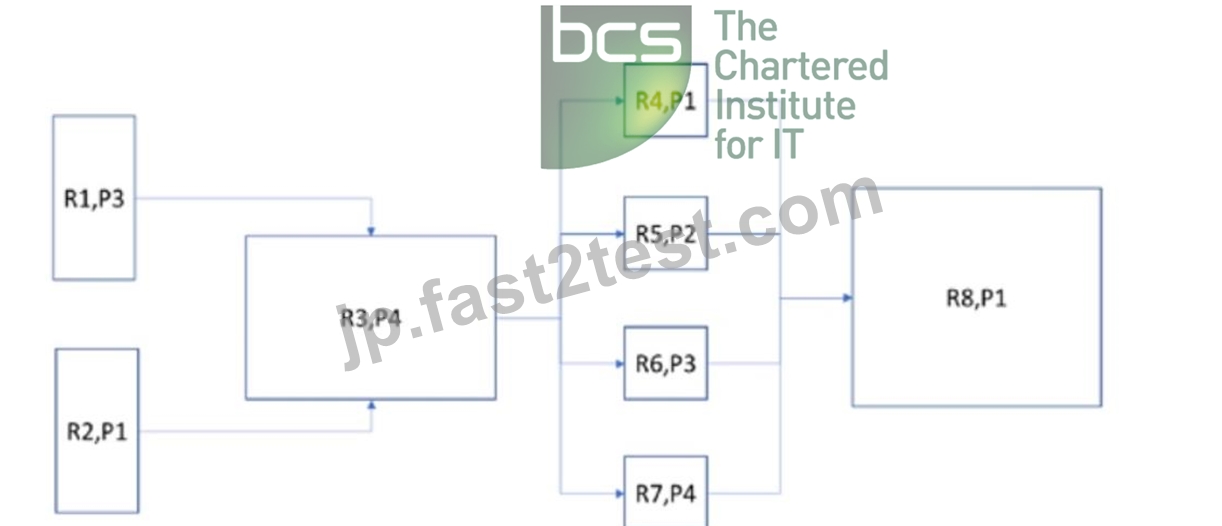
Which one of the following options best describes the test execution sequence using both requirement dependency and priority
- A. R1, R2, R3, R4, R5, R6, R7, R8.
- B. R2, R4. R8, R5, R1, R6, R3, R7.
- C. R2. R1, R3. R4. R5, R6. R7, R8.
- D. . R2, R1,R3,R7,R6,R5,R4,R8.
正解:D
解説:
The correct test execution sequence should consider both the dependencies between the requirements and their priorities. According to the diagram, the sequence begins with R2 (P1) as it is a prerequisite for R3 (P4). Then R1 (P3) can be tested. R3 follows as it depends on R2. Next, R7 (P4) should be tested before R6 (P3) and R5 (P2), as indicated by their dependencies. Finally, R4 (P1) and R8 (P1) can be tested. Therefore, the best sequence is R2, R1, R3, R7, R6, R5, R4, R8. Reference: ISTQB CTFL Syllabus V4.0, Section 5.1.5
質問 # 85
A Test Manager conducts risk assessment for a project. One of the identified risks is: The sub-contractor may fail to meet his commitment". If this risk materializes. it will lead to delay in completion of testing required for the current cycle.
Which of the following sentences correctly describes the risk?
- A. It is a product risk since default on part of the sub-contractor may lead to delay in release of the product
- B. It is no longer a risk for the Test Manager since an independent party (the sub-contractor) is now managing it
- C. It is a product risk since any risk associated with development timeline is a product risk.
- D. It is a object risk since successful completion of the object depends on successful and timely completion of the tests
正解:A
解説:
A product risk is a risk that affects the quality or timeliness of the software product being developed or tested1. Product risks are related to the requirements, design, implementation, verification, and maintenance of the software product2.
The risk of the sub-contractor failing to meet his commitment is a product risk, as it could cause a delay in the completion of the testing required for the current cycle, which in turn could affect the release date of the product. The release date is an important aspect of the product quality, as it reflects the customer satisfaction and the market competitiveness of the product3.
The other options are not correct because:
A . It is not true that any risk associated with development timeline is a product risk. Some risks could be project risks, which are risks that affect the management or control of the software project, such as budget, resources, schedule, or communication1. For example, a risk of losing a key project stakeholder is a project risk, not a product risk.
B . It is not true that the risk is no longer a risk for the Test Manager since an independent party is managing it. The Test Manager is still responsible for ensuring that the testing activities are completed according to the test plan and the quality objectives4. The Test Manager should monitor and control the sub-contractor's performance and communicate with him regularly to identify and mitigate any potential issues or deviations5.
C . It is not clear what is meant by "object" in this option, but it could be interpreted as the software system under test or the test object6. In any case, the risk is not an object risk, as it does not affect the successful completion of the object, but rather the successful completion of the testing of the object. An object risk could be a risk that affects the functionality, reliability, usability, efficiency, maintainability, or portability of the software system under test2. For example, a risk of the software system having a high complexity or a low testability is an object risk, not a product risk.
Reference =
1 ISTQB Certified Tester Foundation Level Syllabus v4.0, 2023, p. 97
2 ISTQB Certified Tester Foundation Level Syllabus v4.0, 2023, p. 98
3 ISTQB Certified Tester Foundation Level Syllabus v4.0, 2023, p. 99
4 ISTQB Certified Tester Foundation Level Syllabus v4.0, 2023, p. 100
5 ISTQB Certified Tester Foundation Level Syllabus v4.0, 2023, p. 101
6 ISTQB Certified Tester Foundation Level Syllabus v4.0, 2023, p. 102
質問 # 86
Test automation allows you to:
- A. produce tests that are less subject to human errors
- B. demonstrate the absence of defects
- C. avoid performing exploratory testing
- D. increase test process efficiency by facilitating management of defects
正解:A
解説:
Test automation allows you to produce tests that are less subject to human errors, as they can execute predefined test scripts or test cases with consistent inputs, outputs, and expected results. Test automation can also reduce the manual effort and time required to execute repetitive or tedious tests, such as regression tests, performance tests, or data-driven tests. Test automation does not demonstrate the absence of defects, as it can only verify the expected behavior of the system under test, not the unexpected or unknown behavior. Test automation does not avoid performing exploratory testing, as exploratory testing is a valuable technique to discover new information, risks, or defects that are not covered by automated tests. Test automation does not increase test process efficiency by facilitating management of defects, as defect management is a separate activity that involves reporting, tracking, analyzing, and resolving defects, which may or may not be related to automated tests. Reference: ISTQB Certified Tester Foundation Level (CTFL) v4.0 sources and documents:
ISTQB Certified Tester Foundation Level Syllabus v4.0, Chapter 3.3.1, Test Automation1 ISTQB Glossary of Testing Terms v4.0, Test Automation2
質問 # 87
Which of the following statements is true?
- A. Experience-based test techniques rely on the experience of testers to identify the root causes of defects found by black-box test techniques
- B. Experience-based test techniques are often useful to detect hidden defects that have not been targeted by black-box test techniques
- C. Some of the most common test basis used by white-box test techniques include user stories, use cases and business processes
- D. The primary goal of experience-based test techniques is to design test cases that can be easily automated using a GUI-based test automation tool
正解:B
解説:
Experience-based test techniques are test design techniques that rely on the experience, knowledge, intuition, and creativity of the testers to identify and execute test cases that are likely to find defects in the software system. Experience-based test techniques are often useful to detect hidden defects that have not been targeted by black-box test techniques, which are test design techniques that use the external behavior and specifications of the software system as the test basis, without considering its internal structure or implementation. Experience-based test techniques can complement black-box test techniques by covering aspects that are not explicitly specified, such as usability, security, reliability, performance, etc. The other statements are false, because:
Experience-based test techniques do not rely on the experience of testers to identify the root causes of defects found by black-box test techniques, but rather to identify the potential sources of defects based on their own insights, heuristics, or exploratory testing. The root causes of defects are usually identified by debugging or root cause analysis, which are activities that involve examining the code or the development process to find and fix the errors that led to the defects.
Some of the most common test basis used by white-box test techniques include the source code, the design documents, the architecture diagrams, and the control flow graphs of the software system. White-box test techniques are test design techniques that use the internal structure and implementation of the software system as the test basis, and aim to achieve a certain level of test coverage based on the code elements, such as statements, branches, paths, etc. User stories, use cases, and business processes are examples of test basis used by black-box test techniques, as they describe the functional and non-functional requirements of the software system from the perspective of the users or the stakeholders.
The primary goal of experience-based test techniques is not to design test cases that can be easily automated using a GUI-based test automation tool, but rather to design test cases that can reveal defects that are not easily detected by other test techniques, such as boundary value analysis, equivalence partitioning, state transition testing, etc. Test automation is the use of software tools to execute test cases and compare actual results with expected results, without human intervention. Test automation can be applied to different types of test techniques, depending on the test objectives, the test levels, the test tools, and the test resources. However, test automation is not always feasible or beneficial, especially for test cases that require human judgment, creativity, or exploration, such as those designed by experience-based test techniques. Reference: ISTQB Certified Tester Foundation Level (CTFL) v4.0 sources and documents:
ISTQB Certified Tester Foundation Level Syllabus v4.0, Chapter 2.2.1, Black-box Test Design Techniques ISTQB Certified Tester Foundation Level Syllabus v4.0, Chapter 2.2.2, White-box Test Design Techniques ISTQB Certified Tester Foundation Level Syllabus v4.0, Chapter 2.2.3, Experience-based Test Design Techniques ISTQB Glossary of Testing Terms v4.0, Experience-based Test Technique, Black-box Test Technique, White-box Test Technique, Test Basis, Test Coverage, Test Automation
質問 # 88
Which of the following is a factor that contributes to a successful review?
- A. All participants in the review are aware they will be evaluated based on the defects they will find
- B. Review metrics must be collected to improve the review process
- C. The author of the work product to be reviewed leads the review meeting.
- D. All participants in the review are trained to deal with the review type and its objectives.
正解:D
解説:
A successful review process involves all participants being trained in the review type and understanding its objectives. This ensures that everyone can contribute effectively and understand what is expected from the review. Proper training helps to identify defects accurately and facilitates constructive feedback, leading to a more efficient and effective review process. Hence, statement C is correct according to the ISTQB CTFL syllabus.
質問 # 89
You are testing the latest version of an air-traffic control system prior to production deployment using exploratory testing. After following an unusual sequence of input steps, the system crashes. After the crash, you document a defect report with the following information:
* Title: System crashes unexpectedly during input.
* Brief summary: System crashes when an unusual sequence of inputs is used.
* Version: V1.001
* Test: Exploratory testing prior to production deployment
* Priority: Urgent
* Risk: High
* Reference: Screenshot of crashed application
What critical Information Is missing from this report?
- A. Description of the defect to enable reproduction.
- B. Status of defect
- C. Change history.
- D. Conclusions, recommendations, and approvals.
正解:A
解説:
The critical information missing from the defect report is a detailed description of the defect to enable reproduction. A clear and concise description of the steps taken to reproduce the defect is essential for developers to understand the context and to be able to replicate the issue in their environment. Without this information, it can be challenging to diagnose and fix the defect. The ISTQB CTFL syllabus emphasizes the importance of providing all necessary details in a defect report to facilitate effective communication and resolution.
質問 # 90
Which of the following statements is TRUE?
- A. User acceptance tests are usually automated and aim to verify the acceptance criteria for user stories
- B. Acceptance criteria for user stories can include details on data definitions, for example by describing the format, allowed values, and default values for a data item
- C. Tests derived from acceptance criteria for user stories are not included in any of the four testing quadrants
- D. Acceptance criteria for user stones should focus on positive scenarios, while negative scenarios should be excluded
正解:B
解説:
Acceptance criteria for user stories often include detailed specifications about data definitions, such as the format, allowed values, and default values for a data item. This helps ensure that the developed feature meets the expected requirements and provides a clear understanding for both developers and testers on what needs to be validated. Therefore, statement B is true as per the ISTQB CTFL syllabus.
質問 # 91
Which of the following statements about static testing and dynamic testing is TRUE?
- A. Both dynamic testing and static testing cause failures, but failures caused by static testing are usually easier and cheaper to analyse.
- B. Static testing is better suited than dynamic testing for highlighting issues that could indicate inappropriate code modulansation.
- C. Security vulnerabilities can only be detected when the software is being executed, and thus they can only be detected through dynamic testing, not through static testing
- D. Dynamic testing can only be applied to executable work products, while static testing can only be applied to non-executable work products.
正解:B
解説:
Static testing, such as code reviews and static analysis, is particularly effective at identifying issues related to code structure and modularization. These techniques allow for the inspection of the code without executing it, making it easier to spot problems related to how the code is organized. Dynamic testing, on the other hand, focuses on the execution of code and is better suited for identifying runtime issues but does not easily reveal structural problems. The ISTQB CTFL Syllabus v4.0 highlights the strengths of static testing in uncovering such structural issue
質問 # 92
As a tester, as part of a V-model project, you are currently executing some tests aimed at verifying if a mobile app asks the user to grant the proper access permissions during the installation process and after the installation process. The requirements specification states that in both cases the app shall ask the user to grant access permissions only to the camera and photos stored on the device. However, you observe that the app also asks the user to grant access permission to all contacts on the device. Consider the following items:
[I]. Test environment
[ii]. Expected result
[iii]. Actual result.
[IV] Test level.
[V]. Root cause.
Based on only the given information, which of the items listed above, are you able to CORRECTLY specify in a defect report?
- A. [ii], [IV] and [V].
- B. [ii], [iii] and [v]
- C. [l] and [IV]
- D. [ii] and [III].
正解:D
解説:
When writing a defect report, the tester can specify the expected result and the actual result based on the observation. The expected result is what the requirements specify, and the actual result is what was observed during testing. These elements are crucial for clearly communicating the nature of the defect to developers and other stakeholders. The other items such as test environment, test level, and root cause may not be clear or necessary at this stage of defect reporting.
質問 # 93
......
BCS CTFL4 認定試験の出題範囲:
| トピック | 出題範囲 |
|---|---|
| トピック 1 |
|
| トピック 2 |
|
| トピック 3 |
|
| トピック 4 |
|
| トピック 5 |
|
合格させるCTFL4テストエンジンPDFで完全版無料問題集がここに:https://jp.fast2test.com/CTFL4-premium-file.html