

初心者向けのDP-600試験 [2026] 問題集でMicrosoftのPDF問題
DP-600プレミアム試験エンジンPDFをダウンロード
質問 # 31
You have a Fabric workspace that contains a Dataflow Gen2 query. The query returns the following data.
You need to filter the results to ensure that only the latest version of each customer's record is retained. The solution must ensure that no new columns are loaded to the semantic model.
Which four actions should you perform in sequence in Power Query Editor? To answer, move the appropriate actions from the list of actions to the answer area and arrange them in the correct order.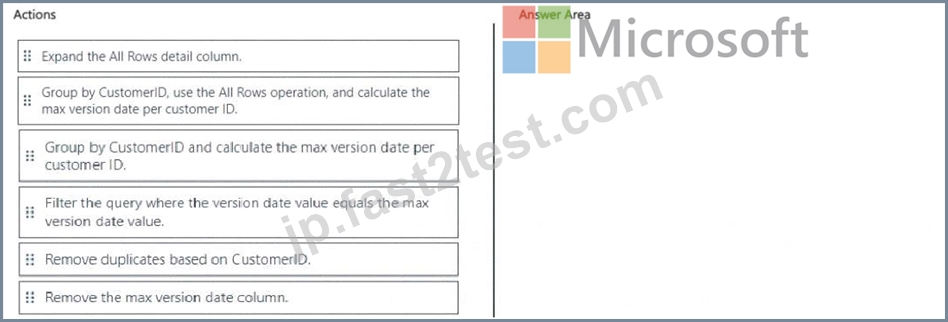
正解:
解説: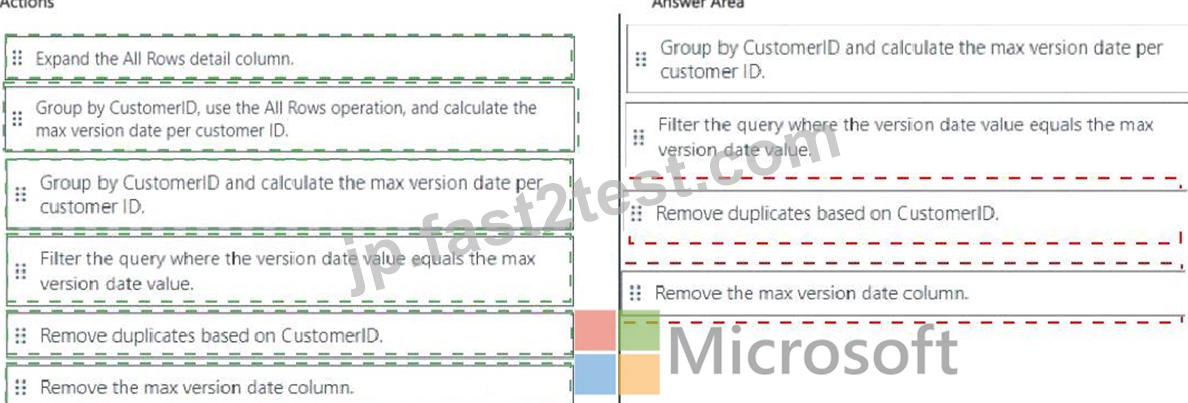
Explanation: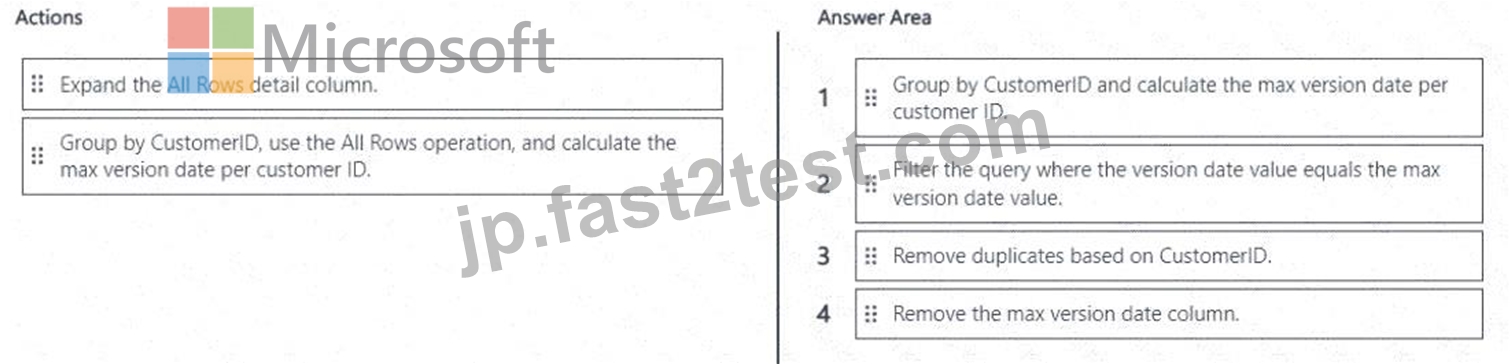
質問 # 32
You have a Fabric tenant that contains a warehouse named Warehouse!. Warehousel contains two schemas name schemal and schema2 and a table named schemal.city.
You need to make a copy of schemal.city in schema2. The solution must minimize the copying of data.
Which T-SQL statement should you run?
- A. SELECT * INTO schema2.eity FROM schemal.city;
- B. CREATE TABLE schema2.city AS CLONE OF schemal.city;
- C. INSERT INTO schema2.city SELECT * FROM schemal.city;
- D. CREATE TABLE schema2.city AS SELECT * FROM schemal.city;
正解:B
質問 # 33
You have a Fabric tenant that contains a semantic model. The model uses Direct Lake mode.
You suspect that some DAX queries load unnecessary columns into memory.
You need to identify the frequently used columns that are loaded into memory.
What are two ways to achieve the goal? Each correct answer presents a complete solution.
NOTE: Each correct answer is worth one point.
- A. Use the Analyze in Excel feature.
- B. Use the Vertipaq Analyzer tool.
- C. Query the $System.DISCOVER_STORAGE_TABLE_COLUMN_SEGMENTS dynamic
management view (DMV). - D. Query the DISCOVER_MEMORYGRANT dynamic management view (DMV).
正解:B、C
質問 # 34
You have a Fabric warehouse named Warehouse1 that contains a table named Table1. Table1 contains customer data.
You need to implement row-level security (RLS) for Table1. The solution must ensure that users can see only their respective data.
Which two objects should you create? Each correct answer presents part of the solution.
NOTE: Each correct selection is worth one point.
- A. FUNCTION
- B. SECURITY POLICY
- C. STORED PROCEDURE
- D. DATABASE ROLE
- E. CONSTRAINT
正解:A、B
解説:
To implement RLS for Table1 in Fabric, create a FUNCTION to define row-filtering logic and a SECURITY POLICY to enforce it. This ensures users only see the rows they are permitted to access.
質問 # 35
You are implementing two dimension tables named Customers and Products in a Fabric warehouse.
You need to use slowly changing dimension (SCO) to manage the versioning of data. The solution must meet the requirements shown in the following table.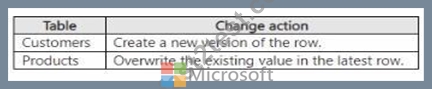
Which type of SCD should you use for each table? To answer, drag the appropriate SCD types to the correct tables. Each SCD type may be used once, more than once, or not at all. You may need to drag the split bar between panes or scroll to view content.
NOTE: Each correct selection is worth one point.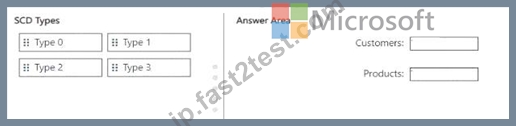
正解:
解説: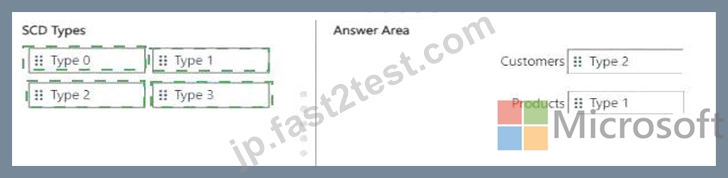
Explanation: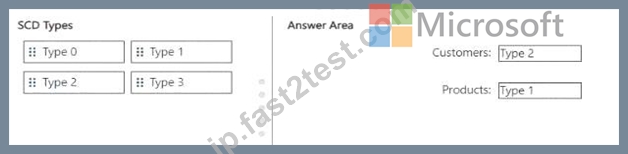
For the Customers table, where the requirement is to create a new version of the row, you would use:
* Type 2 SCD: This type allows for the creation of a new record each time a change occurs, preserving the history of changes over time.
For the Products table, where the requirement is to overwrite the existing value in the latest row, you would use:
* Type 1 SCD: This type updates the record directly, without preserving historical data.
質問 # 36
You are creating a report and a semantic model in Microsoft Power Bl Desktop.
The Value measure has the expression shown in the following exhibit.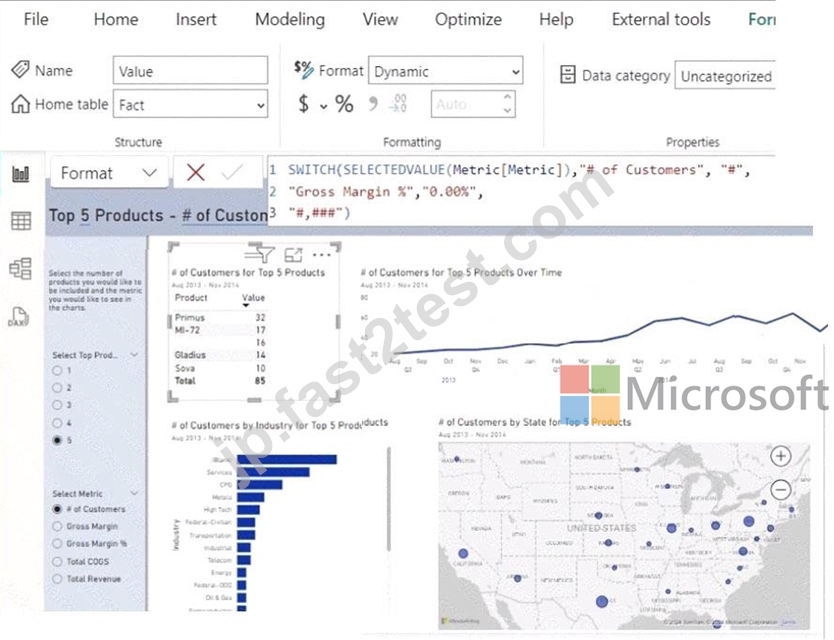
Use the drop-down menus to select the answer choice that completes each statement based on the information presented in the graphic.
NOTE: Each correct selection is worth one point.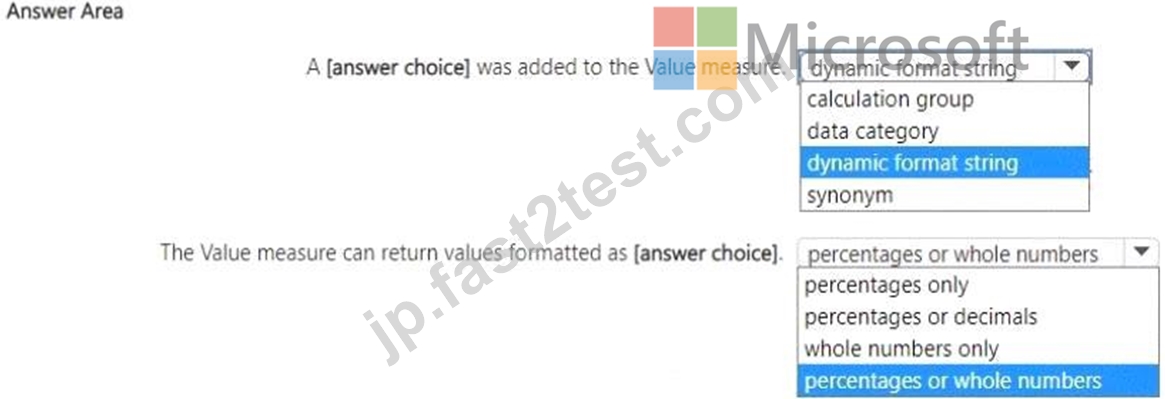
正解:
解説: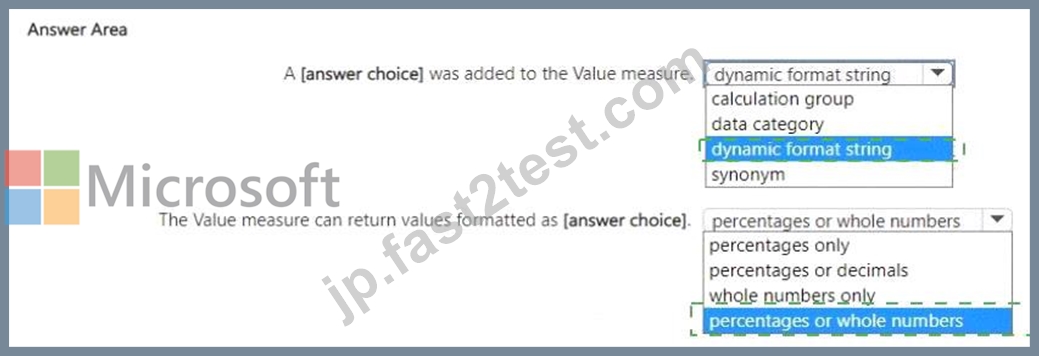
Explanation: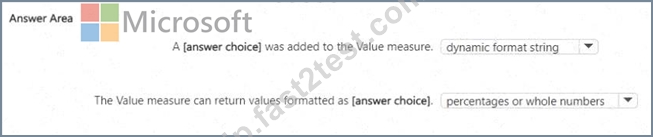
質問 # 37
You need to recommend which type of fabric capacity SKU meets the data analytics requirements for the Research division. What should you recommend?
- A. P
- B. A
- C. EM
- D. F
正解:D
解説:
You need to recommend which type of Fabric capacity SKU meets the data analytics requirements for the Research division.
Requirement: "The Research division workspaces must use a dedicated, on-demand capacity that has per- minute billing." Fabric capacity SKUs:
F (Fabric) = dedicated Fabric capacity, available on pay-as-you-go with per-minute billing.
P (Premium) and EM are Power BI capacities (not Fabric-native).
A refers to Azure Analysis Services capacity.
The only correct option is F SKU.
質問 # 38
Drag and Drop Question
You have a Fabric tenant that contains a semantic model. The model contains data about retail stores.
You need to write a DAX query that will be executed by using the XMLA endpoint. The query must return a table of stores that have opened since December 1, 2023.
How should you complete the DAX expression? To answer, drag the appropriate values to the correct targets. Each value may be used once, more than once, or not at all. You may need to drag the split bar between panes or scroll to view content.
NOTE: Each correct selection is worth one point.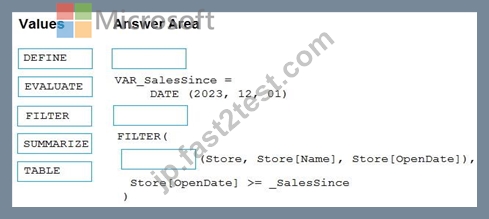
正解:
解説: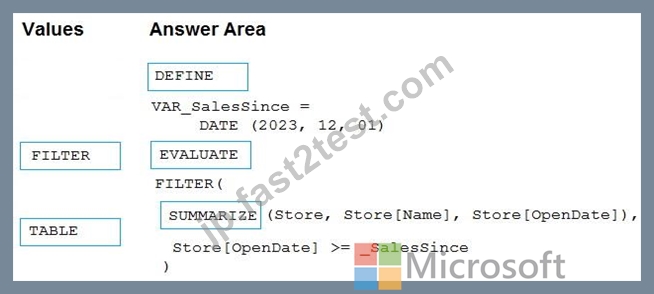
質問 # 39
You have an Azure SQL database named DB1 and a Fabric workspace named Workspace1.
Workspace1 contains a lakehouse named LH1 and a Dataflow Gen2 named Dataflow1.
Dataflow1 includes a query named Query1 that loads data from DB1, applies transformations to the data, and then filters the data.
You discover that Query1 loads all the data before applying the transformations.
You need to ensure that Query1 uses query folding.
What should you do?
- A. Replace DB1 with a Microsoft SQL Server database.
- B. Move the filter steps before the transformation steps in Query1.
- C. Remove unused columns from Query1.
- D. Enable incremental refresh for Query1.
正解:B
解説:
To ensure your Dataflow Gen2 query uses query folding when loading from Azure SQL to a Lakehouse, you need to verify that your transformations are being translated into a single SQL statement that is executed by the source database. This prevents the "load all data" behavior you are currently experiencing.
Rearrange Transformations
Power Query stops folding once it hits a step it cannot translate into SQL. To maximize efficiency:
Filter and Select early: Always place Filter Rows and Choose Columns steps as early as possible. This ensures only necessary data is retrieved from Azure SQL.
Reference:
https://www.linkedin.com/posts/salina-bagwan-1007471b6_qliksense-qlikinterviewquestions- sqlinterviewquestions-activity-7311428148225568769-LDMw
質問 # 40
You have a Fabric tenant that contains a workspace named Workspace1 and a user named User1. Workspace1 contains a warehouse named DW1.
You share DW1 with User1 and assign User1 the default permissions for DW1.
What can User1 do?
- A. Read the underlying Parquet files from OneLake.
- B. Connect to DW1 via the TDS (Tabular Data Stream) endpoint.
- C. Build reports by using the default dataset.
- D. Read data from the tables in DW1.
正解:B
解説:
Assigning a user default permission ("Read") to a warehouse in a Fabric workspace enables them to connect to the SQL analytics endpoint, which is the equivalent of CONNECT permissions in SQL Server. However, this permission only allows them to connect; it doesn't grant them the ability to query tables, views, functions, or stored procedures within the warehouse unless they're also given access to those specific objects through T-SQL GRANT statements.
In essence, the default "Read" permission provides the necessary connectivity to the warehouse's SQL analytics endpoint, but it does not automatically grant access to the data and objects within the warehouse itself. Further permissions need to be granted through T-SQL or Fabric's workspace roles and item permissions system.
Reference:
https://learn.microsoft.com/en-us/fabric/data-warehouse/share-warehouse-manage-permissions
質問 # 41
You to need assign permissions for the data store in the AnalyticsPOC workspace. The solution must meet the security requirements.
Which additional permissions should you assign when you share the data store? To answer, select the appropriate options in the answer area.
NOTE: Each correct selection is worth one point.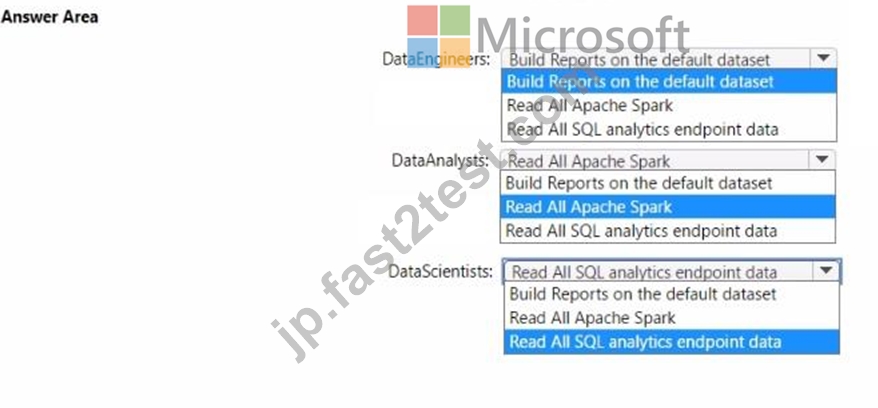
正解:
解説: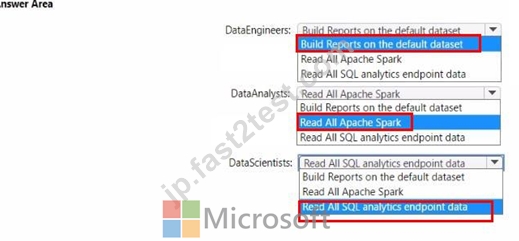
質問 # 42
Case Study 1 - Contoso
Overview
Contoso, Ltd. is a US-based health supplements company. Contoso has two divisions named Sales and Research. The Sales division contains two departments named Online Sales and Retail Sales. The Research division assigns internally developed product lines to individual teams of researchers and analysts.
Existing Environment
Identity Environment
Contoso has a Microsoft Entra tenant named contoso.com. The tenant contains two groups named ResearchReviewersGroup1 and ResearchReviewersGroup2.
Data Environment
Contoso has the following data environment:
- The Sales division uses a Microsoft Power BI Premium capacity.
- The semantic model of the Online Sales department includes a fact table named Orders that uses Import made. In the system of origin, the OrderID value represents the sequence in which orders are created.
- The Research department uses an on-premises, third-party data warehousing product.
- Fabric is enabled for contoso.com.
- An Azure Data Lake Storage Gen2 storage account named storage1 contains Research division data for a product line named Productline1. - The data is in the delta format.
- A Data Lake Storage Gen2 storage account named storage2 contains Research division data for a product line named Productline2. The data is in the CSV format.
Requirements
Planned Changes
Contoso plans to make the following changes:
- Enable support for Fabric in the Power BI Premium capacity used by the Sales division.
- Make all the data for the Sales division and the Research division available in Fabric.
- For the Research division, create two Fabric workspaces named Productline1ws and Productine2ws.
- In Productline1ws, create a lakehouse named Lakehouse1.
- In Lakehouse1, create a shortcut to storage1 named ResearchProduct.
Data Analytics Requirements
Contoso identifies the following data analytics requirements:
- All the workspaces for the Sales division and the Research division must support all Fabric experiences.
- The Research division workspaces must use a dedicated, on-demand capacity that has per- minute billing.
- The Research division workspaces must be grouped together logically to support OneLake data hub filtering based on the department name.
- For the Research division workspaces, the members of ResearchReviewersGroup1 must be able to read lakehouse and warehouse data and shortcuts by using SQL endpoints.
- For the Research division workspaces, the members of ResearchReviewersGroup2 must be able to read lakehouse data by using Lakehouse explorer.
- All the semantic models and reports for the Research division must use version control that supports branching.
Data Preparation Requirements
Contoso identifies the following data preparation requirements:
- The Research division data for Productline1 must be retrieved from Lakehouse1 by using Fabric notebooks.
- All the Research division data in the lakehouses must be presented as managed tables in Lakehouse explorer.
Semantic Model Requirements
Contoso identifies the following requirements for implementing and managing semantic models:
- The number of rows added to the Orders table during refreshes must be minimized.
- The semantic models in the Research division workspaces must use Direct Lake mode.
General Requirements
Contoso identifies the following high-level requirements that must be considered for all solutions:
- Follow the principle of least privilege when applicable.
- Minimize implementation and maintenance effort when possible.
What should you use to implement calculation groups for the Research division semantic models?
- A. DAX Studio
- B. Microsoft Power BI Desktop
- C. Tabular Editor
- D. the Power BI service
正解:C
解説:
https://powerbi.microsoft.com/en-us/blog/announcing-calculation-groups-for-direct-lake-datasets/
質問 # 43
You have a Fabric tenant that contains a semantic model named Model1. Model1 uses Import mode. Model1 contains a table named Orders. Orders has 100 million rows and the following fields.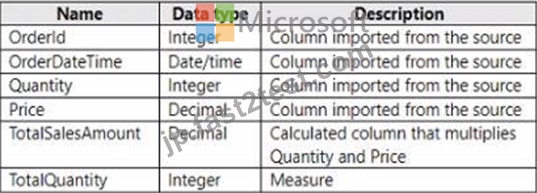
You need to reduce the memory used by Model! and the time it takes to refresh the model. Which two actions should you perform? Each correct answer presents part of the solution. NOTE: Each correct answer is worth one point.
- A. Split OrderDateTime into separate date and time columns.
- B. Replace TotalSalesAmount with a measure.
- C. Replace TotalQuantity with a calculated column.
- D. Convert Quantity into the Text data type.
正解:B、C
解説:
To reduce memory usage and refresh time, splitting the OrderDateTime into separate date and time columns (A) can help optimize the model because date/time data types can be more memory-intensive than separate date and time columns. Moreover, replacing TotalSalesAmount with a measure (D) instead of a calculated column ensures that the calculation is performed at query time, which can reduce the size of the model as the value is not stored but calculated on the fly. References = The best practices for optimizing Power BI models are detailed in the Power BI documentation, which recommends using measures for calculations that don't need to be stored and adjusting data types to improve performance.
質問 # 44
You to need assign permissions for the data store in the AnalyticsPOC workspace. The solution must meet the security requirements.
Which additional permissions should you assign when you share the data store? To answer, select the appropriate options in the answer area.
NOTE: Each correct selection is worth one point.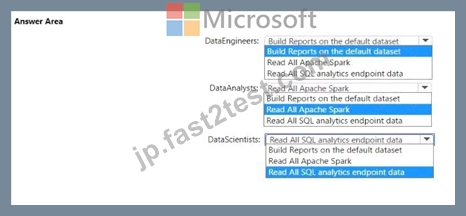
正解:
解説: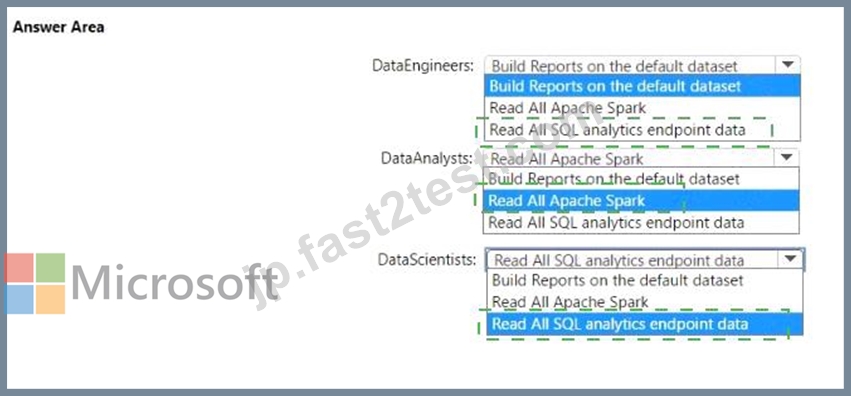
Explanation:
* Data Engineers: Read All SQL analytics endpoint data
* Data Analysts: Read All Apache Spark
* Data Scientists: Read All SQL analytics endpoint data
The permissions for the data store in the AnalyticsPOC workspace should align with the principle of least privilege:
* Data Engineers need read and write access but not to datasets or reports.
* Data Analysts require read access specifically to the dimensional model objects and the ability to create Power BI reports.
* Data Scientists need read access via Spark notebooks. These settings ensure each role has the necessary permissions to fulfill their responsibilities without exceeding their required access level.
質問 # 45
Hotspot Question
You have a Fabric tenant that contains a workspace named Workspace_DEV. Workspace_DEV contains the semantic models shown in the following table.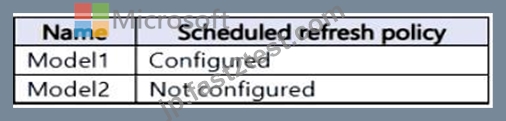
Workspace_DEV contains the dataflows shown in the following table.
You create a new workspace named Workspace_TEST.
You create a deployment pipeline named Pipeline1 to move items from Workspace_DEV to Workspace_TEST.
You run Pipeline1.
For each of the following statements, select Yes if the statement is true. Otherwise, select No.
NOTE: Each correct selection is worth one point.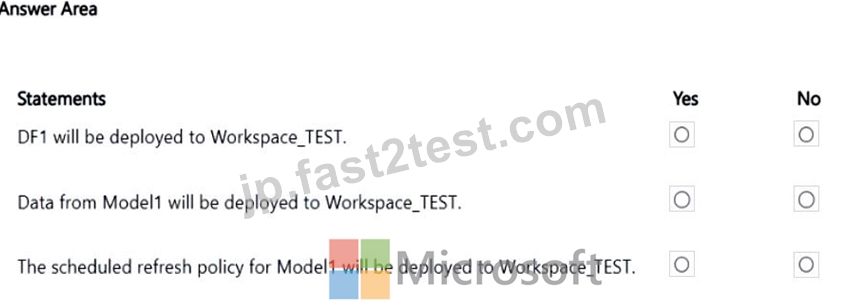
正解:
解説: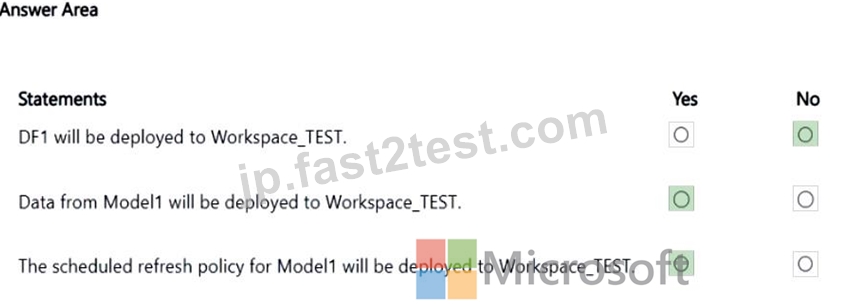
質問 # 46
You have a Fabric tenant that contains a semantic model named Model1. Model1 uses Import mode. Model1 contains a table named Orders. Orders has 100 million rows and the following fields.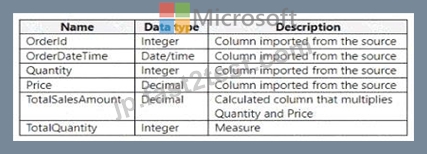
You need to reduce the memory used by Model! and the time it takes to refresh the model. Which two actions should you perform? Each correct answer presents part of the solution. NOTE: Each correct answer is worth one point.
- A. Split OrderDateTime into separate date and time columns.
- B. Replace TotalSalesAmount with a measure.
- C. Replace TotalQuantity with a calculated column.
- D. Convert Quantity into the Text data type.
正解:B、C
解説:
To reduce memory usage and refresh time, splitting the OrderDateTime into separate date and time columns (A) can help optimize the model because date/time data types can be more memory-intensive than separate date and time columns. Moreover, replacing TotalSalesAmount with a measure (D) instead of a calculated column ensures that the calculation is performed at query time, which can reduce the size of the model as the value is not stored but calculated on the fly. References = The best practices for optimizing Power BI models are detailed in the Power BI documentation, which recommends using measures for calculations that don't need to be stored and adjusting data types to improve performance.
質問 # 47
You have a Fabric tenant that contains a lakehouse.
You plan to use a visual query to merge two tables.
You need to ensure that the query returns all the rows in both tables.
Which type of join should you use?
- A. inner
- B. left anti
- C. full outer
- D. right outer
- E. left outer
- F. right anti
正解:C
解説:
Left or right will only return one table all rows and other table if exist in the other table. inner will only return if data match in both tables so Full (outer) join will return all data from both tables
質問 # 48
You need to ensure that Contoso can use version control to meet the data analytics requirements and the general requirements. What should you do?
- A. Modify the settings of the Research division workspaces to use an Azure Repos repository.
- B. Store all the semantic models and reports in Microsoft OneDrive.
- C. Modify the settings of the Research workspaces to use a GitHub repository.
- D. Store all the semantic models and reports in Data Lake Gen2 storage.
正解:C
質問 # 49
You are the administrator of a Fabric workspace that contains a lakehouse named Lakehouse1.
Lakehouse1 contains the following tables:
Table1: A Delta table created by using a shortcut
Table2: An external table created by using Spark
Table3: A managed table
You plan to connect to Lakehouse1 by using its SQL endpoint.
What will you be able to do after connecting to Lakehouse1?
- A. Read Table2.
- B. Update the data in Table1.
- C. Read Table3.
- D. Update the data Table3.
正解:C
質問 # 50
You have a Fabric tenant that contains the workspaces shown in the following table.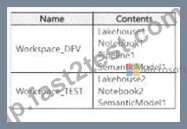
You have a deployment pipeline named Pipeline1 that deploys items from Workspace_DEV to Workspace_TEST. In Pipeline1, all items that have matching names are paired.
You deploy the contents of Workspace_DEV to Workspace_TEST by using Pipeline1.
What will the contents of Workspace_TEST be once the deployment is complete?
- A. Lakehouse1
Lakehouse2
Notebook1
Notebook2
Pipeline1
SemanticModel1 - B. Lakehouse2
Notebook2
Pipeline1
SemanticModel1 - C. Lakehouse2
Notebook2
SemanticModel1 - D. Lakehouse1
Notebook1
Pipeline1
SemanticModel1
正解:D
解説:
Workspace_DEV contents:
Lakehouse1, Notebook1, Pipeline1, SemanticModel1
Workspace_TEST contents (before deployment):
Lakehouse2, Notebook2, SemanticModel1
After deployment:
SemanticModel1 # same name, so it will be paired and overwritten with the DEV version.
Lakehouse1 and Notebook1 # new items, so they will be added to TEST.
Lakehouse2 and Notebook2 # remain because they don't conflict in name.
Pipeline1 # new item, so it will also be added .
So the final content is:
Lakehouse1, Lakehouse2, Notebook1, Notebook2, Pipeline1, SemanticModel1
質問 # 51
You have a Microsoft Power Bl semantic model that contains measures. The measures use multiple calculate functions and a filter function.
You are evaluating the performance of the measures.
In which use case will replacing the filter function with the keepfilters function reduce execution time?
- A. when the filter function references a measure
- B. when the filter function references columns from multiple tables
- C. when the filter function references a column from a single table that uses Import mode
- D. when the filter function uses a nested calculate function
正解:C
解説:
The KEEPFILTERS function modifies the way filters are applied in calculations done through the CALCULATE function. It can be particularly beneficial to replace the FILTER function with KEEPFILTERS when the filter context is being overridden by nested CALCULATE functions, which may remove filters that are being applied on a column. This can potentially reduce execution time because KEEPFILTERS maintains the existing filter context and allows the nested CALCULATE functions to be evaluated more efficiently.
References: This information is based on the DAX reference and performance optimization guidelines in the Microsoft Power BI documentation.
質問 # 52
You have a Fabric tenant that contains two lakehouses.
You are building a dataflow that will combine data from the lakehouses. The applied steps from one of the queries in the dataflow is shown in the following exhibit.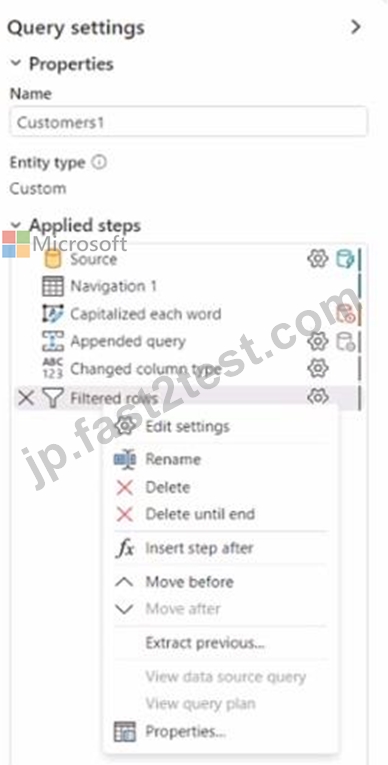
Use the drop-down menus to select the answer choice that completes each statement based on the information presented in the graphic. NOTE: Each correct selection is worth one point.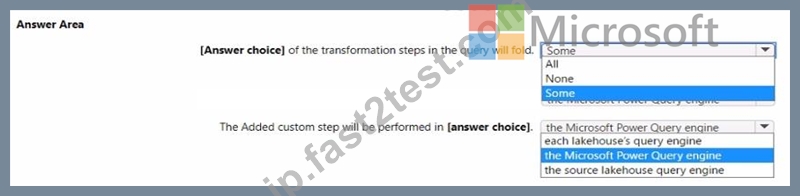
正解:
解説: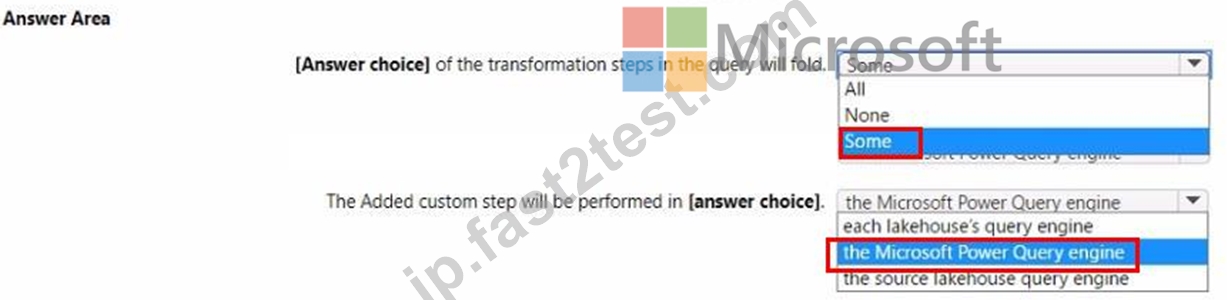
Reference:
Query folding in Power Query
Power Query M formula language
質問 # 53
You have source data in a CSV file that has the following fields:
* SalesTra nsactionl D
* SaleDate
* CustomerCode
* CustomerName
* CustomerAddress
* ProductCode
* ProductName
* Quantity
* UnitPrice
You plan to implement a star schema for the tables in WH1. Thedimension tables in WH1 will implement Type 2 slowly changing dimension (SCD) logic.
You need to design the tables that will be used for sales transaction analysis and load the source data.
Which type of target table should you specify for the CustomerName, CustomerCode, and SaleDate fields? To answer, select the appropriate options in the answer area.
NOTE: Each correct selection is worth one point.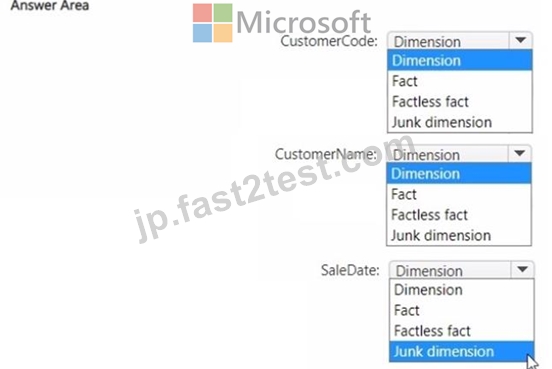
正解:
解説: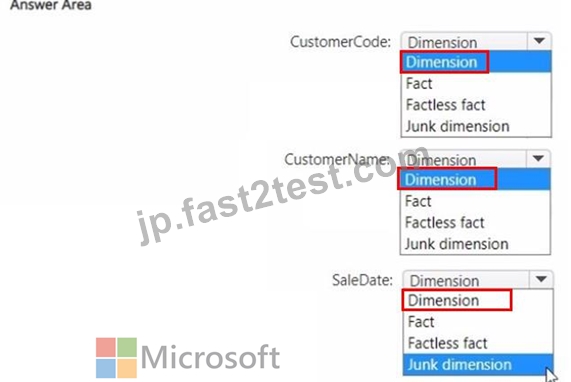
質問 # 54
......
あなたを合格させるMicrosoft試験にはDP-600試験問題集:https://jp.fast2test.com/DP-600-premium-file.html
検証済みDP-600豪華お試しセットリアル試験問題集PDF:https://drive.google.com/open?id=1tbEeSWEfsnVn2vNdDR2xUf9WPUhJjb8z