

ベストSalesforce MuleSoft-Platform-Architect-I学習ガイドと問題集は2025年更新
トップクラスSalesforce MuleSoft-Platform-Architect-I試験最先端学習ガイド!練習問題バージョン
質問 # 84
Version 3.0.1 of a REST API implementation represents time values in PST time using ISO 8601 hh:mm:ss format. The API implementation needs to be changed to instead represent time values in CEST time using ISO 8601 hh:mm:ss format. When following the semver.org semantic versioning specification, what version should be assigned to the updated API implementation?
- A. 3.0.2
- B. 3.0.1
- C. 3.1.0
- D. 4.0.0
正解:D
解説:
Correct Answer : 4.0.0
*****************************************
As per semver.org semantic versioning specification:
Given a version number MAJOR.MINOR.PATCH, increment the:
- MAJOR version when you make incompatible API changes.
- MINOR version when you add functionality in a backwards compatible manner.
- PATCH version when you make backwards compatible bug fixes.
As per the scenario given in the question, the API implementation is completely changing its behavior. Although the format of the time is still being maintained as hh:mm:ss and there is no change in schema w.r.t format, the API will start functioning different after this change as the times are going to come completely different.
Example: Before the change, say, time is going as 09:00:00 representing the PST. Now on, after the change, the same time will go as 18:00:00 as Central European Summer Time is 9 hours ahead of Pacific Time.
>> This may lead to some uncertain behavior on API clients depending on how they are handling the times in the API response. All the API clients need to be informed that the API functionality is going to change and will return in CEST format. So, this considered as a MAJOR change and the version of API for this new change would be 4.0.0
質問 # 85
An operations team is analyzing the effort needed to set up monitoring of their application network. They are looking at which API invocation metrics can be used to identify and predict trouble without having to write custom scripts or install additional analytics software or tools.
Which type of metrics can satisfy this goal of directly identifying and predicting failures?
- A. The ROI from each APT invocation
- B. The number and types of API policy violations per day
- C. The effectiveness of the application network based on the level of reuse
- D. The number and types of past API invocations across the application network
正解:B
解説:
To monitor an application network and predict issues without custom scripts, policy violation metrics are critical. They provide insights into potential problems by tracking instances where API usage does not conform to defined policies. Here's why this approach is suitable:
Predictive Monitoring:
Tracking API policy violations (such as rate limits or spike controls being hit) can indicate surges in traffic or misuse, which may lead to throttling or service degradation if not addressed.
By monitoring these violations, teams can proactively adjust limits or optimize API handling to prevent actual failures.
No Custom Scripting Needed:
Policy violation metrics are available within MuleSoft's Anypoint Monitoring, meaning there's no need to implement custom solutions or external tools to gather and interpret this data.
of Incorrect Options:
Option B (effectiveness based on reuse) does not directly predict failures.
Option C (past invocation counts) offers historical usage data but does not inherently identify issues.
Option D (ROI from API invocation) is a business metric and does not provide technical insights for failure prediction.
Reference
For more details on leveraging policy violation metrics for proactive monitoring, refer to MuleSoft documentation on Anypoint Monitoring.
質問 # 86
Refer to the exhibit. An organization is running a Mule standalone runtime and has configured Active Directory as the Anypoint Platform external Identity Provider. The organization does not have budget for other system components.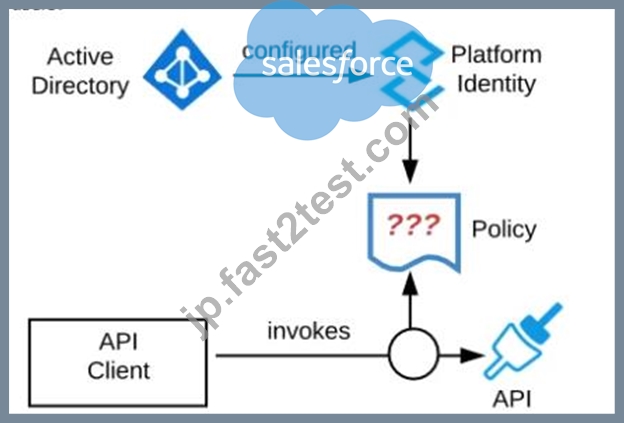
What policy should be applied to all instances of APIs in the organization to most effecuvelyKestrict access to a specific group of internal users?
- A. Apply a client ID enforcement policy; the specific group of users will configure their client applications to use their specific client credentials
- B. Apply an OAuth 2.0 access token enforcement policy; the internal Active Directory will be configured as the OAuth server
- C. Apply an IP whitelist policy; only the specific users' workstations will be in the whitelist
- D. Apply a basic authentication - LDAP policy; the internal Active Directory will be configured as the LDAP source for authenticating users
正解:D
解説:
Correct Answer : Apply a basic authentication - LDAP policy; the internal Active Directory will be configured as the LDAP source for authenticating users.
*****************************************
>> IP Whitelisting does NOT fit for this purpose. Moreover, the users workstations may not necessarily have static IPs in the network.
>> OAuth 2.0 enforcement requires a client provider which isn't in the organizations system components.
>> It is not an effective approach to let every user create separate client credentials and configure those for their usage.
The effective way it to apply a basic authentication - LDAP policy and the internal Active Directory will be configured as the LDAP source for authenticating users.
質問 # 87
What condition requires using a CloudHub Dedicated Load Balancer?
- A. When cross-region load balancing is required between separate deployments of the same Mule application
- B. When custom DNS names are required for API implementations deployed to customer-hosted Mule runtimes
- C. When server-side load-balanced TLS mutual authentication is required between API implementations and API clients
- D. When API invocations across multiple CloudHub workers must be load balanced
正解:C
解説:
Correct Answer : When server-side load-balanced TLS mutual authentication is required between API implementations and API clients
*****************************************
Fact/ Memory Tip: Although there are many benefits of CloudHub Dedicated Load balancer, TWO important things that should come to ones mind for considering it are:
>> Having URL endpoints with Custom DNS names on CloudHub deployed apps
>> Configuring custom certificates for both HTTPS and Two-way (Mutual) authentication.
Coming to the options provided for this question :
>> We
CANNOT use DLB to perform cross-region load balancing between separate deployments of the same Mule application.
>> We can have mapping rules to have more than one DLB URL pointing to same Mule app. But vicevera (More than one Mule app having same DLB URL) is NOT POSSIBLE
>> It is true that DLB helps to setup custom DNS names for Cloudhub deployed Mule apps but NOT true for apps deployed to Customer-hosted Mule Runtimes.
>> It is true to that we can load balance API invocations across multiple CloudHub workers using DLB but it is NOT A MUST. We can achieve the same (load balancing) using SLB (Shared Load Balancer) too. We DO NOT necessarily require DLB for achieve it.
So the only right option that fits the scenario and requires us to use DLB is when TLS mutual authentication is required between API implementations and API clients.
質問 # 88
A Platform Architect inherits a legacy monolithic SOAP-based web service that performs a number of tasks, including showing all policies belonging to a client. The service connects to two back-end systems - a life-insurance administration system and a general-insurance administration system - and then queries for insurance policy information within each system, aggregates the results, and presents a SOAP-based response to a user interface (UI).
The architect wants to break up the monolithic web service to follow API-led conventions.
Which part of the service should be put into the process layer?
- A. Presenting the SOAP-based response to the UI
- B. Authenticating and maintaining connections to each of the back-end administration systems
- C. Combining the insurance policy information from the administration systems
- D. Querying the data from the administration systems
正解:C
解説:
In the API-led connectivity approach, each layer (System, Process, and Experience) has a distinct purpose:
System APIs: These APIs connect directly to backend systems to expose and unlock data in a standardized way.
Process APIs: These are responsible for orchestrating and processing data across different systems, combining information where needed.
Experience APIs: These are designed for specific user interfaces or applications, often transforming data formats to fit the needs of each consumer application.
Why Option A is Correct:
Process APIs are designed to combine data from multiple systems, which aligns with the function of aggregating policy information from both the life and general insurance systems. This aggregation logic would ideally reside in the Process layer, separating data retrieval from data orchestration.
Moving this functionality to the Process layer enables reusability and modularity, as other Experience APIs or services could also leverage the combined policy data if needed.
of Incorrect Options:
Option B (Presenting the SOAP-based response) would be managed by the Experience layer, as this layer adapts data formats for specific interfaces.
Option C (Authenticating and maintaining backend connections) would typically be handled within the System layer, where backend integration and security handling occurs.
Option D (Querying data) is the function of System APIs, which access the backend systems directly and expose the raw data without additional processing.
Reference
For further details on API-led architecture and the roles of each layer, refer to MuleSoft's documentation on API-led connectivity and API layers.
質問 # 89
An online store's marketing team has noticed an increase in customers leaving online baskets without checking out. They suspect a technology issue is at the root cause of the baskets being left behind. They approach the Center for Enablement to ask for help identifying the issue. Multiple APIs from across all the layers of their application network are involved in the shopping application.
Which feature of the Anypoint Platform can be used to view metrics from all involved APIs at the same time?
- A. Custom dashboards
- B. Functional monitoring
- C. API Manager
- D. Built-in dashboards
正解:D
解説:
Understanding the Need for Cross-API Monitoring:
The Center for Enablement (C4E) needs to investigate potential technical issues across multiple APIs in the application network that may be causing customers to abandon their carts.
This requires a solution that allows viewing metrics across several APIs in real-time to identify any performance issues or bottlenecks.
Evaluating Anypoint Platform Features:
Built-in Dashboards: Anypoint Platform provides built-in dashboards in Anypoint Monitoring, allowing teams to view metrics from multiple APIs in a single interface. This feature is designed to monitor API performance, latency, errors, and throughput, and is ideal for tracking performance across all layers of the application network.
Custom Dashboards: While custom dashboards allow for more tailored views, the built-in dashboards already aggregate metrics for multiple APIs, making it unnecessary to build a custom solution for this scenario.
Functional Monitoring: This feature is used to set up tests to monitor specific API functionality and uptime but is not suited for tracking metrics across multiple APIs in real-time.
API Manager: API Manager primarily focuses on managing API policies, contracts, and access control rather than providing detailed, real-time metrics across the entire application network.
Conclusion:
Option B (Built-in dashboards) is the best choice because it provides a comprehensive view of metrics from all APIs involved, enabling the C4E team to quickly identify any issues that may be contributing to abandoned shopping carts.
Refer to MuleSoft's documentation on Anypoint Monitoring and built-in dashboards for more details on configuring and using these dashboards effectively.
質問 # 90
A set of tests must be performed prior to deploying API implementations to a staging environment. Due to data security and access restrictions, untested APIs cannot be granted access to the backend systems, so instead mocked data must be used for these tests. The amount of available mocked data and its contents is sufficient to entirely test the API implementations with no active connections to the backend systems. What type of tests should be used to incorporate this mocked data?
- A. Performance tests
- B. Integration tests
- C. Unit tests (Whitebox)
- D. Functional tests (Blackbox)
正解:C
解説:
Correct Answer : Unit tests (Whitebox)
*****************************************
Reference:
As per general IT testing practice and MuleSoft recommended practice, Integration and Performance tests should be done on full end to end setup for right evaluation. Which means all end systems should be connected while doing the tests. So, these options are OUT and we are left with Unit Tests and Functional Tests.
As per attached reference documentation from MuleSoft:
Unit Tests - are limited to the code that can be realistically exercised without the need to run it inside Mule itself. So good candidates are Small pieces of modular code, Sub Flows, Custom transformers, Custom components, Custom expression evaluators etc.
Functional Tests - are those that most extensively exercise your application configuration. In these tests, you have the freedom and tools for simulating happy and unhappy paths. You also have the possibility to create stubs for target services and make them success or fail to easily simulate happy and unhappy paths respectively.
As the scenario in the question demands for API implementation to be tested before deployment to Staging and also clearly indicates that there is enough/ sufficient amount of mock data to test the various components of API implementations with no active connections to the backend systems, Unit Tests are the one to be used to incorporate this mocked data.
質問 # 91
An eCommerce company is adding a new Product Details feature to their website, A customer will launch the product catalog page, a new Product Details link will appear by product where they can click to retrieve the product detail description. Product detail data is updated with product update releases, once or twice a year, Presently the database response time has been very slow due to high volume.
What action retrieves the product details with the lowest response time, fault tolerant, and consistent data?
- A. Select the product details from a database and put them in Anypoint MQ; the Anypoint MO subseriber will receive the product details and return them within the API response
- B. Select the product details from a database in a Cache scope and return them within the API response
- C. Use an object store to store and retrieve the product details originally read from a database and return them within the API response
- D. Select the product details from a database and return them within the API response
正解:C
解説:
Scenario Analysis:
The eCommerce company's Product Details feature requires low response time and consistent data for a feature where data rarely changes (only once or twice a year).
The database response time is slow due to high volume, so querying the database directly on each request would lead to poor performance and higher response times.
Optimal Solution Requirements:
Low Response Time: Data retrieval should be fast and not depend on database performance.
Fault Tolerance and Data Consistency: Cached or stored data should be consistent and resilient in case of database unavailability, as the product details data changes infrequently.
Evaluating the Options:
Option A: Using a Cache scope would temporarily store the product details in memory, which could improve performance but might not be suitable for infrequent updates (only twice a year), as cache expiration policies typically require shorter durations.
Option B: Storing product details in Anypoint MQ and then retrieving it through a subscriber is not suitable for this use case. Anypoint MQ is better for messaging rather than as a data storage mechanism.
Option C (Correct Answer): Using an object store to store and retrieve product details is ideal. Object stores in MuleSoft are designed for persistent storage of key-value pairs, which allows storing data retrieved from the database initially. This provides quick, consistent access without querying the database on every request, aligning with requirements for low response time, fault tolerance, and data consistency.
Option D: Selecting data directly from the database for each request would not meet the performance requirement due to known slow response times from the database.
Conclusion:
Option C is the best answer, as using an object store allows caching the infrequently updated product details. This approach reduces the dependency on the database, significantly improving response time and ensuring consistent data.
Refer to MuleSoft documentation on Object Store v2 and best practices for data caching to implement this solution effectively.
質問 # 92
What Anypoint Connectors support transactions?
- A. Database, JMS, VM, SFTP
- B. Database, JMS, VM
- C. Database, VM, File
- D. Database, 3MS, HTTP
正解:B
質問 # 93
What Mule application can have API policies applied by
Anypoint Platform to the endpoint exposed by that Mule application?
A) A Mule application that accepts requests over HTTP/1.x
B) A Mule application that accepts JSON requests over TCP but is NOT required to provide a response C) A Mute application that accepts JSON requests over WebSocket D) A Mule application that accepts gRPC requests over HTTP/2
- A. Option A
- B. Option D
- C. Option C
- D. Option B
正解:A
解説:
Correct Answe r: Option A
*****************************************
>> Anypoint API Manager and API policies are applicable to all types of HTTP/1.x APIs.
>> They are not applicable to WebSocket APIs, HTTP/2 APIs and gRPC APIs
質問 # 94
A customer wants to host their MuleSoft applications in CloudHub 1.0, and these applications should be available at the domain https://api.acmecorp.com.
After creating a dedicated load balancer (DLB) called acme-dib-prod, which further action must the customer take to complete the configuration?
- A. Configure the DLB with a TLS certificate for aplacmecorp.com and create a CNAME record from api.aomecorp.com to acme-dib-prod.ei.cloubhub.io
- B. Configure the DLB with a TLS certificate for api.acmecorp.com and create a CNAME record from api.acmecorp.com to acme-dib-prod.|lb.anypointdns.net
- C. Configure the DLB with a TLS certificate for api.acmecorp.com and create an A record for api.acmecorp.com to the public IP addresses associated with their DLB
- D. Configure the DLB with a TLS certificate for acme-dib-prod.Jb.anypointdns.net and create a CNAME record from api.acmecorp:com to acme-dlb-prod.lb.anypointdns.net
正解:B
解説:
When setting up a custom domain for MuleSoft applications hosted on CloudHub 1.0 using a Dedicated Load Balancer (DLB), follow these steps:
Set Up the TLS Certificate: Configure the DLB (acme-dib-prod) with a TLS certificate that covers the custom domain api.acmecorp.com. This certificate will allow HTTPS traffic to be securely directed through the DLB to your Mule applications.
DNS Configuration with CNAME:
Create a CNAME record that points api.acmecorp.com to the DLB hostname acme-dib-prod.lb.anypointdns.net.
The CNAME record enables the custom domain to resolve to the DLB provided by MuleSoft's Anypoint Platform. This CNAME mapping directs all traffic to the correct DLB for processing and load distribution.
Why Option B is Correct:
A CNAME record provides the necessary aliasing to acme-dib-prod.lb.anypointdns.net, which is the endpoint managed by Anypoint Platform for your DLB.
Option B also correctly identifies the need to configure the DLB with a TLS certificate specifically for api.acmecorp.com rather than for the DLB's internal hostname.
of Incorrect Options:
Options that suggest configuring the DLB with a TLS certificate for the DLB's internal hostname or using an A record are not suitable in this scenario. MuleSoft CloudHub 1.0 DLBs work with CNAME records to provide flexible and scalable domain management, and a direct IP (A record) is not supported for these load balancers.
Reference
For more information on configuring custom domains and DLBs on CloudHub 1.0, refer to the MuleSoft documentation on DLB setup and DNS configuration.
質問 # 95
Refer to the exhibit.
Three business processes need to be implemented, and the implementations need to communicate with several different SaaS applications.
These processes are owned by separate (siloed) LOBs and are mainly independent of each other, but do share a few business entities. Each LOB has one development team and their own budget In this organizational context, what is the most effective approach to choose the API data models for the APIs that will implement these business processes with minimal redundancy of the data models?
A) Build several Bounded Context Data Models that align with coherent parts of the business processes and the definitions of associated business entities
B) Build distinct data models for each API to follow established micro-services and Agile API-centric practices C) Build all API data models using XML schema to drive consistency and reuse across the organization D) Build one centralized Canonical Data Model (Enterprise Data Model) that unifies all the data types from all three business processes, ensuring the data model is consistent and non-redundant
- A. Option A
- B. Option D
- C. Option C
- D. Option B
正解:A
解説:
Correct Answe r: Build several Bounded Context Data Models that align with coherent parts of the business processes and the definitions of associated business entities.
*****************************************
>> The options w.r.t building API data models using XML schema/ Agile API-centric practices are irrelevant to the scenario given in the question. So these two are INVALID.
>> Building EDM (Enterprise Data Model) is not feasible or right fit for this scenario as the teams and LOBs work in silo and they all have different initiatives, budget etc.. Building EDM needs intensive coordination among all the team which evidently seems not possible in this scenario.
So, the right fit for this scenario is to build several Bounded Context Data Models that align with coherent parts of the business processes and the definitions of associated business entities.
質問 # 96
An Order API triggers a sequence of other API calls to look up details of an order's items in a back-end inventory database. The Order API calls the OrderItems process API, which calls the Inventory system API. The Inventory system API performs database operations in the back-end inventory database.
The network connection between the Inventory system API and the database is known to be unreliable and hang at unpredictable times.
Where should a two-second timeout be configured in the API processing sequence so that the Order API never waits more than two seconds for a response from the Orderltems process API?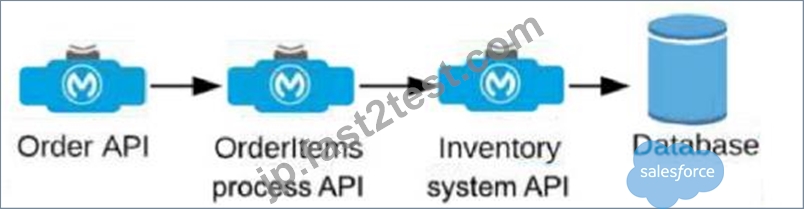
- A. In the Orderltems process API implementation
- B. In the inventory database
- C. In the Inventory system API implementation
- D. In the Order API implementation
正解:A
解説:
Understanding the API Flow and Timeout Requirement:
The Order API initiates a call to the OrderItems process API, which in turn calls the Inventory system API to fetch details from the inventory database.
The requirement specifies that the Order API should not wait more than two seconds for a response from the OrderItems process API, even if there are delays further down the chain (between Inventory system API and the database).
Choosing the Appropriate Timeout Location:
Setting the timeout at the OrderItems process API level ensures that if the Inventory system API takes longer than two seconds to respond, the OrderItems process API will terminate the request and send a timeout response back to the Order API. This prevents the Order API from waiting indefinitely due to the unreliable connection to the database.
If the timeout were set in the Inventory system API or database, it would not help the Order API directly, as the OrderItems process API would still be waiting for a response.
Detailed Analysis of Each Option:
Option A (Correct Answer): Setting the timeout in the OrderItems process API allows it to control how long it waits for a response from the Inventory system API. If the Inventory system API does not respond within two seconds, the OrderItems process API can terminate the call and return a timeout response to the Order API, meeting the requirement.
Option B: Setting the timeout in the Order API would not limit the wait time at the OrderItems process API level, meaning the OrderItems process API could still wait indefinitely for the Inventory system API, leading to a longer delay.
Option C: Setting the timeout in the Inventory system API only affects the connection to the database and does not influence how long the OrderItems process API waits for the Inventory system API's response.
Option D: Setting a timeout in the database is not feasible in this context since database timeouts are typically configured for database operations and would not directly control the API response times in the overall API chain.
Conclusion:
Option A is the best choice, as it ensures that the OrderItems process API does not hold the Order API longer than the required two seconds, even if the downstream connection to the database hangs. This configuration aligns with MuleSoft best practices for setting timeouts in API orchestration to manage dependencies and prevent delays across a chain of API calls.
For additional information on timeout settings, refer to MuleSoft documentation on handling timeouts and API orchestration best practices.
質問 # 97
A Platinum customer uses the U.S. control plane and deploys applications to CloudHub in Singapore with a default log configuration.
The compliance officer asks where the logs and monitoring data reside?
- A. Logs are held in the United States and monitoring data is held in Singapore
- B. Logs and monitoring data are held in Singapore
- C. Logs are held in:Singapore and monitoring data is held in the United States
- D. Logs and monitoring data are held in the United States
正解:D
解説:
For applications deployed on CloudHub in a foreign region (e.g., Singapore), MuleSoft handles log and monitoring data in the region where the control plane resides. This data storage policy is standard for CloudHub deployments to maintain centralized log and monitoring data.
Data Location:
For a U.S.-based control plane, all logs and monitoring data are stored in the United States, regardless of the deployment region.
Although the application itself runs in Singapore, data related to application performance and logs is not localized to the deployment region.
of Correct Answer (B):
Since the control plane is based in the United States, all operational data like logs and monitoring will also be stored there, ensuring compliance with MuleSoft's data handling policies.
of Incorrect Options:
Option A and D are incorrect because MuleSoft does not store logs or monitoring data in the application deployment region when the control plane is located in the United States.
Option C suggests mixed storage, which does not align with MuleSoft's data policy structure.
Reference
For details on data residency in CloudHub deployments, refer to MuleSoft's documentation on CloudHub control planes and data handling policies.
質問 # 98
When should idempotency be taken into account?
- A. When preventing duplicate processing from multiple sent requests
- B. When sending concurrent update requests for the same entity
- C. When making requests to update currently locked entities
- D. When storing the results of s previous request for use in response to subsequent requests
正解:A
解説:
Understanding Idempotency:
Idempotency is a concept in APIs where an operation can be performed multiple times without changing the result beyond the initial application. This is particularly important for operations that may be repeated due to network retries or client errors.
When to Consider Idempotency:
Idempotency should be taken into account when there is a risk of duplicate processing due to multiple requests being sent (e.g., retries or errors). This ensures that repeated requests do not result in unintended side effects, such as creating multiple records or processing the same transaction more than once.
Evaluating the Options:
Option A: While locked entities may need special handling, this is not directly related to idempotency.
Option B: Storing results for future responses could be useful but does not relate to idempotent operations.
Option C: Concurrent requests for the same entity might require handling for conflicts, but this scenario is better suited for transaction management or concurrency control.
Option D (Correct Answer): Preventing duplicate processing from multiple requests is a key reason to implement idempotency, ensuring that repeat requests have no adverse effects.
Conclusion:
Option D is the correct answer as idempotency is specifically used to handle scenarios where duplicate requests might be sent, preventing unintended processing.
Refer to MuleSoft's documentation on best practices for idempotency in API design for more details.
質問 # 99
......
有効なMuleSoft-Platform-Architect-I試験最新問題で2025年最新の学習ガイド:https://jp.fast2test.com/MuleSoft-Platform-Architect-I-premium-file.html