

オンライン問題で最適なAZ-220日本語試験練習問題(最新の137問題)
練習問題AZ-220日本語素晴らしい練習用のMicrosoft Azure IoT Developer (AZ-220日本語版)テスト問題
質問 33
パイロット要件を満たすには、ソリューションにTime Series Insightsを追加する必要があります。
どの3つのアクションを順番に実行する必要がありますか?回答するには、適切なアクションをアクションのリストから回答領域に移動し、正しい順序に並べます。
正解:
解説:
Explanation
Step 1: Provision Time Series Insights
Select Provision new IoT Hub to create a new IoT hub.
Step 2: Route telemetry from IoT Hub to a custom event.
Step 3: Add a data access policy to Time Series Insights for the dashboard web app Scenario: Requirements. Pilot Requirements During the pilot phase, devices will be deployed to 10 offices. Each office will have up to 1,000 devices.
During this phase, you will add Azure Time Series Insights in parallel to Stream Analytics to support real-time graphs and queries in a dashboard web app.
The pilot deployment must minimize operating costs.
Reference:
https://docs.microsoft.com/en-us/azure/time-series-insights/time-series-insights-update-create-environment
質問 34
Azure IoTハブがあります。
次の表に示すように、3種類のIoTデバイスを接続する予定です。
デバイスごとに適切な通信プロトコルを選択する必要があります。
あなたは何を選ぶべきですか?回答するには、適切なプロトコルを正しいデバイスにドラッグします。各プロトコルは、1回、複数回、またはまったく使用しない場合があります。ペイン間で分割バーをドラッグするか、コンテンツを表示するにはスクロールする必要がある場合があります。
注:それぞれの正しい選択は1ポイントの価値があります。
正解:
解説:
Explanation:
Box 1: AMQP
Use AMQP on field and cloud gateways to take advantage of connection multiplexing across devices.
Box 2: MQTT
MQTT is used on all devices that do not require to connect multiple devices (each with its own per-device credentials) over the same TLS connection.
Box 3: HTTPS
Use HTTPS for devices that cannot support other protocols.
Reference:
https://docs.microsoft.com/en-us/azure/iot-hub/iot-hub-devguide-protocols
質問 35
温度モジュールを5つのIoTEdgeデバイスにデプロイするD1という名前のAzureIoTEdge自動デプロイメントがあります。
D1の展開優先度は10で、次のモジュール構成があります。
ReportingModeという名前の新しいツインプロパティを追加する新しいレイヤー展開を作成する必要があります。新しい展開では、D1によって設定された既存のモジュール構成を上書きしてはなりません。
展開をどのように構成する必要がありますか?回答するには、回答領域で適切なオプションを選択します。
注:正しい選択はそれぞれ1ポイントの価値があります。
正解:
解説:
Explanation
Text Description automatically generated with low confidence
Box 1: 1
A priority defines whether a deployment should be applied to a targeted device relative to other deployments.
A deployment priority is a positive integer, with larger numbers denoting higher priority. If an IoT Edge device is targeted by more than one deployment, the deployment with the highest priority applies.
Deployments with lower priorities are not applied, nor are they merged. If a device is targeted with two or more deployments with equal priority, the most recently created deployment (determined by the creation timestamp) applies.
Box 2: "properties.tags": {
You create a deployment manifest and then define which devices it applies to based on tags in the device twin.
Reference:
https://docs.microsoft.com/en-us/azure/iot-edge/module-deployment-monitoring
質問 36
メッセージエンリッチメントを使用して、報告された温度がクリティカルしきい値を超えたときに、IoTゲートウェイデバイスから送信されるメッセージにデバイス情報を追加する必要があります。
エンリッチメッセージの値をどのように設定する必要がありますか?回答するには、回答領域で適切なオプションを選択します。
注:それぞれの正しい選択は1ポイントの価値があります。
正解:
解説:
Explanation
Reference:
https://docs.microsoft.com/bs-cyrl-ba/azure/iot-hub/iot-hub-message-enrichments-overview
質問 37
Azure IoTCentralアプリケーションがあります。
最初にデバイスを登録せずに、SASトークンを使用するIoTデバイスをアプリケーションに接続する必要があります。
どの順序でアクションを実行する必要がありますか?回答するには、すべてのアクションをアクションのリストから回答領域に移動し、正しい順序で配置します。
正解:
解説:
1 - Obtain the group primary key
2 - Generate device SAS Keys.
3 - Flash unique credentials to the devices.
4 - Connect the devices to IoT Central
5 - Associate the devices to a template and approve the connections.
Reference:
https://docs.microsoft.com/en-us/azure/iot-central/core/concepts-get-connected
Topic 1, ADatum
Requirements
Planned Changes
ADatum is developing an Azure IoT solution to monitor environmental conditions. The IoT solution consists of hardware devices and cloud services. All the devices will communicate directly to Azure IoT Hub.
The hardware devices will be deployed to the branch offices and will collect data about various environmental conditions such as temperature, humidity, air quality, and noise level. The devices will be wired by using Power over Ethernet (PoE) connections.
ADatum is developing the solution in the following three phases: proof of value (POV), pilot, and production.
Requirements. POV Requirements
The POV phase will demonstrate that a technical solution is viable. During this phase, 100 devices will be deployed to the main office and Azure Stream Analytics will be connected to an IoT hub to generate real-time alerts. Stream Analytics will perform the following processing:
Calculate the median rate of the telemetry across the entire devices that exceed the median rate by a factor of 4.
Compare the current telemetry to the specified thresholds and issue alerts when telemetry values are out of range.
Ensure that all message content during this phase is human readable to simplify debugging.
Requirements. Pilot Requirements
During the pilot phase, devices will be deployed to 10 offices. Each office will have up to 1,000 devices.
During this phase, you will add Azure Time Series Insights in parallel to Stream Analytics to support real-time graphs and queries in a dashboard web app.
The pilot deployment must minimize operating costs.
Requirements. Production Requirements
The production phase will include all the offices.
The production deployment will have one IoT hub in each Azure region. Devices must connect to the IoT hub in their region.
The production phase must meet the following requirements:
Ensure that the IoT solution can support performance and scale targets.
Ensure that the IoT solution support up to 1,000 devices per office.
Minimize operating costs of the IoT solution.
Requirements. Technical Requirements
Datum identifies the following requirements for the planned IoT solution:
The solution must generate real-time alerts when a fire condition is detected in an office. All the devices in that office must trigger an audible alarm siren within 10 seconds of the alert.
A dashboard UI must display alerts and the system status in real time and must allow device operators to make adjustments to the system.
Each device will send hourly updates to IoT Hub. Condition alerts will be sent immediately.
Multiple types of devices will collect telemetry that has different schemas.
IoT Hub must perform message routing based on the message body.
Direct methods must be used for cloud-to-device communication.
Reports must be provided monthly, quarterly, and annually.
Stored data queries must be as efficient as possible.
The device message size will be under 4 KB.
Development effort must be minimized.
Requirements. Throttle and Quotas
The relevant throttles and quotas for various IoT Hub tiers are shown in the following table.
Requirements. IoT Hub Routing
You plan to implement IoT Hub routing during the POV phase as shown in the following exhibit.
質問 38
デバイスプロビジョニングサービスインスタンスを使用してAzure IoT Edgeデバイスのデプロイを自動化するAzure IoTハブがあります。
IoT Edgeデバイスには、Trusted Platform Module(TPM)2.0チップが搭載されています。
Azureポータルから、IoT EdgeデバイスのTPMを認証メカニズムとして使用する個別の登録をデバイスプロビジョニングサービスに追加する予定です。
登録を作成する前に、どの詳細を取得する必要がありますか。
- A. スコープIDとデバイスプロビジョニングサービスエンドポイント
- B. 承認キーと登録ID
- C. デバイスプロビジョニングサービスの共有アクセスポリシーの主キーとグローバルデバイスエンドポイント
- D. X.509デバイス証明書と証明書チェーン
正解: B
解説:
Explanation
The TPM simulator's Registration ID and the Endorsement key, are used when you create an individual enrollment for your device.
Reference:
https://docs.microsoft.com/en-us/azure/iot-edge/how-to-auto-provision-simulated-device-linux
質問 39
注:この質問は、同じシナリオを提示する一連の質問の一部です。シリーズの各質問には、指定された目標を達成できる独自のソリューションが含まれています。一部の質問セットには複数の正しい解決策がある場合がありますが、他の質問セットには正しい解決策がない場合があります。
この質問の質問に回答した後は、その質問に戻ることはできません。その結果、これらの質問はレビュー画面に表示されません。
Azure IoTハブ、デバイスプロビジョニングサービスインスタンス、および1,000の接続されたIoTデバイスを含むAzure IoTソリューションがあります。
すべてのIoTデバイスは、1つの登録グループを使用して自動的にプロビジョニングされます。 IoTハブへの接続からIoTデバイスを一時的に無効にする必要があります。解決策:登録グループをデバイスプロビジョニングサービスから削除します。ソリューションは目標を達成していますか?
- A. はい
- B. いいえ
正解: B
解説:
Explanation
Instead, from the Device Provisioning Service, you disable the enrollment group, and you disable device entries in the identity registry of the IoT hub to which the IoT devices are provisioned.
Reference:
https://docs.microsoft.com/bs-latn-ba/azure/iot-dps/how-to-unprovision-devices
質問 40
Azure IoTハブのデプロイを計画しています。
IoTハブは以下をサポートする必要があります。
* 3つのAzure IoT Edgeデバイス2,500 IoTデバイス
*各IoTデバイスは5秒ごとに6 KBのメッセージを消費します。
デバイスをサポートするには、IoTハブのサイズを決定する必要があります。ソリューションはコストを最小限に抑える必要があります。あなたは何を選ぶべきですか?
- A. one unit of the S3 tier
- B. one unit of the S1 tier
- C. one unit of the B2 tier
- D. one unit of the B1 tier
正解: A
解説:
Explanation
2500* 6 KB * 12 = 180,000 KB/minute = 180 MB/Minute.
B3, S3 can handle up to 814 MB/minute per unit. Incorrect Answers:
A, C: B1, S1 can only handle up to 1111 KB/minute per unit B: B2, S2 can only handle up to 16 MB/minute per unit.
Reference:
https://docs.microsoft.com/en-us/azure/iot-hub/iot-hub-scaling
質問 41
Azure IoTハブを使用する概念実証(POC)を計画しています。
Cert1とCert2という名前の2つの自己署名クライアント認証証明書があります。 Cert1には、Subject Type = CAを含む基本的な制約があります。 Cert2には、Subject Type = EndEntityを含む基本的な制約があります。
使用する証明書を特定する必要があります。
何を特定する必要がありますか?回答するには、回答領域で適切なオプションを選択します。
注:正しい選択はそれぞれ1ポイントの価値があります。
正解:
解説: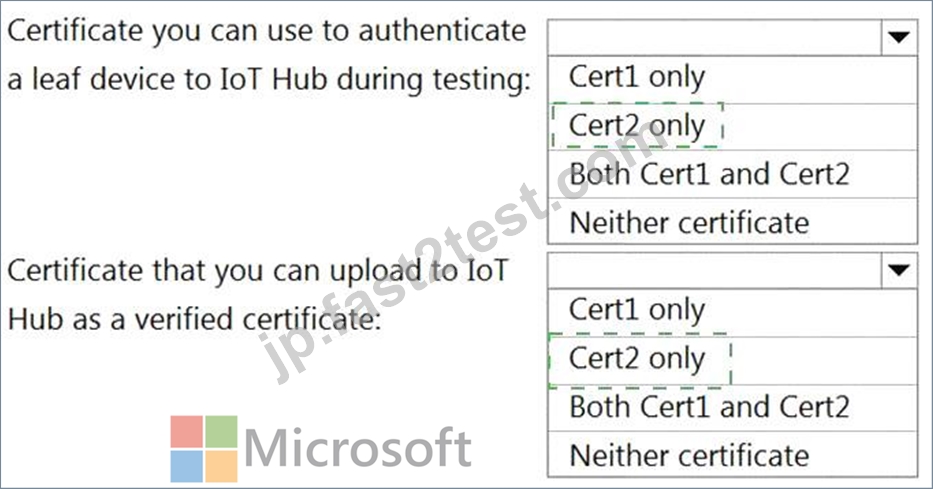
Explanation
Box 1: Cert2 only
Cert2: The leaf certificate, or end-entity certificate, identifies the certificate holder. It has the root certificate in its certificate chain as well as zero or more intermediate certificates. The leaf certificate is not used to sign any other certificates. It uniquely identifies the device to the provisioning service and is sometimes referred to as the device certificate.
Box 2: Cert1 only
Cert1: A root certificate is a self-signed X.509 certificate representing a certificate authority (CA). It is the terminus, or trust anchor, of the certificate chain. Root certificates can be self-issued by an organization or purchased from a root certificate authority.
Reference:
https://docs.microsoft.com/en-us/azure/iot-dps/concepts-x509-attestation
質問 42
AzureIoTソリューションの運用環境を構成しています。
1,000台のIoTデバイスを展開することを計画しています。各デバイスは、1時間ごとに1つのデバイスからクラウドへのメッセージを送信します。各メッセージは4KBになります。
IoTデバイスのデプロイをサポートするAzureIoTハブをデプロイする必要があります。ソリューションは、次の要件を満たす必要があります。
複数のデバイスIDの作成など、デバイスの一括操作を実行します。
コストを最小限に抑える
何をデプロイする必要がありますか?
- A. S2層の1ユニット
- B. S1層の1ユニット
- C. 無料枠の1ユニット
- D. B1層の1ユニット
正解: C
解説:
Reference:
https://docs.microsoft.com/en-us/azure/iot-hub/iot-hub-devguide-quotas-throttling
質問 43
Device Provisioning Service インスタンスを使用する Azure IoT ハブがあります。
対称キー構成証明を使用する新しい個別のデバイス登録を作成します。
Device Provisioning Service を使用してデバイスを自動プロビジョニングするには、登録のどの詳細が必要ですか?
- A. IoT ハブのデバイス ID
- B. 登録の主キー
- C. エンロールメントの登録ID
- D. IoT ハブのホスト名
正解: A
質問 44
既存のAzure IoTハブがあります。
接続されたデバイスで長時間実行されるタスクをスケジュールするには、IoT Hubジョブを使用します。
IoT Hubジョブが直接サポートする3つの操作はどれですか?それぞれの正解は完全なソリューションを示します。
注:それぞれの正しい選択は1ポイントの価値があります。
- A. タグを更新します。
- B. IoTデバイスのレジストリエントリを無効にします。
- C. Azure関数をトリガーします。
- D. 直接メソッドを呼び出します。
- E. クラウドからデバイスへのメッセージを送信します。
- F. 必要なプロパティを更新します。
正解: A,D,F
解説:
Consider using jobs when you need to schedule and track progress any of the following activities on a set ofdevices:
* Invoke direct methods
* Update desired properties
* Update tags
Reference:
https://docs.microsoft.com/en-us/azure/iot-hub/iot-hub-devguide-jobs
質問 45
注: この質問は、同じシナリオを提示する一連の質問の一部です。シリーズの各質問には、記載された目標を達成する可能性のある独自の解決策が含まれています。一部の質問セットには複数の正解がある場合もあれば、正解がない場合もあります。
このセクションの質問に答えた後は、その質問に戻ることはできません。その結果、これらの質問はレビュー画面に表示されません。
建物の 2 階に 20 台の IoT デバイスがデプロイされています。 1 階のデバイスは 60 度に設定する必要があります。 2 階のデバイスは 80 度に設定する必要があります。
デバイス ツインは、ツインが配置されているフロアを識別するタグを使用するように構成されています。
1 階のデバイスに対して次の自動構成を作成します。
2 階のデバイスに次の自動構成を作成します。
1 階の IoT デバイスは、温度が 80 度に設定されていることを報告します。
1 階のデバイスが正しい温度に設定されていることを確認する必要があります。
解決策: 2 階のデバイスの自動構成で、バージョンを 2 に設定します。
これは目標を達成していますか?
- A. はい
- B. いいえ
正解: B
解説:
Reference:
https://docs.microsoft.com/en-us/azure/iot-edge/module-deployment-monitoring?view=iotedge-2020-11
https://docs.microsoft.com/en-us/azure/iot-hub/iot-hub-automatic-device-management-cli
質問 46
注:この質問は、同じシナリオを提示する一連の質問の一部です。シリーズの各質問には、述べられた目標を達成する可能性のある独自の解決策が含まれています。一部の質問セットには複数の正しい解決策がある場合がありますが、他の質問セットには正しい解決策がない場合があります。
このセクションの質問に回答した後は、その質問に戻ることはできません。その結果、これらの質問はレビュー画面に表示されません。
標準層のAzureIoTハブと一連のIoTデバイスがあります。
デバイスは、Message Queuing Telemetry Transport(MQTT)またはAdvanced Message Queuing Protocol(AMQP)のいずれかを使用してIoTハブに接続します。
IoTデバイスにデータを送信する必要があり、各デバイスが応答する必要があります。各デバイスは、データを処理して応答するのに3分かかります。
解決策:ツインタグを更新するようにIoT Hubジョブをスケジュールし、ジョブの進行状況をクエリします。
これは目標を達成していますか?
- A. はい
- B. いいえ
正解: B
解説:
Explanation
Instead update the twin desired property and check the corresponding reported property.
Note: IoT Hub provides three options for device apps to expose functionality to a back-end app:
* Twin's desired properties for long-running commands intended to put the device into a certain desired state. For example, set the telemetry send interval to 30 minutes.
* Direct methods for communications that require immediate confirmation of the result. Direct methods are often used for interactive control of devices such as turning on a fan.
* Cloud-to-device messages for one-way notifications to the device app.
Reference:
https://docs.microsoft.com/en-us/azure/iot-hub/iot-hub-devguide-c2d-guidance
質問 47
Azure IoT Edgeデバイスがあります。
コンテナーレジストリへのアクセスに使用する資格情報を変更する必要があります。何を変更する必要がありますか?
- A. the IoT Edge module
- B. the Azure IoT Hub device twin
- C. the @edgeHub module twin
- D. the $edgeAgent module twin
正解: D
解説:
Explanation
The module twin for the IoT Edge agent is called $edgeAgent and coordinates the communications between the IoT Edge agent running on a device and IoT Hub. The desired properties are set when applying a deployment manifest on a specific device as part of a single-device or at-scale deployment.
These properties include: runtime.settings.registryCredentials.{registryId}.username runtime.settings.registryCredentials.registryId}.password Reference:
https://docs.microsoft.com/en-us/azure/iot-edge/module-edgeagent-edgehub
質問 48
Azure IoTハブをデプロイします。
IoTハブがデバイスからメッセージを受信できることを示す必要があります。
どの3つのアクションを順番に実行する必要がありますか?回答するには、適切なアクションをアクションのリストから回答領域に移動し、正しい順序に並べます。
正解:
解説:
Explanation:
Step 1: Register a device in IoT Hub
Before you can use your IoT devices with Azure IoT Edge, you must register them with your IoT hub. Once a device is registered, you can retrieve a connection string to set up your device for IoT Edge workloads.
Step 2: Configure the device connection string on a device client.
When you're ready to set up your device, you need the connection string that links your physical device with its identity in the IoT hub.
Step 3: Trigger a new send event from a device client.
Reference:
https://docs.microsoft.com/en-us/azure/iot-edge/how-to-register-device
質問 49
Azure IoTハブ、デバイスプロビジョニングサービスインスタンス、および1,000台の接続されたIoTデバイスを含むAzureIoTソリューションがあります。 IoTデバイスは、ツアー登録グループに割り当てられます。各登録グループは、証明書認証を使用するように構成されています。
単一の登録グループ内のすべてのデバイスと登録グループ自体を廃止する必要があります。
どの3つのアクションを順番に実行する必要がありますか?回答するには、適切なアクションをアクションのリストから回答領域に移動し、正しい順序で配置します。
正解:
解説:
Explanation
To deprovision all of the devices that have been provisioned through an enrollment group:
* Disable the enrollment group to disallow its signing certificate.
* Use the list of provisioned devices for that enrollment group to disable or delete each device from the identity registry of its respective IoT hub.
* After disabling or deleting all devices from their respective IoT hubs, you can optionally delete the
* enrollment group. Be aware, though, that, if you delete the enrollment group and there is an enabled enrollment group for a signing certificate higher up in the certificate chain of one or more of the devices, those devices can re-enroll.
Reference:
https://docs.microsoft.com/en-us/azure/iot-dps/how-to-unprovision-devices
質問 50
Azure IoTEdgeソリューションのモジュールを開発することを計画しています。
以下をサポートする開発ツールを推奨する必要があります。
* Node.js
*モジュールテンプレート
* Linuxワークステーションでの開発
何をお勧めしますか?
- A. Microsoft Visual Studio Online
- B. AzureloTエクスプローラー
- C. Microsoft VisualStudioコード
- D. Microsoft Visual Studio
正解: A
解説:
Explanation
Use Visual Studio Code to develop Node.js code and deploy it to a device running Azure IoT Edge.
You can use IoT Edge modules with Linux containers to deploy code that implements your business logic directly to your IoT Edge devices.
Reference:
https://docs.microsoft.com/en-us/azure/iot-edge/tutorial-node-module?view=iotedge-2020-11
質問 51
デバイスプロビジョニングサービスを使用してIoTデバイスをプロビジョニングするコードを記述しています。
新しいIoTクライアントデバイスをプロビジョニングするために必要な、デバイスプロビジョニングサービスの概要ブレードの2つの詳細はどれですか?答えるには、答えの中から適切な詳細を選択してください。
注:正しい選択はそれぞれ1ポイントの価値があります。
正解:
解説:
Explanation
Box 1: ID Scope
In the Azure portal, select the Overview blade for your Device Provisioning service and copy the ID Scope value. The ID Scope is generated by the service and guarantees uniqueness. It is immutable and used to uniquely identify the registration IDs.
Box 2: Global device endpoint
The global_prov_uri variable, which allows the IoT Hub client registration API IoTHubClient_LL_CreateFromDeviceAuth to connect with the designated Device Provisioning Service instance.
Example code:
static const char* global_prov_uri = "global.azure-devices-provisioning.net"; static const char* id_scope = "[ID Scope]"; Reference:
https://docs.microsoft.com/en-us/azure/iot-dps/tutorial-set-up-device
質問 52
Azure IoTEdgeソリューションがあります。
IoTセキュリティエージェント用のAzureSecurityCenterをデプロイすることを計画しています。次の要件を満たすようにセキュリティエージェントを設定する必要があります。
接続イベントは、優先度が高いものとして報告する必要があります。
優先度の高いイベントは7分ごとに収集する必要があります。
azureiotsecurityモジュールツインをどのように構成する必要がありますか?答えるには、適切な値を正しい場所にドラッグします。各値は、1回使用することも、複数回使用することも、まったく使用しないこともできます。コンテンツを表示するには、分割バーをペイン間でドラッグするか、スクロールする必要がある場合があります。
注:正しい選択はそれぞれ1ポイントの価値があります。
正解:
解説:
Explanation
質問 53
注:この質問は、同じシナリオを提示する一連の質問の一部です。シリーズの各質問には、述べられた目標を達成する可能性のある独自の解決策が含まれています。一部の質問セットには複数の正しい解決策がある場合がありますが、他の質問セットには正しい解決策がない場合があります。
このセクションの質問に回答した後は、その質問に戻ることはできません。その結果、これらの質問はレビュー画面に表示されません。
AzureIoTハブとAzureIoTEdgeデバイスを含むAzureIoTソリューションがあります。
10個のBluetoothセンサーを展開する予定です。センサーはMQTT、AMQP、またはHTTPSをサポートしていません。
すべてのセンサーが単一のデバイスとしてIoTハブに表示されることを確認する必要があります。
解決策:IoTEdgeデバイスをIoTEdge透過ゲートウェイとして構成します。デバイスに接続するようにセンサーを構成します。
これは目標を達成していますか?
- A. はい
- B. いいえ
正解: B
解説:
Explanation
IoT Edge transparent gateways support only the MQTT or AMQP protocols.
Instead use a translation gateway.
IoT Hub. The translation module receives messages from downstream devices, translates them into a supported protocol, and then the IoT Edge device sends the messages on behalf of the downstream devices. All information looks like it is coming from one device, the gateway.
Reference:
https://docs.microsoft.com/en-us/azure/iot-edge/iot-edge-as-gateway
質問 54
次の表に示すデバイスがあります。
Azure IoTソリューションの概念実証(POC)を実装しています。
POCの一部としてAzure IoT Edgeデバイスをデプロイする必要があります。
どの2つのデバイスにIOTエッジを展開できますか?それぞれの正解は完全なソリューションを示します。
注:それぞれの正しい選択は1ポイントの価値があります。
- A. デバイス4
- B. デバイス1
- C. デバイス2
- D. デバイス3
正解: C,D
解説:
Explanation
Azure IoT Edge runs great on devices as small as a Raspberry Pi3 to server grade hardware.
Tier 1.
The systems listed in the following table are supported by Microsoft, either generally available or in public preview, and are tested with each new release.
Reference:
https://docs.microsoft.com/en-us/azure/iot-edge/support
質問 55
Azure IoTハブ、Azure IoT Edgeゲートウェイ、および1,000個のリーフデバイスを含むAzureサブスクリプションがあります。リーフデバイスは、IoTハブでサポートされていないカスタム通信プロトコルを使用します。
次の要件を満たすようにゲートウェイを構成する必要があります。
ゲートウェイとIoTハブ間の接続数を最小限に抑えます。
クラウドからデバイスへのメッセージの個々のリーフデバイスへのアドレス指定をサポートします。
ゲートウェイをどのように構成する必要がありますか?回答するには、回答領域で適切なオプションを選択します。
注:正しい選択はそれぞれ1ポイントの価値があります。
正解:
解説:
Reference:
https://docs.microsoft.com/en-us/azure/iot-edge/iot-edge-as-gateway
質問 56
......
リアルなAZ-220日本語試験別格な練習試験問題:https://jp.fast2test.com/AZ-220J-premium-file.html