

あなたのNCP-AIO試験100%合格問題集はここFast2testで一発合格
突破上級者がシミュレーションされたNCP-AIO試験問題集PDF
質問 # 34
Consider a scenario where you're trying to run a Docker container that uses the NVIDIA MPS (Multi-Process Service). However, you keep encountering errors indicating that MPS is not properly initialized within the container. What steps should you take to troubleshoot this issue?
- A. Confirm that the CUDA version within the container is compatible with the NVIDIA drivers on the host and supports MPS.
- B. Verify that MPS is enabled on the host system before launching the Docker container. This typically involves running 'nvidia-smi -i O -gom 1 ' and 'nvidia-cuda- mps-control -d'.
- C. Make sure that the Docker container has the necessary permissions to access the NVIDIA devices. This may involve setting the correct user and group IDs.
- D. Check if any other processes on the host system are already using the GPU exclusively, preventing MPS from initializing correctly.
- E. Ensure that the NVIDIA drivers on the host system are compatible with MPS. MPS requires specific driver versions.
正解:A、B、C、D、E
解説:
All the options play a crucial role in ensuring that MPS functions correctly within a Docker container. MPS requires specific drivers and enabled on the host. Docker container permission should be set to access the NVIDIA devices. Other processes can hinder initialization, and CUDA version compatibility is essential.
質問 # 35
You have a requirement to use SR-IOV (Single Root 1/0 Virtualization) to partition a physical GPU into multiple virtual functions (VFs) for different containers. What steps are necessary to configure BCM and Kubernetes to support this?
- A. Specify the VF resource in the pod's resource requests (e.g., 'nvidia.com/vf: 1 '
- B. Configure the number of VFs to create on each GPU in the node's device tree overlay.
- C. Install the NVIDIA SR-IOV device plugin on each node.
- D. Enable SR-IOV in the node's BIOS.
- E. No special configuration is needed; Kubernetes automatically detects and uses SR-IOV enabled GPUs.
正解:A、B、C、D
解説:
SR-IOV needs to be enabled at the hardware (BIOS) level. The SR-IOV device plugin is required for Kubernetes to discover and manage VFs. VF creation involves device tree configuration. Pods need to explicitly request VF resources. Kubernetes doesn't automatically use SR-IOV without the plugin and configuration.
質問 # 36
You are a Solutions Architect designing a data center infrastructure for a cloud-based AI application that requires high-performance networking, storage, and security. You need to choose a software framework to program the NVIDIA BlueField DPUs that will be used in the infrastructure. The framework must support the development of custom applications and services, as well as enable tailored solutions for specific workloads.
Additionally, the framework should allow for the integration of storage services such as NVMe over Fabrics (NVMe-oF) and elastic block storage.
Which framework should you choose?
- A. NVIDIA TensorRT
- B. NVIDIA CUDA
- C. NVIDIA NSight
- D. NVIDIA DOCA
正解:D
解説:
Comprehensive and Detailed Explanation From Exact Extract:
NVIDIADOCA(Data Center Infrastructure-on-a-Chip Architecture) is the software framework designed to program NVIDIA BlueField DPUs (Data Processing Units). DOCA provides libraries, APIs, and tools to develop custom applications, enabling users to offload, accelerate, and secure data center infrastructure functions on BlueField DPUs.
DOCA supports integration with key data center services including storage protocols such asNVMe over Fabrics (NVMe-oF), elastic block storage, and network security and telemetry. It enables tailored solutions optimized for specific workloads and high-performance infrastructure demands.
* TensorRT is focused on AI inference optimization.
* CUDA is NVIDIA's GPU programming model for general-purpose GPU computing, not for DPUs.
* NSight is a development environment for debugging and profiling NVIDIA GPUs.
Therefore,NVIDIA DOCAis the correct framework for programming BlueField DPUs in a data center environment requiring custom application development and advanced storage/networking integration.
質問 # 37
Given the following Slurm configuration snippet in slurm.conf: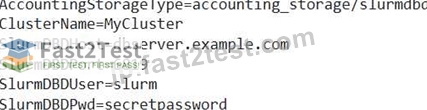
What steps are necessary to ensure that the Slurm cluster is properly connected to the SlurmDBD and that accounting data is being collected correctly?
- A. Ensure that the SlurmDBD service is running on dbserver.example.com and accessible on port 6819.
- B. Test the connection to the database using 'sacctmgr' to create/modify account or user data.
- C. Verify that the 'slurm' user has the necessary privileges on the SlurmDBD database.
- D. Restart the Slurmctld and Slurmd daemons after making the changes to slurm.conf.
- E. All of the above
正解:E
質問 # 38
Your organization is running multiple AI models on a single A100 GPU using MIG in a multi-tenant environment. One of the tenants reports a performance issue, but you notice that other tenants are unaffected.
What feature of MIG ensures that one tenant's workload does not impact others?
- A. Dynamic resource allocation based on workload demand.
- B. Automatic scaling of instances based on workload size.
- C. Hardware-level isolation of memory, cache, and compute resources for each instance.
- D. Shared memory access across all instances.
正解:C
解説:
Comprehensive and Detailed Explanation From Exact Extract:
NVIDIA's Multi-Instance GPU (MIG) technology provideshardware-level isolationof critical GPU resources such as memory, cache, and compute units for each GPU instance. This ensures that workloads running in one instance are fully isolated and cannot interfere with the performance of workloads in other instances, supporting multi-tenancy without contention.
質問 # 39
You are managing a high availability (HA) cluster that hosts mission-critical applications. One of the nodes in the cluster has failed, but the application remains available to users.
What mechanism is responsible for ensuring that the workload continues to run without interruption?
- A. Load balancing across all nodes in the cluster.
- B. Data replication between nodes to ensure data integrity.
- C. The failover mechanism that automatically transfers workloads to a standby node.
- D. Manual intervention by the system administrator to restart services.
正解:C
解説:
Comprehensive and Detailed Explanation From Exact Extract:
In an HA cluster, thefailover mechanismis responsible for detecting node failures and automatically transferring workloads to a standby or redundant node to maintain service availability. This process ensures mission-critical applications continue running without interruption. Load balancing helps distribute traffic but does not handle node failures. Manual intervention is not ideal for HA, and data replication ensures data integrity but does not itself manage workload continuity.
質問 # 40
A system administrator of a high-performance computing (HPC) cluster that uses an InfiniBand fabric for high-speed interconnects between nodes received reports from researchers that they are experiencing unusually slow data transfer rates between two specific compute nodes. The system administrator needs to ensure the path between these two nodes is optimal.
What command should be used?
- A. ibnetdiscover
- B. ibping
- C. ibstatus
- D. ibtracert
正解:D
解説:
Comprehensive and Detailed Explanation From Exact Extract:
To verify the optimal communication path and diagnose issues between two nodes in an InfiniBand fabric, theibtracertcommand is used. It traces the route that InfiniBand packets take through the fabric, identifying each hop and any potential bottlenecks or faulty links along the path.
* ibstatusprovides status information about local InfiniBand devices and ports.
* ibpingtests connectivity and latency between nodes.
* ibnetdiscoverdiscovers and prints the topology of the InfiniBand fabric but does not trace specific paths.
Therefore,ibtracertis the appropriate tool for path optimization verification between two compute nodes.
質問 # 41
An AI model deployed through Fleet Command exhibits a vulnerability. You must urgently patch all edge devices with the updated model.
What is the fastest and safest way to accomplish this, minimizing disruption to ongoing operations?
- A. Immediately shut down all edge devices to prevent further exploitation and then update the model offline.
- B. Employ a staged rollout strategy within Fleet Command, gradually updating subsets of devices while monitoring for any issues before proceeding to the entire fleet.
- C. Use Fleet Command to orchestrate an over-the-air (OTA) update of the model to all devices simultaneously, potentially causing temporary service interruption.
- D. Inform users to manually download and install the patch to all edge devices.
- E. Individually SSH into each device and manually replace the model files.
正解:B
解説:
A staged rollout provides the best balance between speed and safety. It allows for early detection of potential issues during the update process, minimizing the risk of widespread disruption. Manual intervention (A) is too slow. A simultaneous update (B) could cause a large outage if problems arise. Shutting down all devices (D) is overly disruptive. User manual install (E) is not reliable or centrally controlled.
質問 # 42
Your BCM pipeline uses a custom CUDA kernel. After upgrading the NVIDIA driver, the kernel fails to compile with an obscure error.
What is the MOST likely cause and how do you resolve it?
- A. The CUDA toolkit version is incompatible with the new driver. Recompile the kernel with a compatible toolkit.
- B. The new driver introduced a change in CUDAAPI. Update the kernel code to reflect the API change.
- C. The custom kernel has a bug. Debug the kernel using cuda-gdb.
- D. The driver upgrade corrupted the CUDA runtime. Reinstall the CUDA toolkit.
- E. A and D
正解:E
解説:
Driver upgrades can introduce CUDA toolkit incompatibilities or changes in the CUDAAPI that necessitate recompilation or code modification.
質問 # 43
What is the primary purpose of using a container runtime interface (CRI) with BCM and Kubernetes in an AI environment?
- A. To encrypt container images at rest and in transit.
- B. To schedule pods onto nodes based on resource availability.
- C. To handle networking for containers within the Kubernetes cluster.
- D. To manage the lifecycle of containers (create, start, stop, delete).
- E. To provide a standard interface for Kubernetes to interact with different container runtimes (e.g., Docker, containerd).
正解:E
解説:
The CRI allows Kubernetes to work with various container runtimes without being tightly coupled to a specific implementation. It defines an interface that container runtimes must implement. While A is true for a container runtime, the CRI is about Kubernetes interacting with it. The others are related to other parts of Kubernetes.
質問 # 44
Consider a scenario where you have the following deployment manifest for Fleet Command. What is the primary function of 'resources' section within the manifest?
- A. Specifies the location of the AI model to be deployed.
- B. Configures networking settings for the deployment.
- C. Determines which devices receive the deployment based on label match
- D. Specifies dependencies on external libraries or frameworks.
- E. Defines the computational resources (e.g., CPU, GPU, memory) required by the deployment.
正解:E
解説:
The 'resources section in a deployment manifest is primarily used to define the computational resource requirements of the deployment, ensuring that the application has access to the necessary CPU, GPU, and memory to function correctly.
質問 # 45
Which of the following Slurm configuration options are typically modified within the "slurm.conf' file? (Select TWO)
- A. squeue
- B. JobSubmitPlugins
- C. SchedulerParameters
- D. MailType
- E. sacctmgr
正解:B、C
解説:
'JobSubmitPluginS configures plugins for job submission, and 'SchedulerParameterS configures the behavior of the scheduler. These are typically defined cluster-wide in 'slurm.conf. 'squeue' and 'sacctmgr' are commands, not configuration options. 'MailType' can be configured but depends on the email plugin being setup.
質問 # 46
You have an NVIDIAA100 GPU configured with MIG. After restarting the system, the MIG instances are no longer present. Which step is necessary to ensure MIG configurations persist after a reboot?
- A. Enable the 'MIG Persistence' option in the NVIDIA Control Panel.
- B. The MIG configuration is stored in the BIOS; no additional steps are necessary.
- C. Save the MIG configuration to a file using 'nvidia-smi mig -SIP and load it on system startup.
- D. Update the NVIDIA driver after each system restart.
- E. Save the MIG configuration to the persistence database using 'nvidia-smi mig -Igip' . Also make sure you enable persistence mode.
正解:E
解説:
MIG configurations are not persistent by default. You can use command to load and save instance placement to persistence DB (Igip). The '-Igip' option stores the configuration, and the '-elgip' option ensures it is loaded on system startup. Make sure you also enable persistence mode, so that the setting will survive a system restart.
質問 # 47
Which configuration file dictates the initial settings and parameters for the Base Command Manager (BCM) installation?
- A. cluster_config.json
- B. bcm.conf
- C. bcm_config.yaml
- D. nvidia bcm.ini
- E. base_command.config
正解:C
解説:
The 'bcm_config.yaml' file is the primary configuration file used during the initial installation and setup of Base Command Manager (BCM). It specifies various parameters such as the database connection details, authentication methods, and other system-level settings.
質問 # 48
After updating the NVIDIA drivers on your NVSwitch-connected GPU server, 'nvsm' fails to start. The log file shows the following error: 'Failed to initialize NVML'. Which of the following actions is MOST likely to resolve the issue?
- A. Reinstall the operating system.
- B. Disable SELinux.
- C. Increase the allocated memory to the 'nvsm' process.
- D. Ensure that the NVIDIA kernel modules are correctly loaded and that the CUDA toolkit is installed and configured properly.
- E. Downgrade to the previous version of the NVIDIA drivers.
正解:D
解説:
NVML (NVIDIA Management Library) is a core component required for 'nvsm' to function. If NVML fails to initialize, it usually indicates a problem with the NVIDIA drivers, kernel modules, or CUDA installation. Verifying these components is the most direct way to resolve the issue. Downgrading can work but first you should verify your installation.
質問 # 49
You are troubleshooting a performance issue with a GPU-accelerated application running on Kubernetes managed by BCM. You suspect the application is not effectively utilizing the available GPU resources. Which of the following is the MOST effective way to gather detailed performance metrics and identify potential bottlenecks within the container?
- A. Analyzing the application's logs for error messages or performance warnings.
- B. Using 'kubectl exec' to run 'top' within the container and monitor process-level resource consumption.
- C. Using 'kubectl top pods' to monitor the pod's CPU and memory utilization.
- D. Leveraging NVIDIA Nsight Systems or NVIDIA Nsight Compute to profile the application's GPU kernel execution and identify performance bottlenecks.
- E. Using "nvidia-smi' within the container to monitor GPU utilization, memory usage, and temperature.
正解:D
解説:
NVIDIA Nsight Systems and NVIDIA Nsight Compute are specialized profiling tools designed to analyze the performance of GPU- accelerated applications. They provide detailed insights into kernel execution, memory access patterns, and other performance-critical aspects. 'nvidia-smi' provides basic GPU stats but not application-specific profiling. CPU/memory utilization (A, D) and application logs (B) are helpful but don't provide the necessary GPU-specific information. You may have to install it into the container's image.
質問 # 50
You have a Slurm cluster configured with multiple partitions, and you want to restrict a specific user group to only submit jobs to a particular partition. How can you achieve this using Slurm's Quality of Service (QOS) and Access Control features?
- A. Create a QOS that allows access only to the desired partition and assign that QOS to the user group using 'sacctmgr' .
- B. Configure PAM (Pluggable Authentication Modules) to restrict user access based on group membership.
- C. Use the 'scontror command to set the default partition for the user group.
- D. Edit the user's .bashrc file to include #SBATCH --partition=.
- E. Modify the partition configuration to include the user group in the 'AllowGroupS parameter.
正解:A
解説:
Creating a QOS that restricts access to the desired partition and associating that QOS with the user group is the most direct and controlled method. The 'sacctmgr' tool is used to manage QOS and user/group associations.
質問 # 51
Explain the process to perform a Blue-Green deployment for an AI model serving application running on a BCM-managed Kubernetes cluster. How do you minimize downtime and ensure a smooth transition?
- A. Update the existing deployment in place, using a rolling update strategy with a small 'maxSurge' and 'maxUnavailable' to minimize disruption.
- B. Use a service mesh (e.g., Istio) to gradually shift traffic from the old version to the new version, monitoring metrics and performing rollbacks if necessary.
- C. Deploy the new version of the application alongside the existing version, then switch the service to point to the new version once it's ready.
- D. Create a new Kubernetes namespace for the new version, deploy the application, and then migrate traffic using DNS changes.
- E. Take the existing application offline, deploy the new version, and then bring the application back online.
正解:B、C
解説:
Blue-green involves deploying a parallel, identical environment (the 'blue' and 'green' versions) and switching traffic. A direct service switch after verifying the new version minimizes downtime. Service meshes provide fine-grained traffic control, enabling gradual rollouts and rollbacks. Rolling updates are more like incremental updates rather than switching. DNS migration isn't instant. Taking the app offline causes significant downtime. The service mesh can provide a safe path to Blue-Green.
質問 # 52
Your BCM pipeline integrates with a remote REST API to fetch dat
a. The API occasionally returns errors or becomes unavailable, causing the pipeline to fail. How can you make the pipeline more resilient to these API failures?
- A. Implement error logging and monitoring to track API failures.
- B. Use a circuit breaker pattern to prevent the pipeline from overwhelming the API during outages.
- C. Cache the API responses to reduce the dependency on the remote API.
- D. Implement retry logic with exponential backoff to handle transient API errors.
- E. All of the above.
正解:E
解説:
Retry logic handles transient errors. Circuit breakers prevent API overload. Caching reduces API dependency. Monitoring tracks failures. All these techniques enhance pipeline resilience.
質問 # 53
You are implementing a DOCA application on a BlueField-3 DPU that requires secure communication with a remote server. Which of the following methods can be used to establish a secure connection, and what are the key considerations?
- A. Using SSH tunneling: Establish an SSH tunnel between the DPU and the remote server to forward traffic securely, ensuring proper authentication and authorization.
- B. Using DOCA Comm Channel with encryption: Enable encryption within the DOCA Comm Channel for secure control message exchange, managing encryption keys appropriately.
- C. Using MACsec: Implement MACsec on ethernet to ensure communication link level securtiy.
- D. Using TLS/SSL: Implement TLS/SSL encryption for all communication channels, ensuring proper certificate management and key exchange.
- E. Using IPsec: Configure IPsec tunnels between the DPU and the remote server for secure IP-layer communication, considering encryption algorithms and authentication methods.
正解:A、D、E
解説:
TLS/SSL, IPsec, and SSH tunneling are all viable options for establishing secure communication. Key considerations include certificate management, encryption algorithms, authentication methods, and key exchange mechanisms. MACsec is more of a link level security. Comm channel doesnt have security mechanism defined.
質問 # 54
You are deploying a stateful application to your Kubernetes cluster running on NVIDIA hardware provisioned through BCM. This application requires direct access to a persistent volume on a high-performance NVMe drive. Which of the following methods is MOST appropriate for providing this access while ensuring high performance and data consistency?
- A. Configuring a standard Persistent Volume Claim backed by a software-defined storage solution like Ceph or Rook.
- B. Leveraging a local Persistent Volume with 'volumeBindingMode: WaitForFirstConsumer' and node affinity to ensure the pod is scheduled on the node with the NVMe drive.
- C. Using a 'hostPatW volume, directly mapping the NVMe drive's path on the host node to the container.
- D. Creating a PersistentVolumeClaim (PVC) backed by a cloud-based block storage service (e.g., AWS EBS, Azure Disk).
- E. Using a Network File System (NFS) share mounted on the host and exposed to the container via a PersistentVolume.
正解:B
解説:
Local Persistent Volumes with 'WaitForFirstConsumer' and node affinity are designed for scenarios requiring direct access to local storage like NVMe drives. This approach provides the best performance and data consistency compared to network-based solutions like NFS or cloud-based block storage, or shared storage solutions such as Ceph. 'hostPath' is discouraged for production use because it bypasses Kubernetes volume management. Local PV ensures the PVC is bound to PV at time of first use rather than during cluster set up.
質問 # 55
You are setting up a data center for AI research that requires both high-performance computing (HPC) for model training and interactive data science workstations. How would you optimally partition your GPU resources using NVIDIA vGPU?
- A. Use a fixed vGPU profile (e.g., 1/4 GPU) for all VMs, regardless of workload.
- B. Allocate entire physical GPUs to HPC nodes and use CPU-based processing for data science workstations.
- C. Profile the resource utilization of both HPC and workstation workloads and dynamically adjust vGPU profiles to optimize performance and resource allocation.
- D. Dedicate all GPUs to HPC tasks, as training is the most resource-intensive activity.
- E. Oversubscribe all GPUs to maximize VM density, even if it impacts performance.
正解:C
解説:
Profiling and dynamic adjustment of vGPU profiles are crucial for optimal resource allocation. Different workloads have different resource needs. HPC benefits from large slices, while interactive workstations can function well with smaller slices. A fixed profile will likely lead to underutilization or performance bottlenecks. Oversubscribing without careful monitoring can lead to severe performance degradation. Limiting data scientists to CPU-based processing wastes valuable GPU resources.
質問 # 56
......
NVIDIA NCP-AIO 認定試験の出題範囲:
| トピック | 出題範囲 |
|---|---|
| トピック 1 |
|
| トピック 2 |
|
| トピック 3 |
|
| トピック 4 |
|
NCP-AIO問題集トレーニングコース完全版:https://jp.fast2test.com/NCP-AIO-premium-file.html
お客様を合格させる試験学習材料NVIDIA AI Operations:https://drive.google.com/open?id=1WXVD78g2_Oo-kKCES54fa3_uIrPJcklJ